Tech

FREE PARKING

Tesla Giga Texas lot 2 March 21 2025
Satellite image of second Giga Texas parking lot, March 21, 2025 (Sherwood News, SkyFi)

Look at all the Cybertrucks stashed outside Tesla’s factory in Texas

We count more than 500, which is roughly 1% of the entire number of Cybertrucks owned in the US. That’s a lot of stainless steel that can’t survive a car wash.

Cybertrucks represented 5% of all US Tesla sales last quarter, but they make up a huge portion of the inventory piled up outside Giga Texas, the factory where they’re produced. Our analysis of satellite imagery of the production facility suggests that about half the vehicles in the main production lots appear to be Cybertrucks.

That’s likely because the stainless steel trucks, despite recently becoming less expensive, have proven especially difficult to sell as CEO Elon Musk has taken on a more controversial role in the US government and the brand has become increasingly unpopular. The company is sitting on about $200 million worth of Cybertruck inventory, Electrek reported earlier this month.

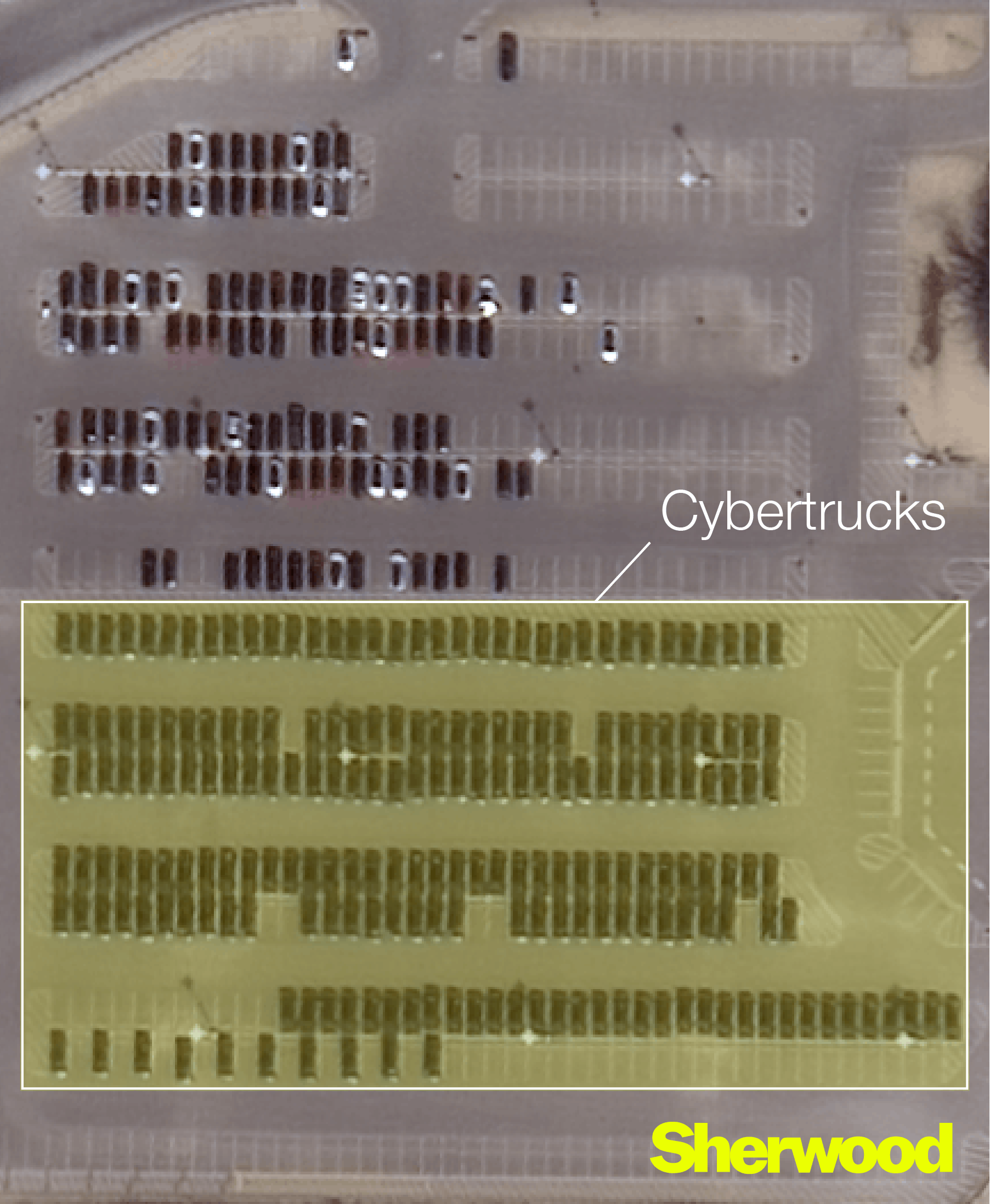
By our count, there are more than 500 Cybertrucks — which amounts to more than 1% of the number of Cybertrucks owned in the US — being stored on lots at Giga Texas. Here’s a view of the the main parking lot there, where new vehicles reside before they’re shipped off to customers:
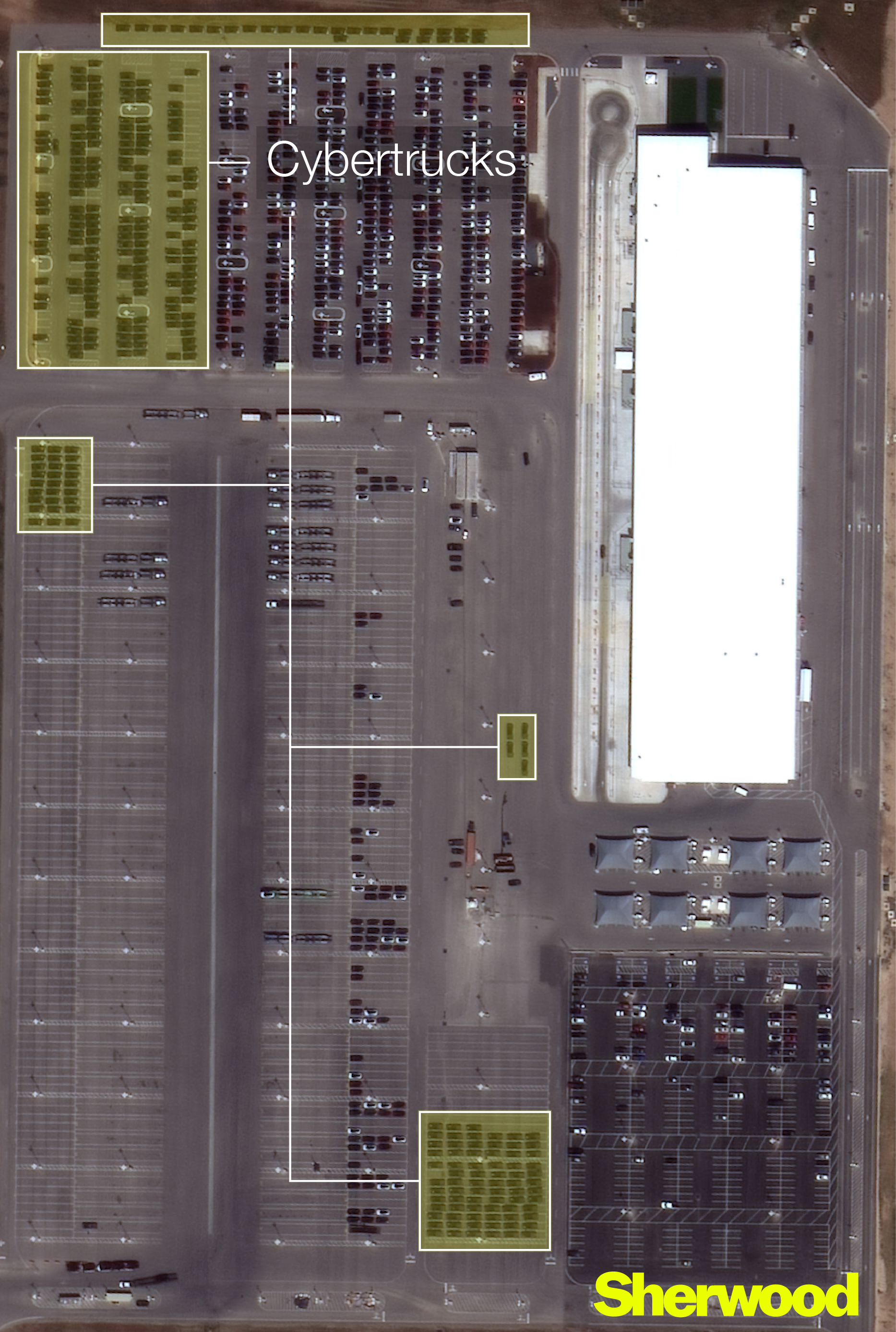
Tesla Giga Texas lot March 21 2025
Satellite image of second Giga Texas parking lot, March 21, 2025 (Sherwood News, SkyFi)

Here’s a second major inventory lot, which appears to be mostly Cybertucks.
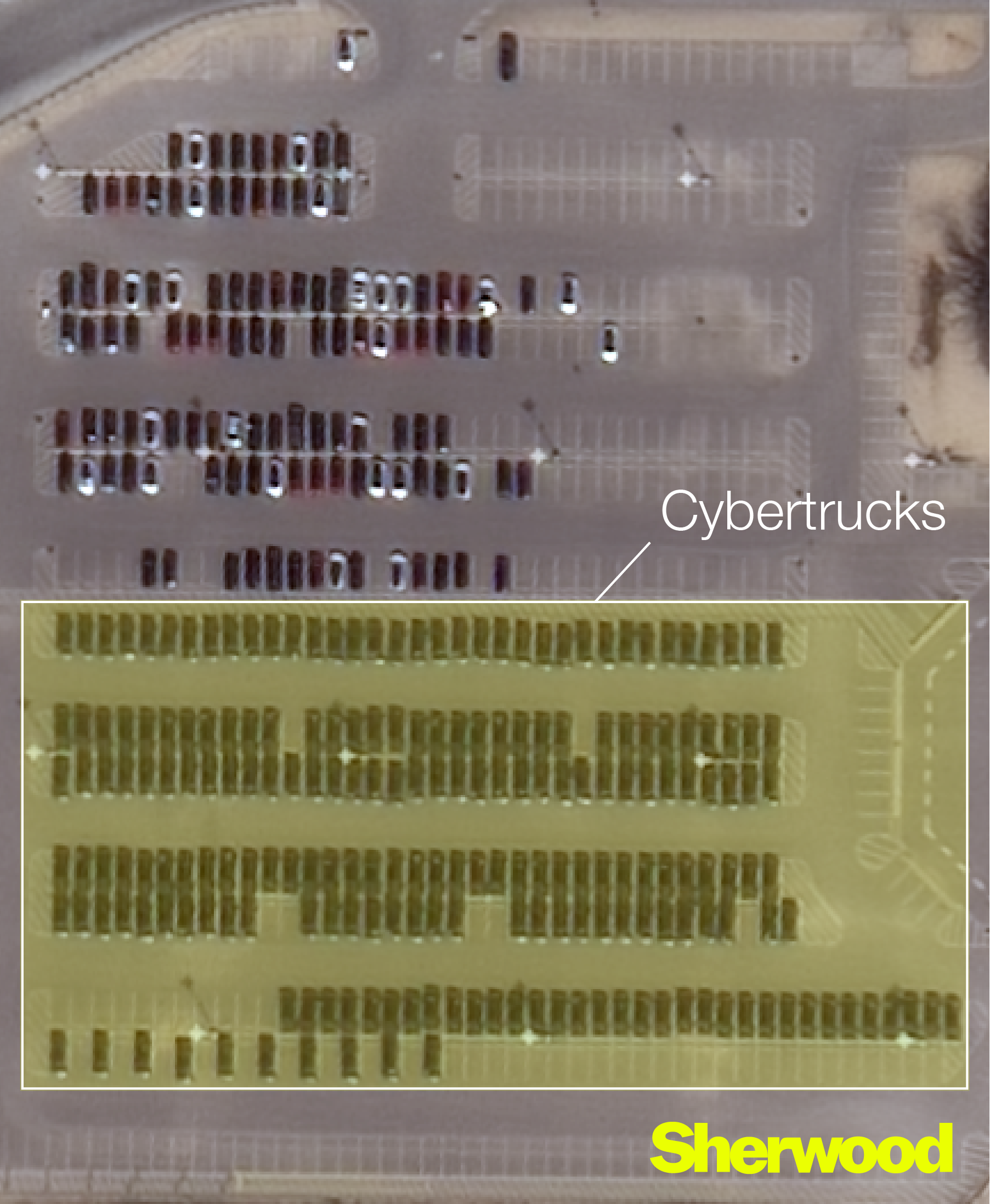
Tesla Giga Texas lot 2 March 21 2025
Satellite image of second Giga Texas parking lot, March 21, 2025 (Sherwood News, SkyFi)

Since the Cybertrucks began coming off the line just over a year ago, Tesla has sold fewer than 50,000 of the vehicles in the US — something we know from government data after the vehicle’s eighth recall last month. The 6,406 the company sold in Q1 is also about half of what it sold a quarter earlier, according to data from Cox Automotive, when the truck was less of a political lightning rod. By any accounting, the Cybertruck’s numbers are far fewer than the 1.5 million preorders it originally had.

Tesla didn’t immediately respond to a request for comment.

Today, Business Insider reported that Tesla is reducing Cybertruck production and reallocating employees to work on the much better-selling Model Y lines instead, though it should be noted that Tesla’s total sales are down significantly.

As a result of the excess of Cybertrucks already produced, they’re starting to pop up in parking lots around the country as well. Tesla also seems to be using these idle Cybertrucks to tow around Model Ys as a form of advertising.

Let us know if you see any more Cybertrucks hiding in plain sight.

More Tech

See all Tech
tech
Jon Keegan

Anthropic launches “Claude Design,” sending shares of Figma and Adobe down

Anthropic has been slowly and steadily gaining a leading share in the enterprise AI market by focusing on coding, spreadsheets, and other common productivity and workplace apps.

Now it’s going after design apps.

Today Anthropic launched Claude Design, a dedicated app powered by its latest model, Claude Opus 4.7, that lets users use text prompts to build website designs, user interface prototypes, presentations, and marketing materials.

Shares of Figma and Adobe sank on the news.

While Claude has previously had the ability to create designs and user interfaces, breaking it out into a dedicated app signals a major new piece of its enterprise strategy alongside its popular Claude Code product.

Today Anthropic launched Claude Design, a dedicated app powered by its latest model, Claude Opus 4.7, that lets users use text prompts to build website designs, user interface prototypes, presentations, and marketing materials.

Shares of Figma and Adobe sank on the news.

While Claude has previously had the ability to create designs and user interfaces, breaking it out into a dedicated app signals a major new piece of its enterprise strategy alongside its popular Claude Code product.

tech
Rani Molla

Apple’s China iPhone shipments surged 20% in Q1 even as overall smartphone shipments fell

Apple’s iPhone shipments in China jumped 20% last quarter, even as the country’s overall smartphone market fell 4%, according to new data from Counterpoint Research. Rising memory costs have pushed prices higher across the industry, weighing on demand.

Apple appears poised to ride out the broader smartphone slump. Its strength at the less price-sensitive high end of the market and its unusual leverage over suppliers, which helps keep costs in check, give it an edge over rivals.

Greater China remains a critical region for Apple, making up about 18% of its total revenue in the fourth quarter. The company accounted for 19% of China’s smartphone market in the first quarter, up from 15% a year earlier, per Counterpoint.

tech
Rani Molla

Anthropic has surged past OpenAI in capturing business spending on generative-AI software

Last quarter, Anthropic attracted the lion’s share of trackable business spending on generative-AI software, according to new data from Ramp, a fintech company that provides corporate cards and expense management software for small firms and Fortune 500 companies alike.

The data showed that in the first quarter, Anthropic saw 37% of spending, its biggest share yet, versus 33% for OpenAI. Notably, the dataset doesn’t capture spending by Google or Microsoft.

OpenAI, which makes ChatGPT, still leads in overall adoption at 81% of AI buyers, but Anthropic is catching up, at nearly 63% in March. Overall, more than half of Ramp’s customers currently pay for AI, up from just 18% two years ago.

Anthropic’s enterprise tools, including Claude Code and Cowork, have been making waves among the business class, sending its revenue soaring.

Anthropic’s revenue share is even higher among companies spending on AI for the first time.

“Anthropic has definitely been on a tear,” Ara Kharazian, Ramp’s economist, told Sherwood News. “Its increase in adoption rates has been driven by its ability to sell to less technical users and smaller contracts than it typically has.”

It’s notable that midway through the first quarter, Anthropic had a falling-out with one of its biggest customers, the US government, which near the end of February decided to shun Anthropic’s products and lean into working with OpenAI.

tech
Jon Keegan

Report: Google ditches its objection to defense work, pitches Gemini to Pentagon

In 2018, Google employees protested against the company’s tech being used for the US military’s Project Maven — a drone targeting program — reminding the company of its “don’t be evil” motto.

After the controversy, the company declined to renew the contract with the Pentagon, drawing a bright line between Big Tech and the national security establishment.

What a difference a few years makes.

Google is now actively working to get its Gemini AI model to be used in classified national security settings, according to a new report from The Information. Seeking a similar deal to the one OpenAI hashed out with the Pentagon, Google reportedly wants a contract that allows use of Gemini in classified work, but with a prohibition on mass domestic surveillance and autonomous lethal weapons.

But Google is playing catch-up in a major way. Amazon and Microsoft both have been widely used for classified defense work, and contractors are already experienced in working with their cloud systems, while Google’s services have never been used in classified work.

What a difference a few years makes.

Google is now actively working to get its Gemini AI model to be used in classified national security settings, according to a new report from The Information. Seeking a similar deal to the one OpenAI hashed out with the Pentagon, Google reportedly wants a contract that allows use of Gemini in classified work, but with a prohibition on mass domestic surveillance and autonomous lethal weapons.

But Google is playing catch-up in a major way. Amazon and Microsoft both have been widely used for classified defense work, and contractors are already experienced in working with their cloud systems, while Google’s services have never been used in classified work.

Latest Stories

Sherwood Media, LLC produces fresh and unique perspectives on topical financial news and is a fully owned subsidiary of Robinhood Markets, Inc., and any views expressed here do not necessarily reflect the views of any other Robinhood affiliate, including Robinhood Markets, Inc., Robinhood Financial LLC, Robinhood Securities, LLC, Robinhood Crypto, LLC, Robinhood Derivatives, LLC, or Robinhood Money, LLC. Futures and event contracts are offered through Robinhood Derivatives, LLC.