

Tech
Cube in hands
(CSA-Printstock)

Stanford AI report: Model capability accelerating, China has closed the gap with the US

Stanford’s annual AI Index Report says “leading models are now nearly indistinguishable” from each other, and benchmarks used to evaluate them are falling behind their accelerating capabilities.

China has closed the gap with the US in the global competition for AI model superiority, and any talk of an AI performance plateau is just flat-out wrong. Those are two big takeaways from this year’s AI Index Report from Stanford University’s Institute for Human-Centered Artificial Intelligence.

Models are continuing to make impressive leaps in performance, and the pace is accelerating, the 2026 edition of the report finds. But it also carefully examines this rapid acceleration to show that it may not be exactly what it seems.
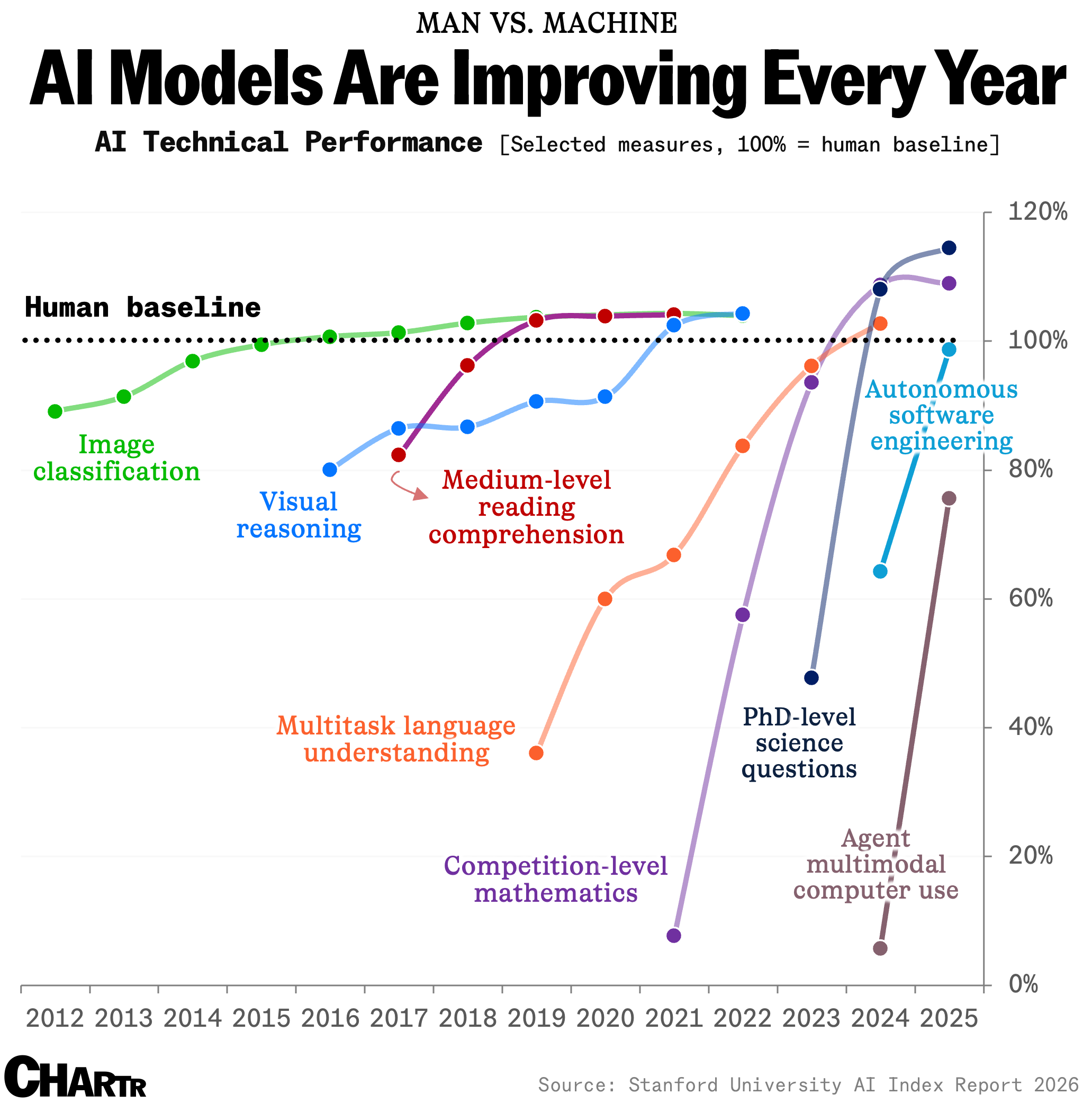
While last year’s class of AI models have been steadily approaching or surpassing human baseline scores on benchmarks, all of the major frontier models are clustered at the top of the benchmark charts together, all separated by just a few points between them. The authors of the report say “leading models are now nearly indistinguishable from one another.”

That could mean that the ecosystem of benchmarks — the yardsticks used to measure the models’ capabilities — may not be keeping pace with the rapidly evolving models’ skills. For example, the report notes that AI models can win a gold medal in the International Mathematical Olympiad, but are hilariously bad at telling the time by reading a clock face.

AI Index 2026 Annual Report chart - China models
Source: 2026 AI Index Report, AI Index Steering Committee, Institute for Human-Centered AI, Stanford University, Stanford, CA, April 2026

And in another worrying sign for its plan to dominate AI, the US has seen a rapid, alarming decline in its ability to attract global AI talent. The Trump administration has added significant new restrictions to the H-1B visa program, which helped lure top AI talent to the US. New requirements such as imposing a $100,000 fee that employers must pay per H-1B hire have resulted in a sharp drop in AI researchers coming to the US.

Net flow of top Al authors and inventors by country, 2010-25
Source: 2026 AI Index Report, AI Index Steering Committee, Institute for Human-Centered AI, Stanford University, Stanford, CA, April 2026

More Tech

See all Tech
tech

Meta will surpass Google in ad revenue this year, new industry data shows

In a world supported by digital ad dollars, Meta may soon be king. The Instagram owner’s net digital ad revenues are expected to hit $243.5 billion in 2026, surpassing Google’s projected $239.5 billion, according to new data from eMarketer.

The shift is happening as Big Tech companies, including Meta and Google, are increasing their spending on AI in hopes that AI will grow their top and bottom lines.

On the company’s last earnings call, Meta CFO Susan Li credited AI with driving performance gains, and said that growth will continue: “We expect the set of investments we’re making in 2026 will enable us to drive further gains as we continue to integrate AI across all layers of the marketing and customer engagement funnel.”

“In surpassing Google, Meta has essentially had many of its core strategies validated,” said Max Willens, principal analyst at eMarketer. “Meta has long understood that scale, network effects, and habits are more important than anything else in digital media. It has carefully built and defended the advantages it has in all three areas.”

JAPAN-FOOD-DRINK-SCIENCE-REASEARCH-MSG-AJINOMOTO

What does delicious Asian food seasoning have to do with a potential bottleneck for AI chips?

Japanese food flavoring company Ajinomoto, which commercialized MSG, also makes a key component in AI chips. It’s having trouble scaling to meet demand.

tech

Report: Microsoft looks to remake Copilot in the image of OpenClaw

Microsoft is feeling the heat from all corners of the tech world as it tries to infuse its productivity apps with useful AI tools.

OpenAI, Anthropic, and now open-source OpenClaw are enabling powerful agentic AI that can do work on your computer for you — including productivity functions like managing emails, spreadsheets, and slide decks.

This is obviously an area where Microsoft needs to compete, or it will be left in the dust by AI startups.

The Information reports that Microsoft is indeed realizing this, and is now trying to reboot its many Copilot tools to act more like the extremely popular DIY agentic AI tool OpenClaw.

OpenClaw is usually set up running on a dedicated personal computer, and given access to all of a user’s permissions and logins. The user issues orders to OpenClaw through messaging apps like Telegram or WhatsApp, and the agent goes off and completes tasks in the background, notifying you when they’re done. But many users have had security disasters with the setup, so Microsoft is looking to borrow the popular concept but implement the strict security controls needed for use in enterprise environments.

According to the report, Microsoft CEO Satya Nadella has made revamping 365 Copilot a top priority.

This is obviously an area where Microsoft needs to compete, or it will be left in the dust by AI startups.

The Information reports that Microsoft is indeed realizing this, and is now trying to reboot its many Copilot tools to act more like the extremely popular DIY agentic AI tool OpenClaw.

OpenClaw is usually set up running on a dedicated personal computer, and given access to all of a user’s permissions and logins. The user issues orders to OpenClaw through messaging apps like Telegram or WhatsApp, and the agent goes off and completes tasks in the background, notifying you when they’re done. But many users have had security disasters with the setup, so Microsoft is looking to borrow the popular concept but implement the strict security controls needed for use in enterprise environments.

According to the report, Microsoft CEO Satya Nadella has made revamping 365 Copilot a top priority.

tech

Tesla competitor Slate closes $650 million funding round and says 2026 production is “on time and on budget”

Tesla competitor Slate Auto said it closed a $650 million Series C funding round led by TWG Global, giving it the “operating capital to reach the next stage of development.” Slate’s new CEO, Peter Faricy, says it has more than 160,000 reservations, up from 150,000 in December, and is “on time and on budget” to deliver its first mid-$20,000 electric trucks to customers by the end of 2026.

Latest Stories

Sherwood Media, LLC produces fresh and unique perspectives on topical financial news and is a fully owned subsidiary of Robinhood Markets, Inc., and any views expressed here do not necessarily reflect the views of any other Robinhood affiliate, including Robinhood Markets, Inc., Robinhood Financial LLC, Robinhood Securities, LLC, Robinhood Crypto, LLC, Robinhood Derivatives, LLC, or Robinhood Money, LLC. Futures and event contracts are offered through Robinhood Derivatives, LLC.

