
Tech
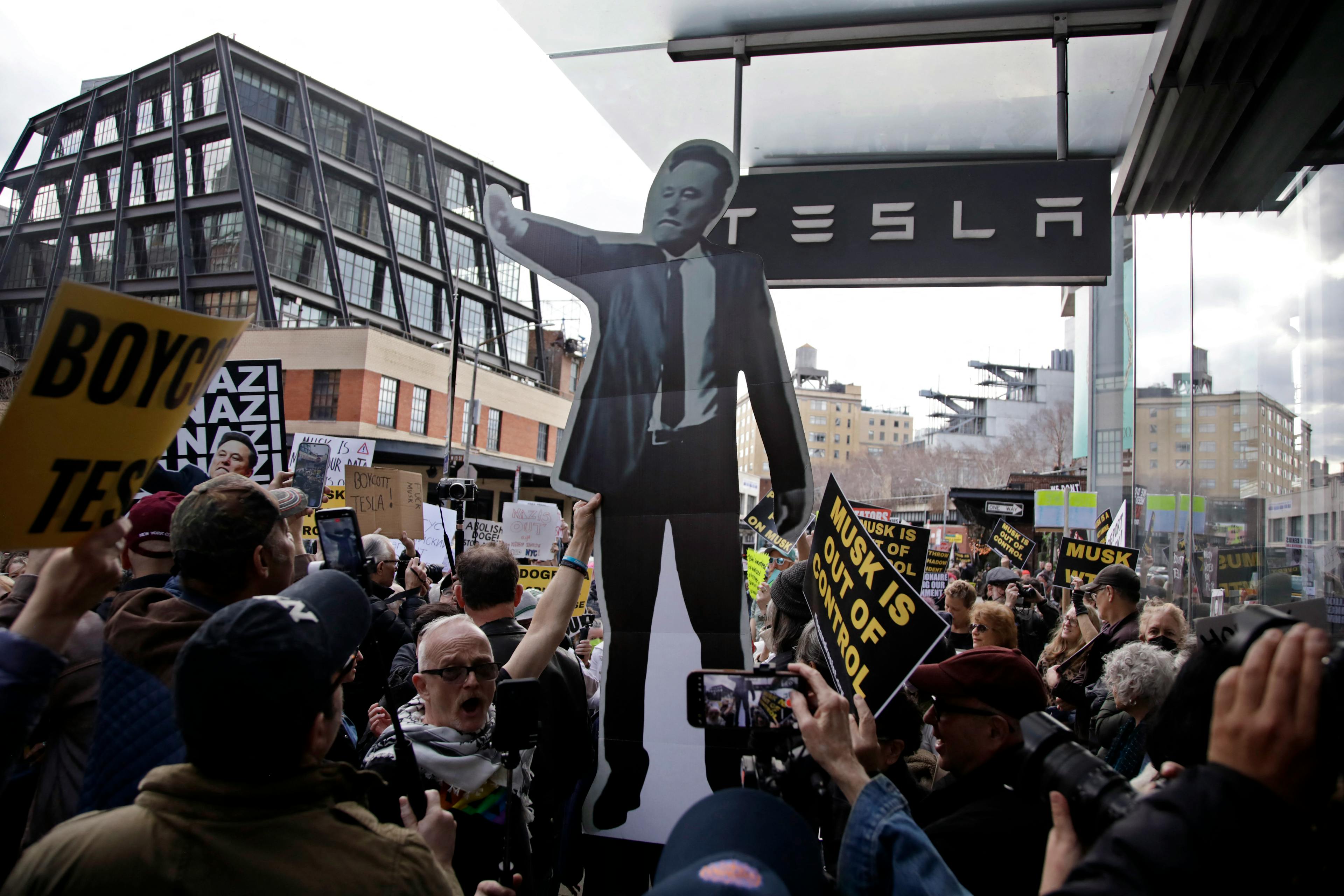
Tesla Protest Musk Salute Cutout
Protestors at a Tesla dealership in New York (Leonardo Munoz/Getty Images)
Electric Shock

Tesla stock is slumping into the weekend

Blame tariffs, protests, and Q1 delivery estimates.

Rani Molla

Tesla’s stock is down 3.3% today. And while, as we’ve mentioned before, the stock doesn’t really need specific reasons to jump up or down, three factors are likely weighing on it ahead of the weekend.

1) Trump tariffs are going to hurt Tesla, too

While Tesla is more sheltered from President Trump’s auto tariffs than other car companies because it domestically manufactures its electric vehicles sold in the US, levies on parts it imports are certainly going to take a toll. Tariffs negatively affect the company’s aim to lower prices and raise margins. Don’t believe us? CEO Elon Musk, Tesla leadership, and the biggest Tesla bull out there, Wedbush Securities analyst Dan Ives, have all said so.

2) Protests are scheduled at Tesla locations around the country Saturday

While it might be tough to put an exact number on how damaging the recent string of Tesla protests have been to the brand’s bottom line, having people picketing out front of hundreds of Tesla locations nationewide this weekend doesn’t seem like it’s going to help. An FBI task force to “crack down on violent Tesla attacks” also doesn’t breed brand confidence. Already, Americans’ impression of the company is at an all-time low, following Musk’s forays into American politics. The vast majority of people are aware of the brand, but don’t want to buy it. And the number of used Teslas listed for sale has jumped 33% this year.

3) It reports Q1 deliveries next week and they’re expected to sting

Tesla is scheduled to report Q1 deliveries before market opening next Wednesday, April 2, and by most accounts vehicle sales are not headed toward Tesla’s promised “return to growth.” A Tesla-compiled list of analyst estimates pegs deliveries at 377,000, down from last year’s 387,000 first-quarter deliveries. Estimates this week from Wedbush and Deutsche Bank are even lower, predicting up to an 11% year-on-year decline.

More Tech

See all Tech
tech

Meta reportedly plans to cut about 10% of employees in Reality Labs metaverse business

Meta is planning to cut roughly 10% of its Reality Labs employees, according to a report from The New York Times. The division is home to products related to the namesake of the company — the metaverse — which includes virtual and augmented reality glasses and headsets. Employees working on the metaverse are the target of the cuts, per the report.

Reality Labs has been bleeding cash and struggling to build significant revenue, racking up losses of around $70 billion since the company started reporting its numbers in 2020. Other than Meta Ray-Ban glasses, the group’s products have not been popular with consumers, and the idea of the metaverse that CEO Mark Zuckerberg evangelized never took off.

The company has since pivoted to a focus on building AI “superintelligence.”

Reality Labs has been bleeding cash and struggling to build significant revenue, racking up losses of around $70 billion since the company started reporting its numbers in 2020. Other than Meta Ray-Ban glasses, the group’s products have not been popular with consumers, and the idea of the metaverse that CEO Mark Zuckerberg evangelized never took off.

The company has since pivoted to a focus on building AI “superintelligence.”

tech

Tesla’s Elon Musk says AI deal with Apple gives Google “unreasonable concentration of power”

Apple has selected Google’s Gemini AI model to power the next generation of Siri — and Tesla and xAI CEO Elon Musk is not pleased. Responding on X to Google’s announcement, Musk wrote that the deal “seems like an unreasonable concentration of power for Google,” pointing to the company’s control of Android and Chrome.

Musk has previously sued Apple, accusing the company of unfairly favoring OpenAI’s ChatGPT — with which Apple also has a more limited AI partnership — in its App Store. Musk’s xAI, which works closely with Tesla, develops a competing AI model, Grok. Long considered the AI front-runner, OpenAI, which was also in the running to power Siri, has been facing increased competition from Google.

In a monopoly case last September, a judge ruled that agreements such as Apple’s deal to preload Google Search on Safari were permissible as long as they were not exclusive — a decision that may have helped clear the path for the companies’ new multiyear AI partnership.

tech

Apple selects Google’s Gemini to power Siri, CNBC reports

Apple has selected Google’s Gemini model as part of a multiyear partnership to power its revamped, AI-powered Siri, set to launch this year.

Per a statement seen by CNBC, Apple said: “After careful evaluation, we determined that Google’s technology provides the most capable foundation for Apple Foundation Models and we’re excited about the innovative new experiences it will unlock for our users.”

Apple first announced a revamped AI Siri back in June 2024 but failed to execute on many of its promises of personalized features and deep system integration. The newest iteration of Siri was expected this spring. Bloomberg previously reported that Apple plans to pay Google $1 billion a year to use its AI model to power Siri.

With this news, the iPhone maker has ticked one of the four boxes that Wedbush Securities analyst Dan Ives said would be integral to the stock’s success in 2026.

“This is what the Street has been waiting for with the elephant in the room for Cupertino revolving around its invisible AI strategy,” Ives wrote in a follow-up note, calling the move a “major validation moment for Google as a premier foundation model and for Apple as a stepping stone to accelerate its AI strategy into 2026 and beyond.”

Google, which has been riding high on the the stellar reception of its latest Gemini model, briefly notched a $4 trillion market cap on the news. Apple hit the notable milestone in 2025 but has since fallen and is currently worth $3.8 trillion.

Apple first announced a revamped AI Siri back in June 2024 but failed to execute on many of its promises of personalized features and deep system integration. The newest iteration of Siri was expected this spring. Bloomberg previously reported that Apple plans to pay Google $1 billion a year to use its AI model to power Siri.

With this news, the iPhone maker has ticked one of the four boxes that Wedbush Securities analyst Dan Ives said would be integral to the stock’s success in 2026.

“This is what the Street has been waiting for with the elephant in the room for Cupertino revolving around its invisible AI strategy,” Ives wrote in a follow-up note, calling the move a “major validation moment for Google as a premier foundation model and for Apple as a stepping stone to accelerate its AI strategy into 2026 and beyond.”

Google, which has been riding high on the the stellar reception of its latest Gemini model, briefly notched a $4 trillion market cap on the news. Apple hit the notable milestone in 2025 but has since fallen and is currently worth $3.8 trillion.

850M

Apple’s App Store saw an average of 850 million weekly active users at the end of 2025, up from 813 million last June, underscoring the sheer scale of its Services business even as hardware growth has slowed. The company highlighted the milestone in a year-end Services roundup, noting record App Store traffic across major markets including the US, China, India, and Japan.

Apple takes a cut of most digital transactions that run through its App Store payment system, making growth there a key driver of its increasingly important Services segment.

Apple also indicated record Apple TV viewership and Apple Music listenership, but did not disclose specific figures.

tech

Anthropic rolls out health features, following OpenAI

Healthcare is turning out to be a key battleground as AI companies race to roll out new features in their quest to lure new users to their platforms.

Last week, OpenAI announced the launch of ChatGPT Health, in response to the 40 million health-related queries per day that the chatbot answers. The consumer-focused feature lets users connect health apps and upload medical records securely for the chatbot to analyze and explain.

Today Anthropic unveiled Claude for Healthcare, which offers similar features while also serving healthcare providers. The company described the new product as a “set of tools and resources that allow health care providers, payers, and consumers to use Claude for medical purposes through HIPAA-ready products.”

The company said the feature can be used by healthcare providers to speed up prior authorization requests, build stronger claims appeals, and coordinate patient care.

Patients can connect to systems to access their medical records and lab results, share health data securely from health apps, and “detect patterns” from health metrics.

Anthropic also expanded its existing Claude for Life Sciences product, enabling new connections to additional scientific platforms to support clinical trial management and regulatory work.

Today Anthropic unveiled Claude for Healthcare, which offers similar features while also serving healthcare providers. The company described the new product as a “set of tools and resources that allow health care providers, payers, and consumers to use Claude for medical purposes through HIPAA-ready products.”

The company said the feature can be used by healthcare providers to speed up prior authorization requests, build stronger claims appeals, and coordinate patient care.

Patients can connect to systems to access their medical records and lab results, share health data securely from health apps, and “detect patterns” from health metrics.

Anthropic also expanded its existing Claude for Life Sciences product, enabling new connections to additional scientific platforms to support clinical trial management and regulatory work.

Latest Stories

Sherwood Media, LLC produces fresh and unique perspectives on topical financial news and is a fully owned subsidiary of Robinhood Markets, Inc., and any views expressed here do not necessarily reflect the views of any other Robinhood affiliate, including Robinhood Markets, Inc., Robinhood Financial LLC, Robinhood Securities, LLC, Robinhood Crypto, LLC, or Robinhood Money, LLC.