
Tech
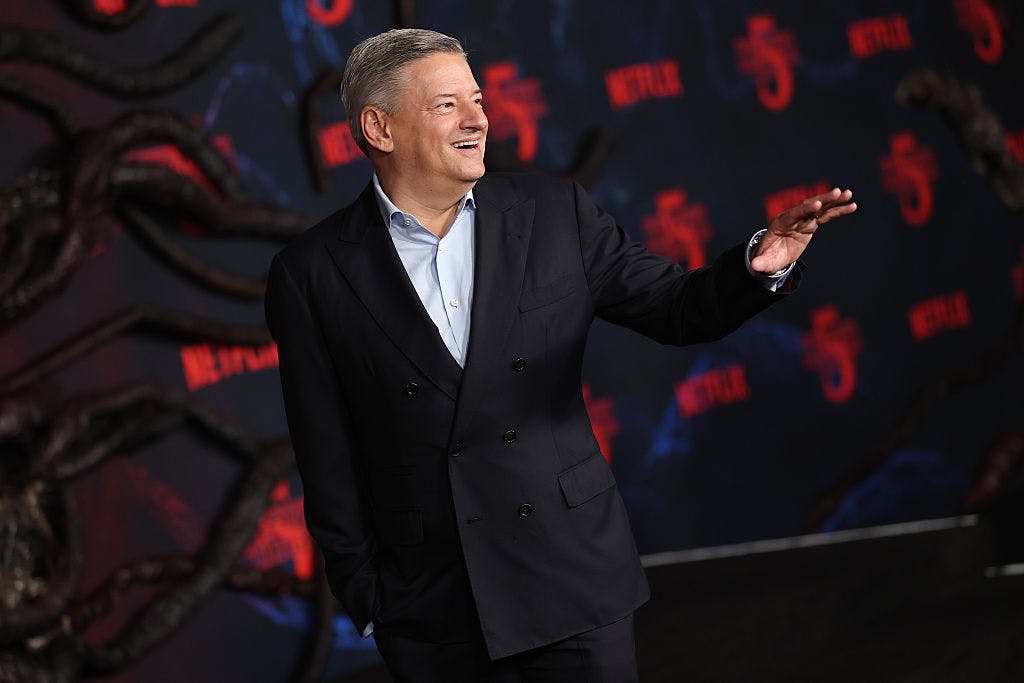
Los Angeles Premiere Of Netflix's "Stranger Things" Season 5 - Arrivals
Netflix co-CEO Ted Sarandos (Monica Schipper/WireImage)

Things Netflix said it would never do, then did

Desperate times call for desperate measures.

With its announcement that it plans to buy Warner Bros. Discovery’s studio and streaming businesses, Netflix is doing something it repeatedly said it never would: buying an asset it long insisted it could build itself.

“It’s true that, historically, we have been more builders than buyers,” co-CEO Ted Sarandos said on the company’s last earnings call, when asked about entertainment industry M&A. “And we think we have plenty of runway for growth without fundamentally changing that playbook.”

Sarandos did seem to leave the door open, though, for a big enough opportunity, like one that includes, say, both HBO and a 100-year-plus portfolio of films.

“We focus on profitable growth and reinvesting in our business, both organically and through selective M&A,” he told investors. “And when it comes to M&A opportunities, we look at them — and we look at all of them, and we apply the same framework and lens that we look at when we look to invest in a build: is it a big opportunity?”

This wouldn’t be the first time Netflix has changed its tune, with notorious flip-flops on everything from advertising to password sharing. What’s perhaps more important, though, than a reversal of a corporation’s stated principles is why Netflix is considering such an about-face in the first place.

“Short form entertainment... is doing to streaming what streaming has done to traditional TV.”

As Pivotal Research Group Principal and Senior Analyst Jeffrey Wlodarczak wrote today, while the acquisition cements the streaming platform’s dominance in long-form entertainment, it belies a greater underlying tension: Netflix is afraid of competition from short-form content platforms TikTok and YouTube.

“...we believe this very expensive deal highlights NFLX management’s concern that short form entertainment (TikTok, Insta, X, YouTube shorts and Snap) is doing to streaming what streaming has done to traditional TV as (especially younger) consumers spend an increasing amount of time on these free platforms amidst declining attention spans (which is fundamentally negative for long form content),” Wlodarczak wrote, explaining why he lowered his price target to $105 from $160.

YouTube, of course, continues to be the biggest thing on TV, as TV disruptor Netflix itself fears disruption amid flat or weakening user engagement growth.

“While we still think it is early, time spent by consumers is migrating from traditional multichannel TV to streaming and now to social media platforms,” the Pivotal analyst wrote. “Flat to declining engagement, arguably is a precursor to subscriber weakness and difficulty taking price and NFLX is doing an extremely expensive content acquisition deal to at least temporarily offset this, but we believe this trend is likely set in stone.”

Here are some other instances where Netflix said it would never do something it then did — and why.

Netflix embraced ads.

Netflix upset traditional TV in part by giving users a more frictionless viewing experience: they could binge seasons of their favorite shows all at once, without so much as a single ad getting in the way.

Back in 2020, Netflix cofounder Reed Hastings said the company’s subscription-only strategy wasn’t “philosophical” but rather the “best capitalism” at the time. Two years later, after facing subscriber losses and slowing growth, the company changed its stance and launched its first ad-supported tier, giving it access to a new revenue source and more price-conscious consumers.

It cracked down on password sharing.

For a company that made its money from paying subscribers, Netflix had been notoriously loose on policing password sharing, going as far as declaring in 2017 that “love is sharing a password.”

Fast-forward a few years and the love had faded. Netflix began cracking down on password sharing by charging for extra users. Again, the move helped Netflix deal with subscriber losses and juice revenue.

Live TV, games, sports — Netflix moved beyond regular streaming.

Hastings long said that he preferred to excel at streaming rather than losing focus and being mediocre at other products.

"Its a product clarity thing,” he told Wired a decade ago. “We’re really about streaming — if you add these features then it gets more complicated and sometimes thats worth it but on the other hand, sometimes you get Microsoft Office.”

These days Netflix has fully embraced that complexity — the “MS Office” approach, so to speak — adding live TV, sports, and gaming as it acknowledges that its competition (and its users) have changed. The hope: features found on rival platforms could counter subscription losses, attract new customers, and increase engagement.

It’s possible, though, that Netflix’s latest reversal is different than the others. Buying part of Warner Bros. Discovery isn’t just doing something it said it wouldn’t do; it’s also doing what the TV giants it once disrupted did: consolidating and doubling down on what it knows.


More Tech

See all Tech
tech
Jon Keegan

DeepSeek releases new V4 series models highlighting efficiency and long context

Chinese AI lab DeepSeek has released a major new version of its eponymous open-source AI models that are nipping at the heels of leading frontier models in some areas.

The most significant DeepSeek-V4 Pro and DeepSeek-V4 Flash both have a 1 million-token context — the amount of information the model can actively work with in a single session — which is a crucial feature for complex, long-running coding tasks.

DeepSeek rebuilt how the models process information under the hood, making them substantially more efficient — and that efficiency is what makes the large context window actually usable.

Also, the new models’ coding skills have closed the gap with the major frontier models from Anthropic, OpenAI, and Google.

The authors of the model acknowledge some of V4’s shortcomings, such as its lower scores on reasoning benchmarks, saying that V4 “trails state-of-the-art frontier models by approximately 3 to 6 months.”

As open-weight models, V4 can be run on any user’s own hardware, making the V4 models among the top-performing open-source models out there. V4’s large context and token efficiency are especially significant among open-source models.

But like with earlier DeepSeek models, don’t ask it about Tiananmen Square.

DeepSeek rebuilt how the models process information under the hood, making them substantially more efficient — and that efficiency is what makes the large context window actually usable.

Also, the new models’ coding skills have closed the gap with the major frontier models from Anthropic, OpenAI, and Google.

The authors of the model acknowledge some of V4’s shortcomings, such as its lower scores on reasoning benchmarks, saying that V4 “trails state-of-the-art frontier models by approximately 3 to 6 months.”

As open-weight models, V4 can be run on any user’s own hardware, making the V4 models among the top-performing open-source models out there. V4’s large context and token efficiency are especially significant among open-source models.

But like with earlier DeepSeek models, don’t ask it about Tiananmen Square.

$28.5T
Rani Molla

SpaceX thinks its total addressable market (TAM) is a whopping $28.5 trillion for its businesses, according to an S-1 filing for its upcoming IPO reviewed by Reuters. And most of that market isn’t rockets. The company says roughly 90% could come from AI — largely selling artificial intelligence tools to businesses.

“We believe that our enterprise strategy, which is focused on serving the digital needs of the world’s largest industries with Al solutions, positions us competitively to pursue this rapidly ⁠growing opportunity,” ​SpaceX said in the filing. “We believe we have identified the largest actionable total addressable market in human ​history.”

TAM, of course, assumes capturing every possible customer. But even a small slice of a $28.5 trillion market would be enormous.

tech
Rani Molla

Tesla Cybercab production has begun

On Tesla’s earnings call earlier this week, CEO Elon Musk said production of the company’s steering-wheel-less Cybercab had begun. Since then, Musk and Tesla have posted videos showing the gold two-seater rolling off the line at its Texas Gigafactory and onto the road.

The Cybercab — meant both for consumers and Tesla’s Robotaxi network — is widely seen as central to the company’s future. “The future of the company is fundamentally based on large-scale autonomous cars and large scale and large volume, vast numbers of autonomous humanoid robots,” Musk said last year.

Whether these cars actually make it to consumers is another question. For now, regulations generally require steering wheels, and Tesla still has to prove the vehicles can reliably drive themselves.

On the earnings call, Musk said production would be “very slow” but would ramp up and go “kind of exponential towards the end of the year and certainly next year.”

tech
Rani Molla

Meta signs deal to use Amazon Graviton chips

Meta said it will deploy “tens of millions” of Amazon Web Services Graviton CPU cores to power so-called “agentic” AI systems — tools that can reason, plan, and act on their own. The move makes Meta one of the largest customers of Amazon’s in-house chips.

The deal also underscores a broader shift in AI infrastructure, as companies move beyond Nvidia GPUs and use different chips for different tasks.

Meta, which is working on its own custom inference chips, also has chip deals with Advanced Micro Devices and Nvidia.

The deal also underscores a broader shift in AI infrastructure, as companies move beyond Nvidia GPUs and use different chips for different tasks.

Meta, which is working on its own custom inference chips, also has chip deals with Advanced Micro Devices and Nvidia.

tech
Rani Molla

Oracle rises after Wedbush’s Dan Ives calls the stock a buy with 25% upside

Oracle extended its premarket gains Friday after Wedbush Securities’ Dan Ives initiated coverage with an “outperform” rating and a $225 price target — about 25% upside to its pre-initiation level — calling the enterprise software and cloud infrastructure company a “foundational infrastructure provider for the AI revolution.”

Ives argues investors are misreading Oracle’s heavy capital spending and negative free cash flow as risky, despite being backed by a massive $553 billion backlog of contracted demand. He says the company’s “secret sauce” is a two-part strategy: building high-performance cloud infrastructure for AI workloads while connecting those models directly to companies’ own data.

“We believe Oracle is in the early innings of a significant repositioning as it executes on this generational opportunity,” Ives wrote.

Latest Stories

Sherwood Media, LLC produces fresh and unique perspectives on topical financial news and is a fully owned subsidiary of Robinhood Markets, Inc., and any views expressed here do not necessarily reflect the views of any other Robinhood affiliate, including Robinhood Markets, Inc., Robinhood Financial LLC, Robinhood Securities, LLC, Robinhood Crypto, LLC, Robinhood Derivatives, LLC, or Robinhood Money, LLC. Futures and event contracts are offered through Robinhood Derivatives, LLC.
