Tech
tech
Rani Molla

Trump to push Big Tech to fund new power plants as AI drives up electricity costs

President Donald Trump is expected to announce a plan Friday morning that would require Big Tech companies to bid on 15-year contracts for new electricity generation capacity. The move would effectively force companies to help fund new power plants in the PJM region as soaring demand from AI data centers pushes up electricity costs across the US power grid.

Earlier this week, Trump called on tech giants to “pay their own way,” arguing that households and small businesses should not bear the cost of power infrastructure needed to support energy-hungry data centers.

Microsoft quickly responded, saying it would “pay utility rates that are high enough to cover our electricity costs,” along with committing to other changes aimed at easing pressure on the grid. Other major tech companies are expected to follow suit, though Wedbush Securities analyst Dan Ives warned the added costs could slow the pace of data center build-outs.

As we’ve noted, forcing tech companies to shoulder higher electricity costs is likely to hit some firms harder than others. Companies like Microsoft, Google, and Amazon can pass at least some of those costs on to customers by selling data center capacity downstream. Meta, in contrast, does not have a cloud business, meaning its AI ambitions lack a direct revenue stream to offset rising power costs.

So far tech stocks don’t appear to be affected much in premarket trading. However utility companies most levered to the AI boom certainly are, with Vistra, Constellation Energy, and Talen Energy deep in the red ahead of the open as analysts at Jefferies warn that these firms face risks from this plan.

Earlier this week, Trump called on tech giants to “pay their own way,” arguing that households and small businesses should not bear the cost of power infrastructure needed to support energy-hungry data centers.

Microsoft quickly responded, saying it would “pay utility rates that are high enough to cover our electricity costs,” along with committing to other changes aimed at easing pressure on the grid. Other major tech companies are expected to follow suit, though Wedbush Securities analyst Dan Ives warned the added costs could slow the pace of data center build-outs.

As we’ve noted, forcing tech companies to shoulder higher electricity costs is likely to hit some firms harder than others. Companies like Microsoft, Google, and Amazon can pass at least some of those costs on to customers by selling data center capacity downstream. Meta, in contrast, does not have a cloud business, meaning its AI ambitions lack a direct revenue stream to offset rising power costs.

So far tech stocks don’t appear to be affected much in premarket trading. However utility companies most levered to the AI boom certainly are, with Vistra, Constellation Energy, and Talen Energy deep in the red ahead of the open as analysts at Jefferies warn that these firms face risks from this plan.

More Tech

See all Tech
tech

OpenAI’s new GPT-5.3 Instant: Less “cringe” tone, no more “over-caveating” responses

OpenAI has released GPT-5.3 Instant, a conversational model that the company says will have smoother, more-to-the-point conversations.

It seems OpenAI is walking back from its cautious guardrails, allowing a more permissive AI chatbot.

In a video describing the new model, a researcher explained, “People are noticing that our models can sometimes seem like a bit of a nanny.” The company describes this over-cautious behavior as “over-caveating,” and this new model aims to relax a bit and let more things slide.

An example showed a question about calculations for “a really long-distance archery scenario.” The previous version of the model included caveats that the AI could not help with calculations that could be harmful. The new model’s response just went ahead and answered the question, without assuming any bad intent.

The researcher in the video said that these changes did not loosen safety controls, but rather just improved contextual understanding of the user’s query.

The model also features more useful web searches, which attempt to infer the context of why the user is asking the question, and then tailor a more useful response. The company says results won’t just appear to be a list of links, but rather a more direct response with the information the user was looking for.

The company said the new model is available today for all users of ChatGPT.

In a video describing the new model, a researcher explained, “People are noticing that our models can sometimes seem like a bit of a nanny.” The company describes this over-cautious behavior as “over-caveating,” and this new model aims to relax a bit and let more things slide.

An example showed a question about calculations for “a really long-distance archery scenario.” The previous version of the model included caveats that the AI could not help with calculations that could be harmful. The new model’s response just went ahead and answered the question, without assuming any bad intent.

The researcher in the video said that these changes did not loosen safety controls, but rather just improved contextual understanding of the user’s query.

The model also features more useful web searches, which attempt to infer the context of why the user is asking the question, and then tailor a more useful response. The company says results won’t just appear to be a list of links, but rather a more direct response with the information the user was looking for.

The company said the new model is available today for all users of ChatGPT.

tech

Apple updates Mac chips and amps up AI claims

Apple’s new M5 Pro and M5 Max chips are the latest step in its steady silicon march: faster CPUs, stronger graphics, more memory bandwidth. The 30% CPU performance increase is meaningful but incremental — not the kind of leap that accompanied the original M1 transition from Intel.

What’s more notable is how aggressively Apple is framing this around AI. The company is touting up to 4x higher peak GPU compute for AI workloads and the ability to run larger models locally, leaning hard into the on-device AI narrative as it positions the MacBook Pro as a more capable personal AI development machine.

It may be paying off in unexpected ways, as the explosion of interest in roll-your-own AI agents like Moltbot have made low-cost Macs like the MacMini a hot item.

It may be paying off in unexpected ways, as the explosion of interest in roll-your-own AI agents like Moltbot have made low-cost Macs like the MacMini a hot item.

tech

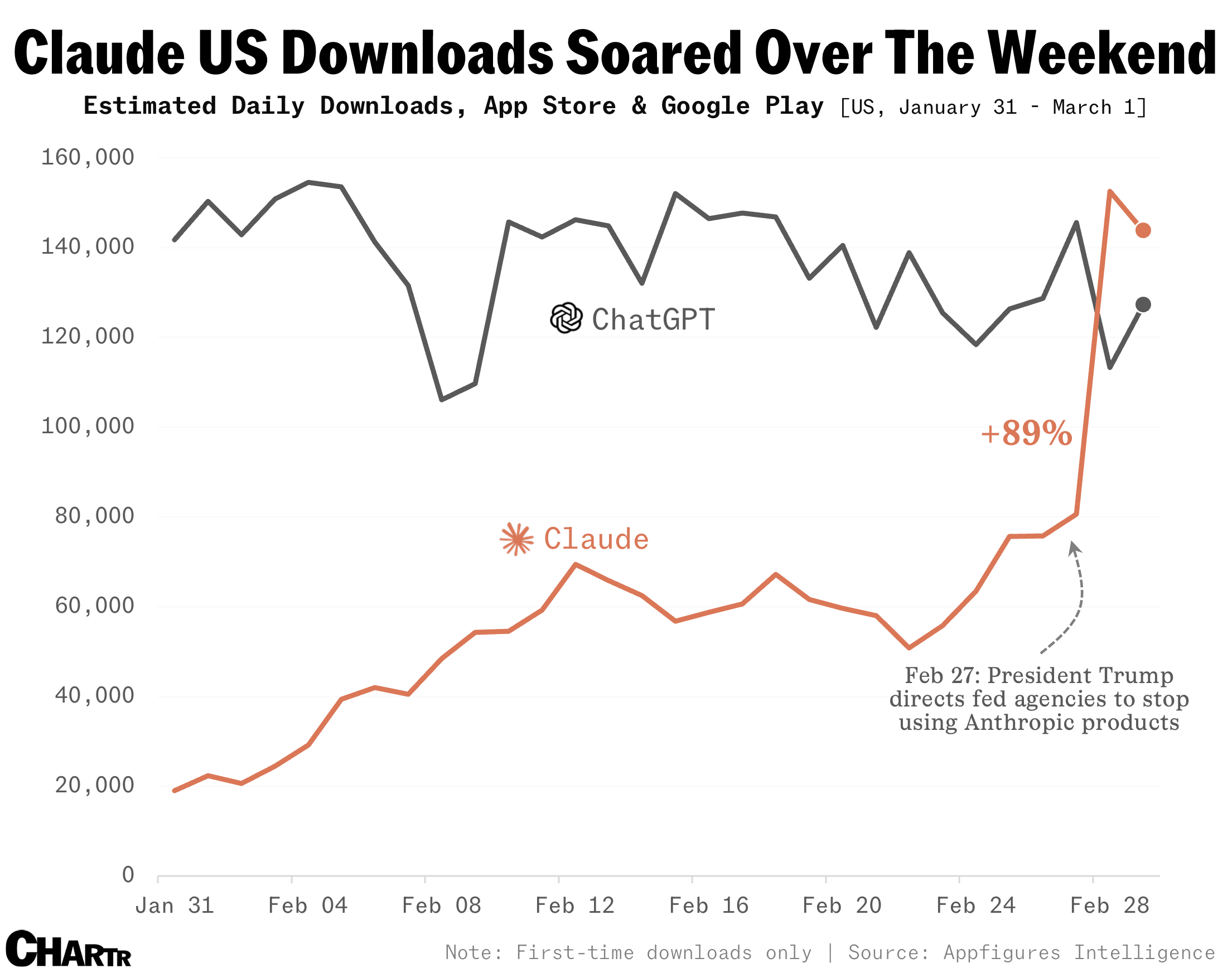
Claude is still top of the US free App Store, as users defect from ChatGPT following Pentagon deal

Last Friday, President Trump directed federal agencies to cease using all Anthropic products owing to its very messy, very public dispute with the Department of War (née Defense), which had centered around the potential US military use of its AI. Just a day later, OpenAI announced that it had made an agreement to supply artificial intelligence to the Pentagon.

It didn’t take long for consumers to respond to news of the deal, which OpenAI CEO Sam Altman has now conceded looked “opportunistic and sloppy” in a post on X. Uninstalls of the ChatGPT mobile app jumped 295% on Saturday from the day before, according to figures from Sensor Tower reported by TechCrunch, as fears around the since-amended agreement’s privacy implications grew.

Claude ChatGPT downloads Feb chart
Sherwood News

Latest Stories

Sherwood Media, LLC produces fresh and unique perspectives on topical financial news and is a fully owned subsidiary of Robinhood Markets, Inc., and any views expressed here do not necessarily reflect the views of any other Robinhood affiliate, including Robinhood Markets, Inc., Robinhood Financial LLC, Robinhood Securities, LLC, Robinhood Crypto, LLC, or Robinhood Money, LLC.