SEND IT
Look out! Jeff Bezos is lurking in our closets

1 of every 8 clothing items bought in America comes from... Amazon?
The online retail giant sold more than double the amount of apparel of any other retailer in 2023.
Kelsey Clark can’t stop extolling the virtues of Amazon Essentials clothing.
The mother of one from Springfield, Illinois, wears Amazon Essentials’ slim-fit camisoles and has a drawer full of Amazon Essentials cotton bikini brief bottoms. Combined, the two products have amassed a staggering 195,000 reviews (and in case you’re wondering, they’re both rated 4.4 stars).
Her husband heads to work most days after donning an Amazon Essentials crew neck undershirt, which has another 43,000 reviews and goes for a little under $18 for a pack of six shirts.
“They’re pretty good quality, they’re as cheap as you’ll find anywhere, you know what you’re getting, and it gets delivered right to your door,” she said.
When you think of Amazon, you probably don’t think of clothing. You certainly don’t think of fashion. But the famed “everything store” has become just that — and “everything” includes clothing. Wells Fargo estimates that one out of every eight clothing items bought in the US comes from Amazon.
Even Jeff Bezos, Amazon’s founder and one of the richest men on the face of the Earth, seems into Amazon’s fits: He was virally panned for wearing what appeared to be a $12 butterfly print shirt from the e-commerce giant to Coachella in 2023.
Amazon sold an estimated $68 billion of apparel and footwear in the US in 2023, according to Ike Boruchow, an equity analyst at Wells Fargo. “This represents a highly impressive 13.2% share of all apparel sold in the U.S. and 41.4% share of all apparel sold online,” Boruchow wrote. Amazon’s control of the so-called “softlines” segment of the retail market is bigger than Walmart and TJ Maxx combined. The investment bank estimates that this year, the value of clothing sold on Amazon is set to top $76 billion.
“When people think of a clothing retailer, in their head, they imagine some kind of high-fashion store,” said Juozas Kaziukėnas, an independent technology analyst based in New York City and a specialist on Amazon e-commerce. But he said that idea is misguided. “Most clothes in general are these kind of cheaper, day-to-day use items. And Amazon just happens to sell a lot of them.”
Amazon didn’t respond to a request to comment for this article.
Amazon Essentials and dozens of other in-house clothing labels have become a cornerstone of Amazon’s retail strategy, serving up basic tees, socks, and jeans at ultracompetitive prices — the kind of staples that shoppers once bought at Walmart or Target. Basic apparel is the second-most-likely product category consumers are willing to buy on Amazon, a Wells Fargo survey found, just behind electronics and ahead of shoes and books. Fashion apparel is the fifth-most-popular product among would-be consumers.
By blanketing its site with thousands of these private-label apparel items, Amazon is putting them in front of shoppers like Clark who buy six-packs of undershirts and multipacks of socks, reinforcing the site’s reputation as the go-to source for inexpensive basics. In 2019, Amazon reportedly offered nearly 160,000 private-label products across 45 brands, per Wells Fargo. But Amazon has since cut back, leaving just three of its own clothing brands from a list of 30 after a 2023 reduction.
Amazon’s clothing business has grown enormously. In 2013, Amazon’s gross market volume in softlines was just $4 billion. A decade later, it was $68 billion — a roughly 30% compound annual growth rate. Covid, with the closing of physical stores, was a major contributor to that eye-popping growth: Amazon leapt from 7.7% market share of the apparel and footwear market in 2019 to 11.9% a year later.
Clark was one of those who had previously bought occasional clothing items from Amazon prepandemic, but formed a habit during the worst of the lockdowns. “I had always been nervous about fit when you can’t see what an item really looks like,” she said. “But when stores were closed, I had no other option, and it turned out better than I thought.”
Amazon’s website layout also helps it dominate the market, selling more than 10x more clothing than its next-biggest competitor online, Gap. “It’s the default place we buy things — including clothes,” Kaziukėnas said. “That, and the sort of infinite catalog nature of it. As long as you’re willing to click through the number of pages in search, or adjust your search query, there are probably things you’re going to find that are exactly the things you’re looking for.”
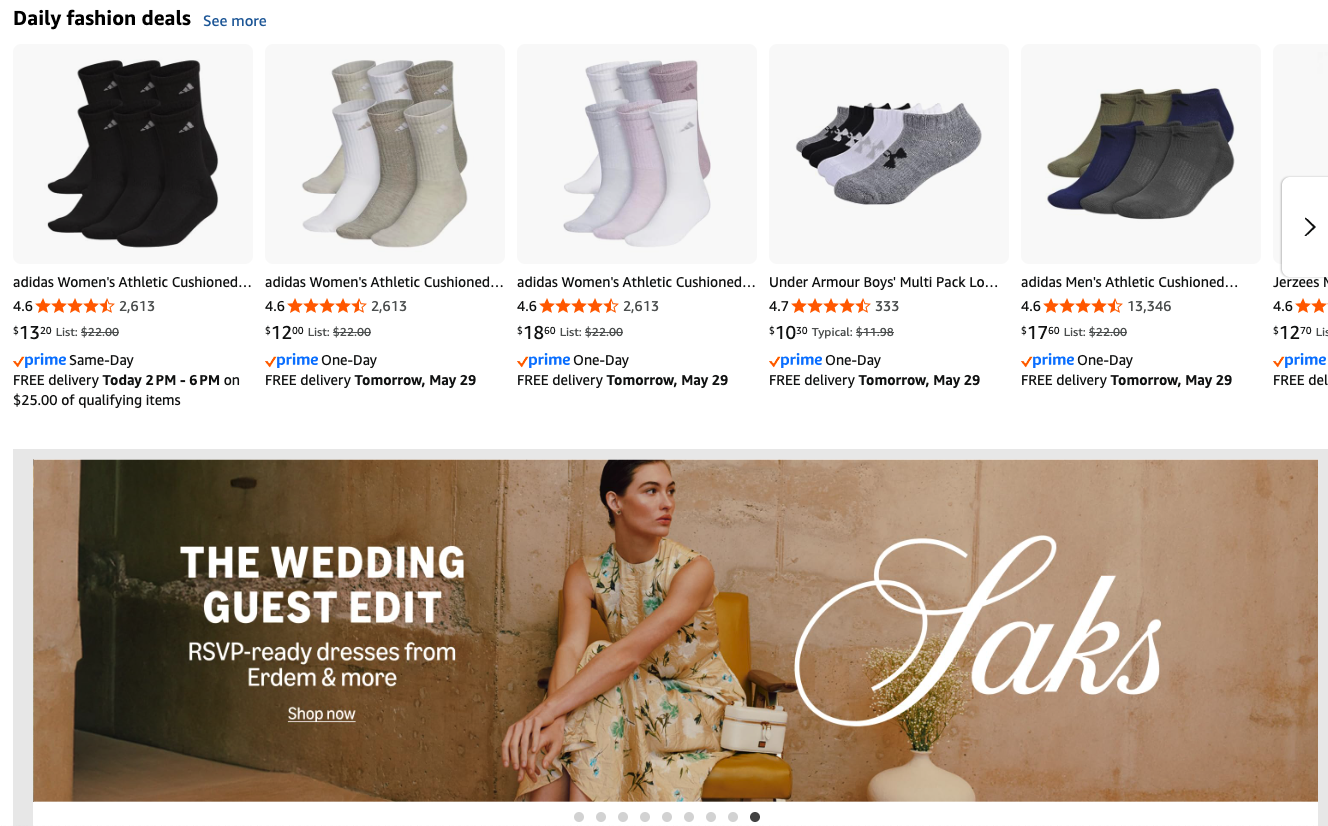
Some 31% of consumers told UBS they buy online because of a larger product selection than in stores — the second-strongest reason why people shop online. (The first is that it’s more convenient.)
As older holdouts gradually come around to the concept of e-commerce, the next generations are fully embracing it. For Gen Z and young millennials, shopping on a phone screen feels as natural as the old ritual of hanging out at the mall, replaced by late-night browsing and one-click buying, with packages arriving on the doorstep sometimes within hours.
Demographics are also working in Amazon’s favor. While many have held off buying much of their clothing online because of the medium’s limitations — some 45% of survey respondents told UBS that the main reason they don’t shop online is that you can’t try the items on before you part with your cash — younger shoppers aren’t as concerned about the need to return items in the wrong size. Shoppers aged 18 to 24 spend nearly half of all their money on apparel online, according to UBS, about 10 percentage points higher than those aged 65 or older. And each year more digital natives enter their prime spending years, the balance tilts further toward online shopping.
Of course, online retail has its hitches when it comes to fashion. An overreliance on returns damages margins for online sellers, with many charging fees for sending back items in an attempt to discourage shoppers from buying multiple sizes of the same item and then returning those that didn’t fit. Starting in 2017, Amazon tried to convince holdouts who worried about ill-fitting clothes to shop online by offering its “Try Before You Buy” service to paying Amazon Prime subscribers. Shoppers could send back any unwanted items within seven days of purchase for free and receive a full refund for the unworn items. But Amazon shut down the service earlier this year, as the company looked to cut costs.
A spokesperson for the company told CNBC that better sizing charts, plus AI features like virtual dressing rooms that allow users to “try on” clothes before checking out, meant Try Before You Buy was no longer needed.
Still, Kaziukėnas reckons that’s the major hurdle for those shoppers still holding out from adopting Amazon as their main clothing provider.
“Sizing of items is perhaps the category where Amazon doesn’t have necessarily the ability to invest effort into making sure all the products are cataloged as correctly or as well as one of these individual brands might do,” he said.
The entire industry is moving in the same direction, betting on tech to solve the online fit problem. In 2022, Walmart launched a feature called “Be Your Own Model,” which uses augmented reality to show shoppers how clothing will look on their bodies based on a photo. And as AI becomes more popular, other businesses are adopting the tech and trying to transform online shopping. From footwear companies using 3D scanning for precise sizing to beauty brands enabling virtual makeup try-ons, retailers across the board are racing to make online shopping feel as close to in-person as possible.
The hope is that these AI-powered tools and virtual experiences can help consumers buy with confidence — and chip away at the one big advantage the fitting room still holds over the smartphone screen. Some 36% of shoppers say they prefer to buy in-store for precisely those reasons, UBS reported.
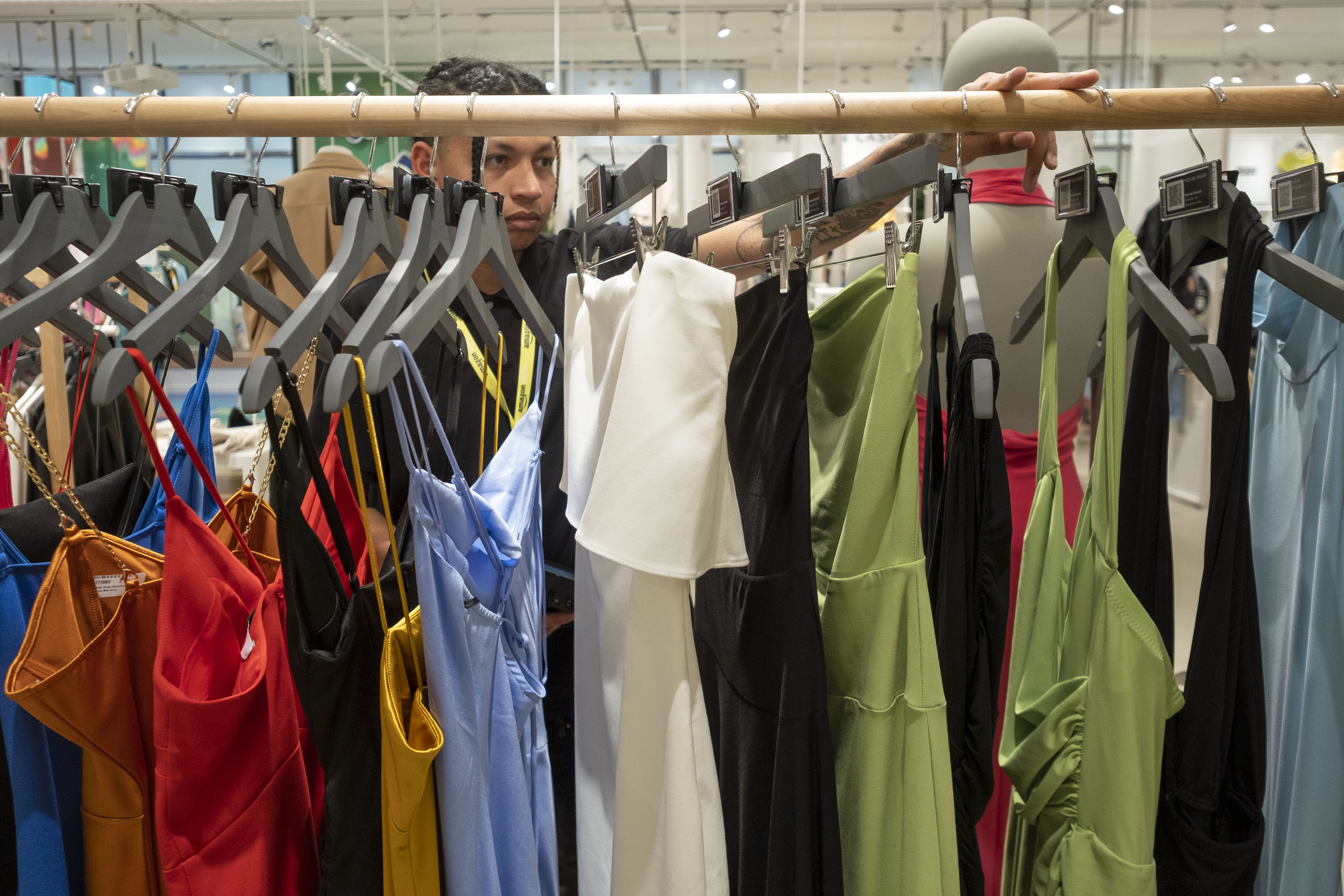
Three years ago, Amazon tried a different way of addressing that concern, opening its first-ever physical fashion store in Los Angeles in May 2022, followed by a second outlet in Columbus, Ohio, four months after that. Barely a year later, both were closed, alongside Amazon’s Books and 4-Star stores.
The broader retail world has contracted. Mall-based clothing chains and department stores, once the default destinations for back-to-school wardrobes and holiday shopping, have been struggling with dwindling foot traffic and an identity crisis.
Shoppers tell UBS they increasingly go to malls to grab a bite or just browse, rather than to visit big-box anchors like Macy’s. It’s a far cry from the days when those department stores were the main attraction.
Some of the big beasts of clothing retail are even deciding that if they can’t beat Amazon, they should join them. Gap opened a dedicated Amazon storefront in late 2022 after years of flagging sales and store closures.
Just last month, Saks Global, which Amazon is an investor in, chose to launch its own Amazon storefront, which will sit within Amazon Luxury, a high-end retail vertical.
“We’re really excited about this opportunity to be able to access a client who’s shopping on Amazon, who is qualified for luxury,” Saks Global President and Chief Commercial Officer Emily Essner said in a news release.
The thinking behind the choice seems clear: Amazon offers access to millions of online customers and the logistical benefit of Prime delivery. Still, it does require ceding control of the shopping experience to a competitor that’s already far ahead, and growing.
“It’s the same thing as in all other categories,” Kaziukėnas said. “If you find yourself competing with Amazon, then you probably made a mistake.”
Chris Stokel-Walker is a UK-based journalist. His latest book is “How AI Ate the World.”