Earningacrust
Uncrustables are on track to become a billion-dollar business
If growing up you were begrudgingly made to eat your crusts, we’re sorry — you may have just missed the golden age of borderless bread.
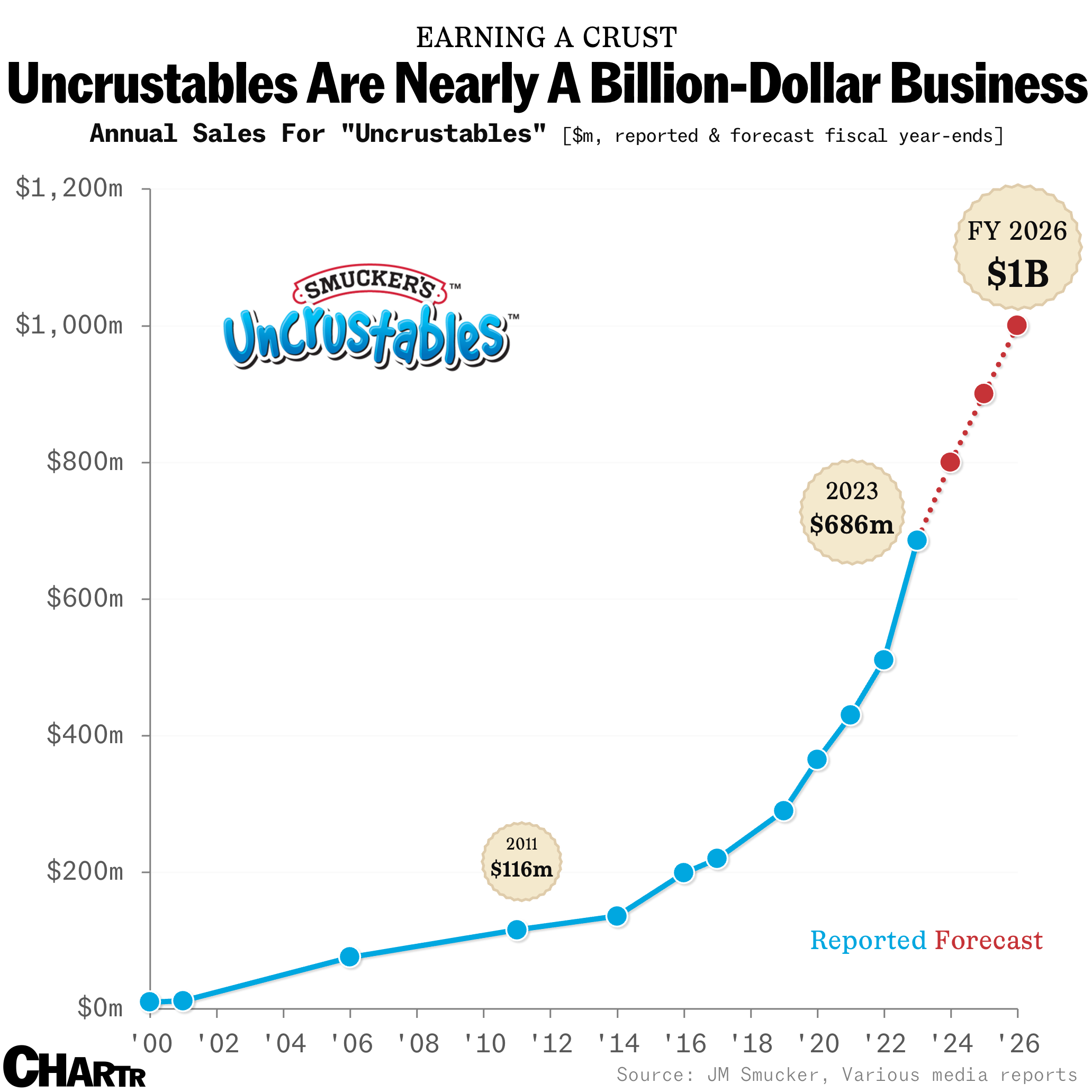
Smucker’s Uncrustables are the frozen sealed sandwiches that have taken snacktimes by storm, and might quietly be one of the greatest deals in consumer goods. Since acquiring “Incredible Uncrustables” back in 1998 from two North Dakota dads, consumer giant J.M. Smucker Co. has made even more incredible returns on their $1 million bet, as the brand sold nearly $700 million worth of crustless sandwiches last year.
Indeed, charting the company’s sales of the snack, which have soared 136% since 2019, makes Smucker’s look more like a high-flying tech startup than a brand peddling crustless PB&Js.
Society in a sandwich
It might seem incredulous that so many people would outsource something as quick, simple, and cost-effective as a peanut butter and jelly sandwich. But, in the age of ultra-convenience, the ultra-processed Uncrustables has found a lucrative niche. Sold frozen, many parents turn to the circular treats as an easy option for their kids’ school snacks, putting one in their lunchbox in the morning to be defrosted by noon.
But, in recent years, demand has skyrocketed as Uncrustables’ consumer base has expanded from kids, to big kids, to thousands of full-grown adults, with sales rising some 34% in the last year alone. In fact, the biggest challenge that Smucker’s has had thus far is not making enough sandwiches.
To keep up with the pace of demand, construction is currently underway for an enormous third factory — a cool $1.1 billion project in Alabama, expected to come online next month — that will be devoted solely to making Uncrustables.
In case you are wondering how construction is going on the new J.M. Smucker facility... pic.twitter.com/UeGiGAO5yS
— Jefferson County, AL (@JeffCoToday) October 13, 2022
[The uncrustables mega factory being built]
With production capacity rising, Smucker’s expects that the brand will become a billion-dollar business by 2026 even in the face of wider headwinds in the processed food industry.
Starsmuck
Smucker’s results are especially astounding considering that they’ve been achieved with minimal advertising efforts. Beyond unprovoked celebrity endorsements from the likes of Lil Yachty, Dillon Francis, and NFL star brothers Jason and Travis Kelce, the latter of which says he eats the snacks “more than anything else in the world”, Uncrustables’ simplicity and mystery — How do they make the bread so soft? What do they do with the crusts? (Animal feed, turns out) — have been enough to intrigue customers.
In 2018, a Tumblr post sparked debate about whether the snacks are ravioli, dumplings, or empanadas. Ever since, social media users have been trying uncrusted recipes, creating their own customized bites with special sandwich cutters, and relentlessly rowing over whether they’re better frozen or thawed. Leaning into the hype, the brand finally aired its first-ever TV ad in November… during a Kelce vs. Kelce football game. Moreover, their quick-fix calorie density has long made them a favorite of NBA athletes, golfers, and, of course, football players: the Baltimore Ravens reportedly got through 7,500 last season.
Sickly sweet
The 128-year-old owner of Uncrustables, the J.M. Smucker Company, is a consumer goods giant, shifting more than $8.5 billion worth of pet food, coffee, and snacks last year.
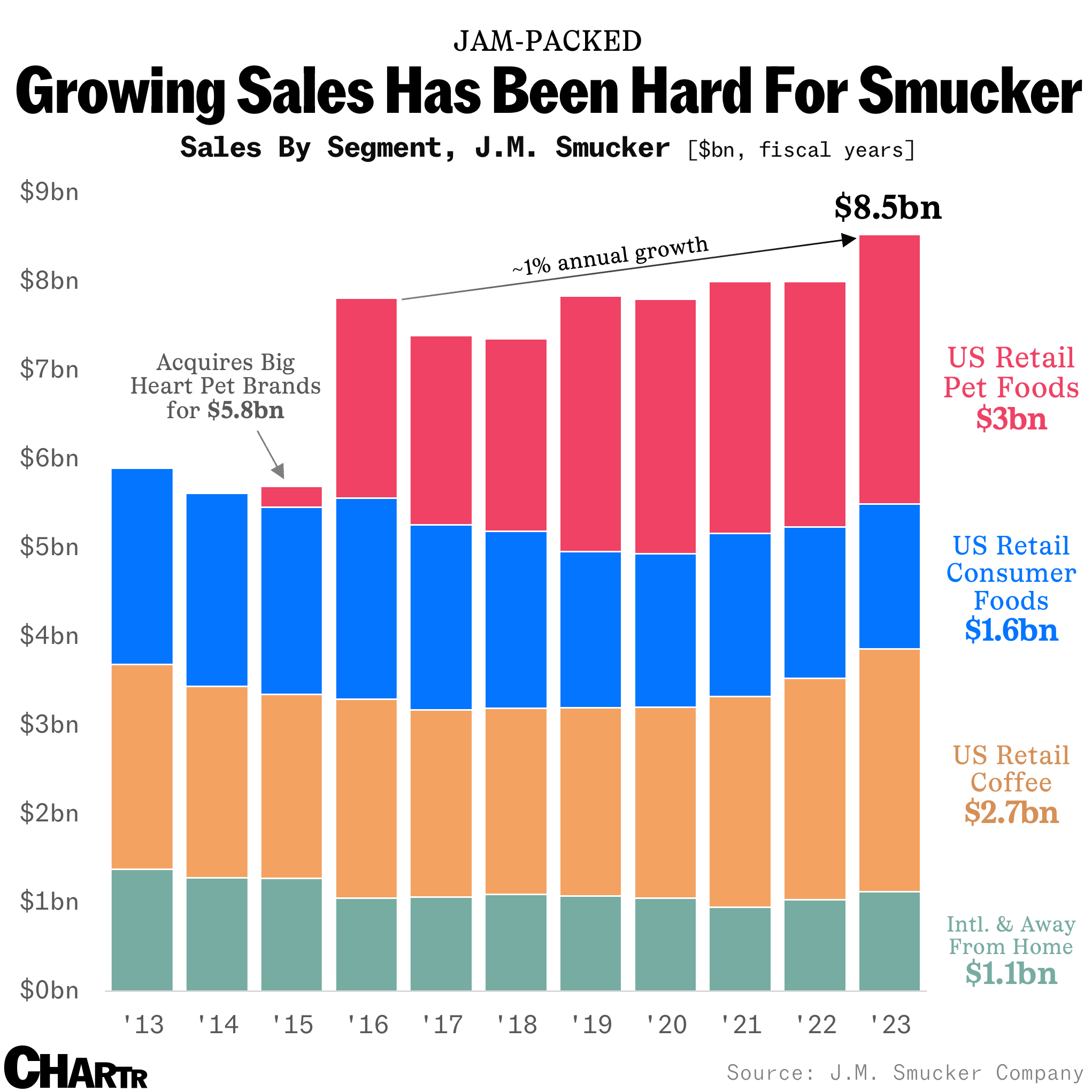
Although solidly profitable — the company made almost $100m of operating profit each month in the first 9 of its latest fiscal year — Smucker has struggled to take market share in the extremely competitive category of consumer foods, which includes all spreads and snacks. On balance, even with household brands like Folgers coffee, Jif peanut butter (which it acquired in 2001), an expansive pet foods division, and Uncrustables in its portfolio, the company has struggled to grow sales, which expanded at a glacial ~1% a year from 2016 to 2023.
Last November, it made another huge play, acquiring Hostess Brands — makers of Twinkies, DingDongs, and HoHos — for a cool $5.6bn, sending Hostess shares soaring… but Smucker shares down 7% on the news as investors considered the deal too expensive.
Freedom of the press
With great product, though, comes contentious patentability: as it stands, Uncrustables’ iconic circular, crimped shape is trademarked, but not patented. In 2000, the US patent office denied Smucker’s application to extend its original 1998 patent, forgoing the argument that their PB&J was unique because the sandwiches are sealed by compression pressing, rather than “smushing”.
While the “sealed crustless sandwich” patent has gained some infamy in the legal world, it still isn’t the intellectual property of Smucker’s; but, the company has taken it upon itself to stamp out competition. They sent LA-based Chubby Snacks a cease-and-desist in 2020 for their crustless sandwiches on the basis of its roundness being “too similar” to the Uncrustables trademark (the snacks are now “cloud-shaped” to avoid confusion), and, just 2 years later, they were telling another smaller rival, Gallant Tiger, to cut it out.
There’s only so much variation within the realm of the humble PB&J, and it seems the hill that Smucker’s is willing to die on is its disc-like form. Both Costco and Walmart sell popular “no crust frozen sandwiches” by making them rectangular.
The state of snacking
Smucker’s continued attempts to corner the round sandwich market come at a somewhat fraught time to be a snack seller. The dawn of semaglutide products like Ozempic — the get-slim-quick diabetes drugs capturing America’s appetites and supersizing margins for pharmaceutical titans Eli Lilly and Novo Nordisk — has made investors less bullish on treats, even for iconic brands.
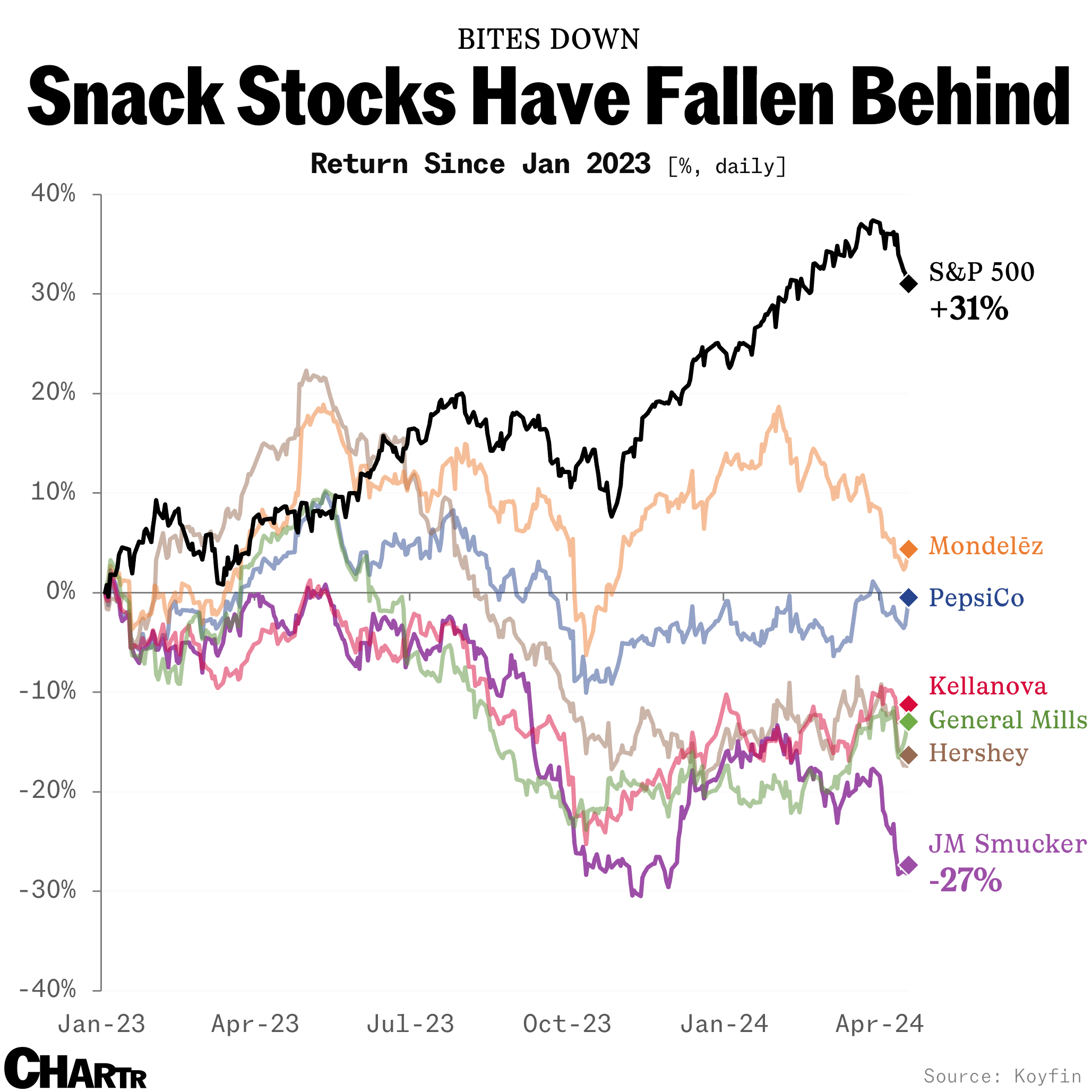
While the stock market has continued its relentless upward march, with the S&P 500 up 31% since the start of 2023, America’s leading snack brands, previously relatively safe bets even in a recession, are bearing the brunt of foodstuff’s unclear future. Even with the mighty Uncrustables, J.M. Smucker shares have shed 27% in value in the last 16 months — the worst of a group of snack titans that includes PepsiCo (owner of FritoLays) and Hershey (which is also wrestling with soaring cocoa prices).
Turning the glutide
The impact that Ozempic and its peers could have on the food industry is hard to quantify, particularly because of the ways that a “miracle” weight-loss trick (PepsiCo investors HATE her!) might fundamentally change society.
Morgan Stanley recently predicted that 24 million Americans will be taking these medications by 2035, and that those people could cut their daily calorie intake by up to 30%. Despite the high cost of the drugs, in 2023, approximately 1.7% of America’s population had already been prescribed a semaglutide, up 40-fold in the past five years. If these drugs change long-term consumer behavior, ultra-processed, energy dense products like Uncrustables could fall out of favor.
But Uncrustables might be more resilient. Rather than marketing them as an indulgent treat, which is spelling trouble for some brands caught in the consumer cravings chasm, the sandwiches fill the gap for intermittent snacking, a category that’s hardly going to disappear overnight. And, of course, there’s the constant “innovation” — Smucker’s has recently formulated a ready-to-eat, non-leaking refrigerated version of the snack (interestingly developed following the Hostess acquisition).
Billion-dollar ideas don’t need to be complicated.