
Business
Adobe’s revenue

Adobe’s subscription business is still booming

Updated 6/17/24 4:17PM

On Friday, shares in Adobe rose more than 15%, after the company reported record quarterly sales of $5.3B and raised its annual revenue forecast. The design software giant appears to be reaping the rewards from its generative AI tool Firefly, with net-new annualized recurring revenue for its Digital Media division coming in $50M ahead of analyst forecasts.

That came after a tough week for the company’s PR team, who found themselves fighting a backlash against its updated terms and conditions — yes, thankfully there are some people who read them cover to cover — after users criticized language which seemed to suggest that Adobe could use customers’ work to train generative AI models.

Turns out this week won’t be that easy for Adobe PR, either: The US Justice Department sued the company, saying its subscriptions — which help drive the aforementioned revenue gains — are too hard for its users to cancel.

Trust fall

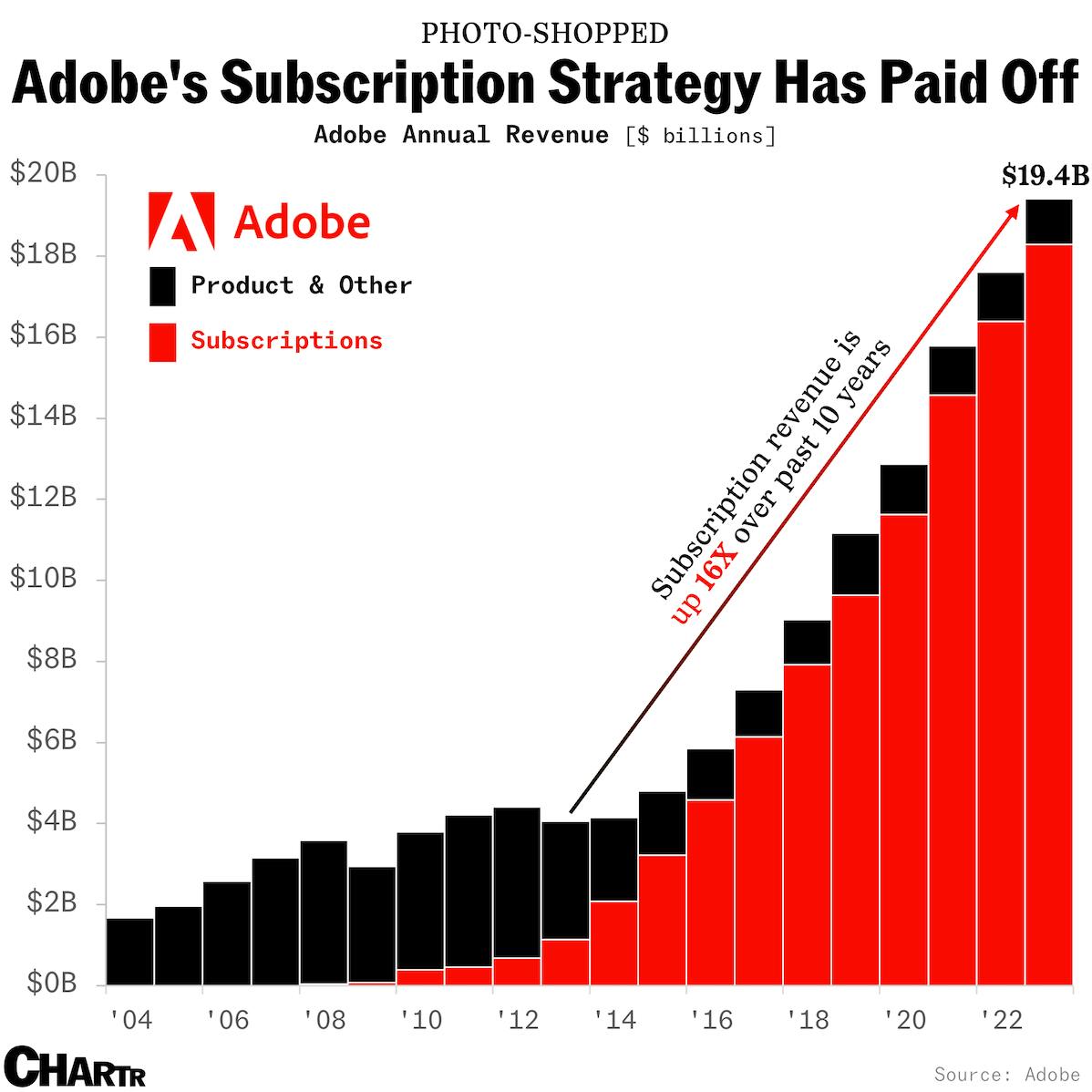
From a financial perspective, Adobe has done a phenomenal job of pivoting away from its old perpetual license model, where customers would buy once and own for a lifetime, to a monthly subscription model in which the product, and the terms of use that govern the product, are always changing. Indeed, over the past 10 years, subscription revenue has grown 16x, driving much of the company’s growth and turning it into a $200B+ giant… albeit one that isn’t universally trusted, per viral posts on X.

To clear up any confusion, Adobe says it will roll out a new terms of use agreement tomorrow, which will clarify that users own their work and that the company doesn’t train generative AI on customer content.

Zoom out: In a year marked by a record number of global elections, generative AI is taking off and users are asking simple questions like “how do I know what’s real?” and “how do I know my likeness or content isn’t being used by AI?” Companies don’t always have the answers.

Update (4 p.m. EST): Added new information following DOJ suit against Adobe.

More Business

See all Business
Daily Life In Warsaw

Smartphones are 12% cheaper than last year, according to the latest inflation data... except they’re not

Phones are one of a few important categories that get quality, or “hedonic,” adjustments in the Consumer Price Index — which make their price go down in the official statistics.

business

Texas sues Netflix, accusing streamer of spying on children and collecting user data without consent

The state of Texas filed a lawsuit Monday against streaming giant Netflix, alleging that the company has built a “behavioral-surveillance program of staggering scale.”

The suit alleges that Netflix is “deceptively designed” to be addictive, using features like autoplay to get viewers hooked, “mining those users for data, and then converting that data into lucrative intelligence for global advertising juggernauts.”

“When you watch Netflix, Netflix watches you,” the lawsuit reads.

“This lawsuit lacks merit and is based on inaccurate and distorted information,” Netflix said in a statement to Sherwood News. “Netflix takes our members’ privacy seriously and complies with privacy and data‑protection laws everywhere we operate.”

Texas is seeking civil penalties of “up to $10,000 per violation” of the Texas Deceptive Trade Practices-Consumer Protection Act, along with an additional penalty of up to $250,000 per violation involving a consumer aged 65 or older.

“Netflix is not the ad-free and kid-friendly platform it claims to be. Instead, it has misled consumers while exploiting their private data to make billions,” said Texas Attor­ney Gen­er­al Ken Pax­ton in the press release announcing the lawsuit.

Netflix did not immediately respond to a request for comment.

“This lawsuit lacks merit and is based on inaccurate and distorted information,” Netflix said in a statement to Sherwood News. “Netflix takes our members’ privacy seriously and complies with privacy and data‑protection laws everywhere we operate.”

Texas is seeking civil penalties of “up to $10,000 per violation” of the Texas Deceptive Trade Practices-Consumer Protection Act, along with an additional penalty of up to $250,000 per violation involving a consumer aged 65 or older.

“Netflix is not the ad-free and kid-friendly platform it claims to be. Instead, it has misled consumers while exploiting their private data to make billions,” said Texas Attor­ney Gen­er­al Ken Pax­ton in the press release announcing the lawsuit.

Netflix did not immediately respond to a request for comment.

Latest Stories

Sherwood Media, LLC and Chartr Limited produce fresh and unique perspectives on topical financial news and are fully owned subsidiaries of Robinhood Markets, Inc., and any views expressed here do not necessarily reflect the views of any other Robinhood affiliate, including Robinhood Markets, Inc., Robinhood Financial LLC, Robinhood Securities, LLC, Robinhood Crypto, LLC, Robinhood Money, LLC, Robinhood U.K. Ltd, Robinhood Derivatives, LLC, Robinhood Gold, LLC, Robinhood Asset Management, LLC, Robinhood Credit, Inc., Robinhood Ventures DE, LLC and, where applicable, its managed investment vehicles.
