Business

BigBerkshireEnergy

US billionaire investor Warren Buffett
(Frederic J. Brown/Getty Images)

So you invested in Berkshire Hathaway: What did you buy?

Berkshire Hathaway’s Assets: Railroads. Energy. Insurance. $277 billion in cash. $300 billion in stocks. Patience.

With roots that can be traced all the way back to 1839 — when it was a textile manufacturer in Rhode Island — the $900+ billion behemoth that is Berkshire Hathaway today bears little resemblance to its origins.

Now, in the heart of Omaha, Nebraska, America’s largest non-technology company is slowly changing once again.

Price is what you pay…

A student of famed investor Benjamin Graham, Warren Buffett honed his skills and folksy charm with a multitude of investments that have become the stuff of investing lore since he first bought a controlling stake in Berkshire in 1965. Most notable, perhaps, are Buffett’s acquisitions of various insurance companies, assets that created a formidable financial flywheel. By using some of the insurance premiums (or float) collected to make further investments, he gained more diversification, which allowed him to underwrite additional insurance, collect more premiums upfront, and so on and so forth.

… value is what you get

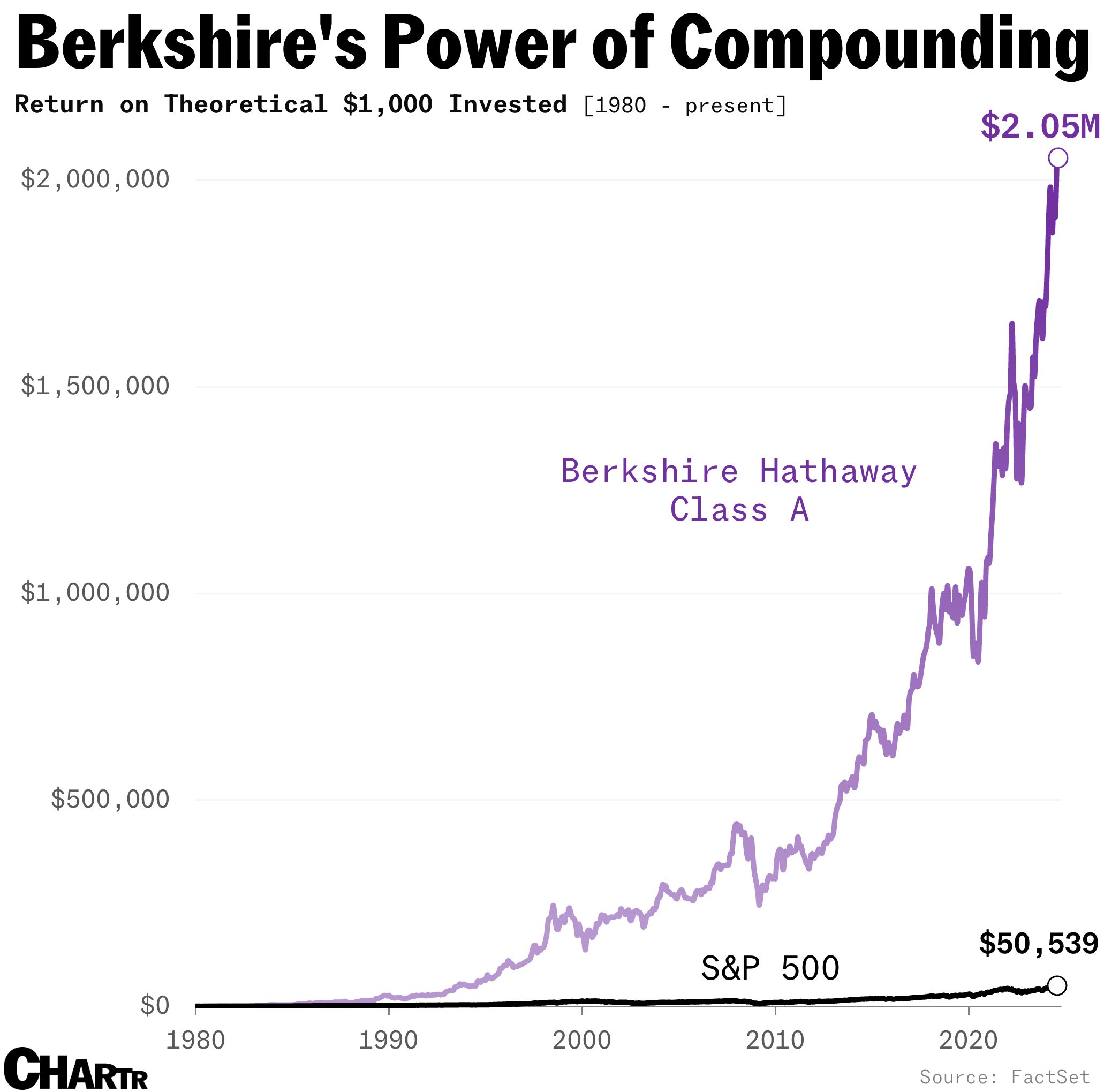
As his reputation grew, some investors scrambled to copy his moves. The wisest among them simply invested in Berkshire Hathaway itself, collecting staggering returns. A theoretical $1,000 investment in Berkshire shares at the beginning of 1980 would be worth more than $2 million today.
Berkshire Hathaway vs. the S&P 500 Index
Sherwood News

The same investment in the S&P 500 would have yielded a comparatively modest ~$50,000.

For some, Buffett took on an almost ethereal energy, earning the nickname “The Oracle of Omaha”. And although he made mistakes — like doubling down on the dying textile business by purchasing Waumbec Mills in 1975 — patience and discipline, particularly after partnering with Charlie Munger (who passed away in December 2023), became hallmarks of Berkshire’s investment process. But what is Berkshire today?

Know what you own, and why

Although we wish it would, splitting a pizza into 6, 8, or 10 slices doesn’t change how much food you’ve got: it just changes how unwieldy the food is to eat. Stocks are similar. Most companies try to split their equity ownership into slices that aren’t too big or too small, usually in the tens or hundreds of dollars, to appeal to as wide a range of investors as possible.

Indeed, numerous companies do stock splits to arbitrarily lower their stock price. Tesla did a 3-for-1 split in August 2022, Walmart announced one in January of this year, and high-flying Nvidia did a 10-for-1 split in June. Berkshire has never split its Class A shares… which is why buying one will set you back some $660,000 and change.

That strategy has attracted shareholders who align more with Buffett and co.’s longer term strategy and thinking. But, as Berkshire’s share price climbed into the many tens of thousands and beyond, people floated the idea of creating entities that “would hold nothing but Berkshire stock, and then parcel out its own shares in smaller denomination pieces to the public” — a potential arrangement that Buffett saw as ripe for abuse. So, in 1996, Berkshire created the Class B share, which is currently worth 1/1,500th of the Class A.

But, if you decide to invest in BRK.B, what are you really buying?
What do you get if you buy $1,000 of Berkshire Hathaway
Sherwood News

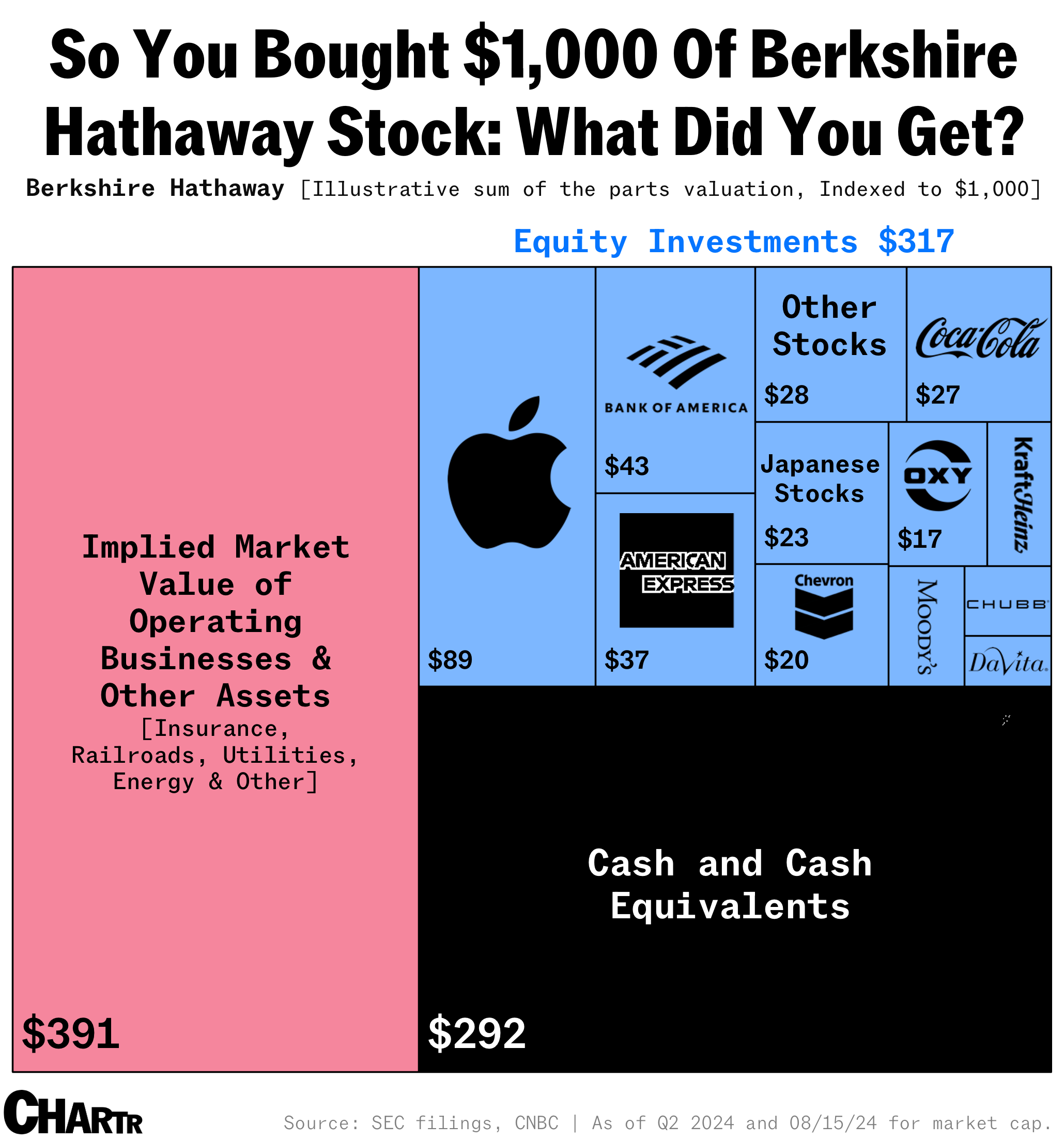
Well, for starters, Berkshire now has more cash than ever, some $277 billion worth at the end of Q2. Taking that at face value (assuming no holding company discounts), that’s roughly 30% of the company’s market value. So $292 of our $1,000 hypothetical investment in our example is just cash.

Next up is the company’s stock portfolio. An updated 13F filing from Wednesday reveals that — again assuming no conglomerate discount — it’s worth about $317 out of our $1,000. That implies that the rest of the business, primarily Berkshire’s actual operating divisions, is worth the remainder, or some $391 in our example. So if you’re buying Berkshire you’re getting exposure to: a bunch of iconic American stocks, some Japanese equities, cash, some railroads, insurance companies, and energy assets. Oh, and Dairy Queen and Duracell, which Berkshire also owns.

There’s even some technology investments… but that portion is shrinking.

Old dog, new tricks

For years, Warren Buffett claimed he "didn't understand tech companies" and avoided investing in them, preferring companies with a durable competitive advantage, often channeling one of his other mantras: “Invest in businesses any idiot could run because someday one will”.

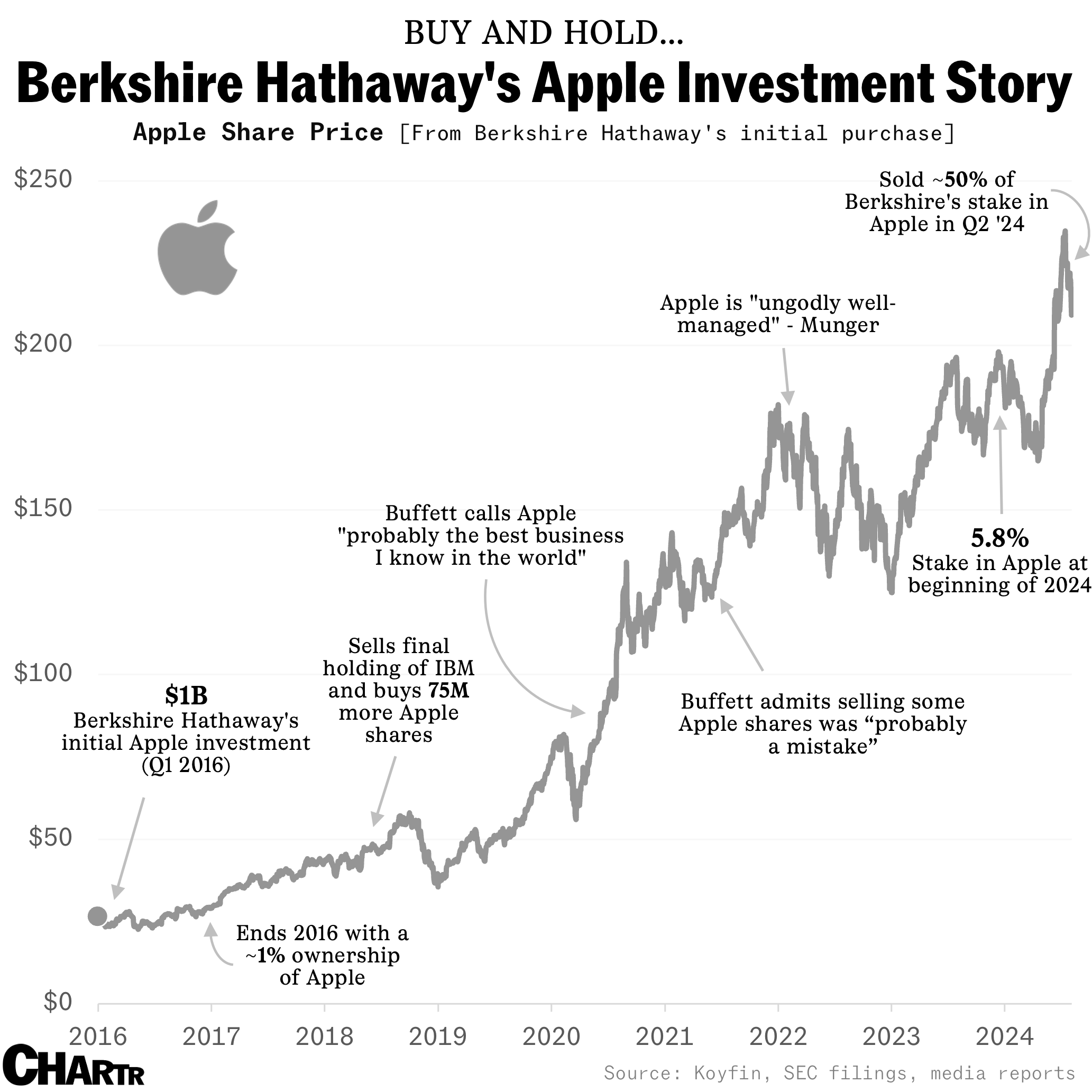
But, 2011 marked a turning point. As the tech giants boomed, Buffett made his first foray into tech, investing $11 billion in IBM. That investment didn’t really work out, but it set the stage for what — in pure dollar terms — became one of the most successful investments of all time: Berkshire’s investment in Apple, which started with a ~$1 billion purchase revealed in a filing from 2016. This decision, likely influenced by one of Buffett's investment managers, Ted Weschler or Todd Combs, proved to be a game-changer.
Berkshire Apple Timeline
Sherwood News

Bite out of the Apple

Since that initial purchase, Apple’s shares have made a total return of nearly 800%, with Berkshire seemingly happy to sit on its huge stake — until recently.

Indeed, Buffett and his team’s love of the iPhone-maker appears to be waning. In the last quarter, Berkshire roughly halved its position in the company, leaving it owning exactly 400 million shares, a sell-down that took Berkshire Hathaway's cash pile to more than $270 billion.

That cash buffer is, obviously, an asset. But, it’s also potentially a bit of a headache. There’s no point in investing in a company if all they do is park your cash at a bank. You can do that yourself.

So the problem for Berkshire, and we’re using “problem” in truly the loosest definition imaginable, is that its cash balance is just so enormous that the ways to deploy it meaningfully are becoming vanishingly small. Take Ulta Beauty for example. This week, Berkshire revealed a $266 million stake in the company. That was a big deal for Ulta Beauty, but a relative triviality for Berkshire: it represents about 0.03% of Berkshire’s value.

If Warren Buffett were to spend an hour talking about Berkshire’s portfolio, and he spoke about each asset in proportion to its value to the group, the new $266 million investment in Ulta Beauty would get 1.01 seconds of discussion, just enough time to say “Ulta-”. That’s how big Berkshire is.

How will Berkshire deploy its mounting cash pile? Will it jump back into tech investments, or wait for a more serious market wobble than the one we had a couple of weeks ago? Whatever it is, the decision won’t be rushed.

More Business

See all Business
business
Tom Jones

Prime Day is here again and Amazon’s subscription service has never been more popular

Well, it’s that time of year again: many have made their wish lists, people are scraping together the money they’ve saved to pick out a perfect gift, some are presumably leaving out refreshments for the weary delivery drivers and, more and more, drones.

It’s Amazon Prime Day — meaning that it’s the second day of the four-day promotional event that Amazon still calls Prime Day — of course, and it’s even come early this year, with the company bringing the period into late June from July, when it’s been traditionally held for the last five years.

The Prime Age

Alongside the eyes and endless clicks that the arbitrary stream of listicles on “The Best Prime Day Deals” that almost every media outlet pours into, Amazon will also be cheering the fact that there’s now more Prime users than ever before to devour the retailer and its sellers’ sometimes-contested “discounts.” Indeed, according to the latest annual estimates from Consumer Intelligence Research Partners (CIRP), there were just over 200 million American shoppers using Amazon’s massive subscription service at the end of 2025.

business

Electronic Arts launches a platform to put more ads in its games

Video game publishing giant EA launched a new platform on Monday designed to make the process of selling immersive ad space in its popular games easier.

The company says the platform, called EA Advertising, allows brands to “integrate directly into gameplay through dynamic, real-time placements, from stadium signage to custom in-game content.”

More so than other studios, EA has incorporated advertising into its most popular titles. As Kotaku points out, the company’s ad efforts stretch as far back as 2006. Several of its sports franchises already feature partnerships with brands like Visa, Lowe’s, Red Bull, and PepsiCo.

In-game advertising hasn’t exactly been embraced by fans, but industry experts expect it to ramp up as companies seek more revenue to offset higher games budgets and surging memory costs. EA rival Take-Two has taken a different approach, with CEO Strauss Zelnick recently saying the company was “not at risk of doing brand partnerships” in the forthcoming “Grand Theft Auto VI,” and that ads in full-price games seems “unfair.”

The $55 billion deal to take EA private, led by Saudi Arabia’s Public Investment Fund, is set to close at the end of this month. Being the largest leveraged buyout in history, EA will likely look for more ways to boost revenue to cover interest payments.

More so than other studios, EA has incorporated advertising into its most popular titles. As Kotaku points out, the company’s ad efforts stretch as far back as 2006. Several of its sports franchises already feature partnerships with brands like Visa, Lowe’s, Red Bull, and PepsiCo.

In-game advertising hasn’t exactly been embraced by fans, but industry experts expect it to ramp up as companies seek more revenue to offset higher games budgets and surging memory costs. EA rival Take-Two has taken a different approach, with CEO Strauss Zelnick recently saying the company was “not at risk of doing brand partnerships” in the forthcoming “Grand Theft Auto VI,” and that ads in full-price games seems “unfair.”

The $55 billion deal to take EA private, led by Saudi Arabia’s Public Investment Fund, is set to close at the end of this month. Being the largest leveraged buyout in history, EA will likely look for more ways to boost revenue to cover interest payments.

business

JM Smucker says it sold $1 billion worth of Uncrustables in FY2026

After years of booming sandwich sales, JM Smucker has finally earned a billion-dollar crust.

On Tuesday, the company reported results for fiscal year 2026, highlighting better-than-expected profits driven by higher prices for coffee and sweet baked goods. However, at another point on the earnings call, CEO Mark Smucker pointed to one particularly jammy figure: in line with previous forecasts, the company sold $1 billion worth of its (almost always) crustless sandwiches, Uncrustables, in the last year alone.

business

Paramount reportedly offers concessions to resolve multistate antitrust investigation

Paramount has reportedly offered up some concessions in an effort to prevent an antitrust lawsuit by California and about 10 other states, according to Bloomberg reporting on Monday.

Reuters first reported on the potential suit from a group of unnamed states last week, which could throw a wrench in Paramount’s plans to buy rival Warner Bros. Discovery in a Hollywood megamerger.

The list of concessions is unknown, though Bloomberg previously reported that Paramount is open to divesting some of its kids TV assets to appease EU regulators.

Late last month, reports said US regulators appeared likely to approve the $110 billion merger, following a meeting between Paramount CEO David Ellison and DOJ antitrust staffers.

The list of concessions is unknown, though Bloomberg previously reported that Paramount is open to divesting some of its kids TV assets to appease EU regulators.

Late last month, reports said US regulators appeared likely to approve the $110 billion merger, following a meeting between Paramount CEO David Ellison and DOJ antitrust staffers.

$98B ⛽

The IATA released its latest financial outlook for the airline industry over the weekend, forecasting a $98 billion jump in the sector’s collective fuel bill. The world’s largest trade group representing airlines expects the oil spike to halve profits by 49% from last year to $23 billion.

The group also expects profit margins to halve year over year, falling from 2025’s 4.2% to 2%. Still, revenue is expected to climb to $1.17 trillion from $1.07 trillion.

A surge in the cost of jet fuel has rocked US and global airlines this year, leading Delta Air Lines, United Airlines, American Airlines, Southwest Airlines, JetBlue, and others to raise fares and ancillary charges like bag fees. Low-cost carriers, which operate on smaller margins, have been squeezed the hardest, resulting in Spirit’s shutdown.

“It’s a tough year for all airlines, especially those whose balance sheets had not yet recovered from COVID. And, of course, for those operating in the Gulf,” said IATA Director General Willie Walsh, who added that demand is holding up and about half of passengers expect to spend more on travel this year. “That bodes well for a strong northern summer peak season. The big unknown is how long travelers and shippers can tolerate the higher costs of connectivity.”

Latest Stories

Sherwood Media, LLC and Chartr Limited produce fresh and unique perspectives on topical financial news and are fully owned subsidiaries of Robinhood Markets, Inc., and any views expressed here do not necessarily reflect the views of any other Robinhood affiliate, including Robinhood Markets, Inc., Robinhood Financial LLC, Robinhood Securities, LLC, Robinhood Crypto, LLC, Robinhood Money, LLC, Robinhood U.K. Ltd, Robinhood Derivatives, LLC, Robinhood Gold, LLC, Robinhood Asset Management, LLC, Robinhood Credit, Inc., Robinhood Ventures DE, LLC and, where applicable, its managed investment vehicles.