

Back stage drama

A British company backed by private equity has invaded Broadway. Will it change the Theater District forever?
New Broadway power player ATG Entertainment hopes its lavish production of Cabaret will get a boost when the cast performs at Sunday's Tony Awards, after the show fell surprisingly flat with New York critics. Whichever way things go after Sunday night, the private equity-backed theater owner's big-money Broadway ambitions are just starting to take shape.
Broadway has always been a tight game of real estate: 41 houses, 40 of them squeezed into a 13-block radius in Midtown Manhattan, and the majority owned for decades by three major family-owned operators: the Shuberts (17 theaters), Nederlanders (9 theaters) and Jujamcyn Theaters, which operated five houses, with influential socialite Jordan Roth — son of billionaire real estate magnate Steven Roth — most recently serving as President.
But last year, for the first time in decades, that game changed. ATG, a theater owner, ticketing provider and live entertainment producer with huge international reach, bought a majority stake in the five Jujamcyn houses on Broadway — the St. James, Al Hirschfeld, Eugene O’Neill, August Wilson and Walter Kerr theaters — in a deal estimated at over $300 million.
The acquisition, technically billed as a merger, was finalized in July of last year. Roth retained a 7% stake, remained on the board and took up the title of Creative Director. ATG expanded its Broadway footprint to 7 theaters total — the company already owned the Lyric (home to Harry Potter and the Cursed Child) and the Hudson (where mega-hit revival Merrily We Roll Along closes July 7). ATG, which was known as Ambassador Theatre Group before it rebranded in April, owns 64 venues worldwide.
ATG has been an “expansionist” force for years, said Gordon Cox, contributing theater editor at Variety. On London’s West End, the company owns 10 out of the 39 total venues following years of growth.
“Theater owners are among the most powerful forces, if not the most powerful force on Broadway, in terms of deciding what shows happen and when,” Cox said.
ATG’s expansionism is partly driven by the company’s private equity ownership. Providence Equity Partners became ATG’s majority shareholder in 2013, at a reported $500 million cost. For good or ill, the model of private equity firms is to grow the worth of private companies, often by cutting costs, and turn a profit in an eventual sale.
Given the private equity factor, some in the industry may be “wary about ATG Entertainment's recent expansion,” said Marc Hershberg, an entertainment attorney and theater correspondent for Forbes. But Hershberg also noted that “it is reassuring to see such interest and investment in Broadway.”
ATG’s press representative didn’t return requests for comment prior to deadline. A representative for Roth also didn’t return requests for comment.
The company went big with Cabaret, the first show from ATG Productions at one of its newly purchased venues. For Rebecca Frecknall’s ambitious staging of Fred Ebb & John Kander’s masterwork, the August Wilson Theatre was transformed into gritty Berlin nightclub “The Kit-Kat Club.” A pre-show environmental experience stretched throughout the theater, while food and drink services were offered at stage-side tables for premium ticket buyers. The production cost roughly $26 million to produce, per Philip Boroff of Broadway Journal.
While Broadway attendance is approaching pre-Covid levels, costs are rising rapidly and fewer shows are turning a profit. Cabaret represented an ambitious risk by ATG, a bet that the event-style production could command top ticket prices and run for several years with rotating leads, as it has on the West End since November 2021.
“Particularly the suburbs aren’t coming back, so everybody is looking for ways to rethink what a Broadway experience can be,” said Cox. “Cabaret is a big swing that falls right in line with ATG’s hospitality [focus] — their rethinking of how food, beverage and hospitality can be worked into a premium Broadway experience.”
So far, that bet is looking shaky. Though it earned raves in London, Frecknall’s bitterly dark staging received a much harsher critical reception in New York, variously derided as a “money-grabbing misfire” and “one note, screamed off-key.”
“Greeters offer free shots of cherry schnapps that taste, I’m reliably told, like cough syrup cut with paint thinner,” wrote New York Times theater critic Jesse Green wrote, referring to shots passed out as audiences enter the club. Then he stuck in the knife: “Too often I thought the same of the show itself.”
Thanks to the star power of Oscar-winning star Eddie Redmayne, who leads Cabaret on Broadway as The Emcee through September, grosses are still strong — for now. Last week the production earned $1,899,832, with an impressive average ticket price of $222.28. Redmayne will lead the performance on this weekend’s Tony broadcast. But the tepid critical response and mixed word-of-mouth has the costly production’s future looking uncertain once Redmayne departs (future lead performers have not yet been announced). The show is not expected to earn any trophies on Sunday.
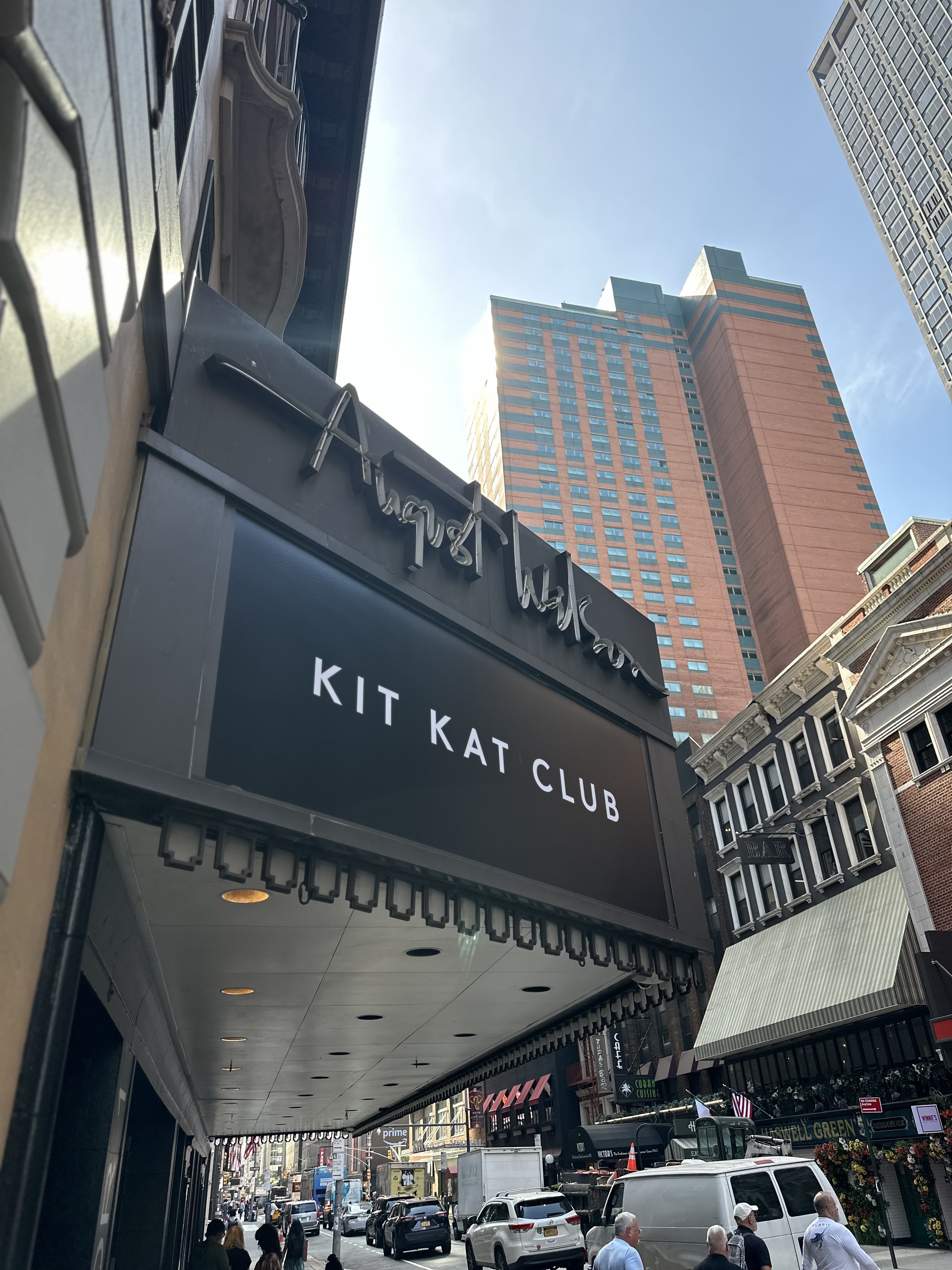
Beyond Cabaret, ATG’s future plans for its four other new houses will take shape gradually. Three are currently occupied with long running tenants – Moulin Rouge in the Al Hirschfeld, The Book of Mormon in the O’Neill and Hadestown in the Walter Kerr. This fall, ATG and Jamie Lloyd Productions will present another West End smash, Lloyd’s minimalist revival of Sunset Boulevard led by Nicole Scherzinger at the St. James.
One prominent Broadway producer, speaking on the condition of anonymity, expressed concern that ATG's own ample pipeline of productions (future ATG prospects include Sunset, a Paul Mescal-led Streetcar Named Desire and a musical adaptation of The Curious Case of Benjamin Button) could consistently fill the five new venues, further limiting real-estate options for producers seeking homes for independent productions.
But Hershberg expects that ATG Entertainment will ultimately favor productions that present the most attractive package, whether originating from ATG Productions or an outside producer.
“I suspect that the company will ultimately make whatever decisions will maximize its profits,” he said.
Other producers see an opportunity, with a new player on the scene less bound by longstanding relationships and handshake agreements than the Shuberts or Nederlanders.
“Here’s a new game in town, they are upfront that they want stars in their shows or big-ticket items, and it takes away the mystery,” said one prominent Broadway producer, who requested anonymity to speak freely. “It’s going to be a massive shift once the buildings start becoming more available – it will be less about who has the loyalty edge and more about what your show has to offer from a business standpoint."
ATG’s size and corporate structure is a new proposition for Broadway, which is otherwise run by companies more firmly invested in New York’s theatrical scene. The recent rebrand seems partly designed to offset a potentially faceless, corporate image by pitching ATG as artistically driven at its core – the new slogan is “Passion Behind Performance.” And ATG recruited Kristin Caskey, lead producer on Fun Home, to help lead its North American arm, putting a respected and familiar face at the head of its local operation.
“From my experience with ATG, they are so willing to nurture and foster newer, younger producers, and give you the tools you need to be successful,” said Lamar Richardson, a co-producer on Appropriate and The Wiz, both led by ATG Productions (though housed at a Shubert and Nederlander theater, respectively). “That’s really going to be appealing to the younger generation of producers, because we’re all looking to open up Broadway and be more creative in terms of bringing in new audiences and getting lesser-known playwrights on stage.”
Yet ATG can also move in a more mercenary way when needed. After its merger with Jujamcyn, the company inherited a contract with concessions provider Sweet Hospitality Group set to run through 2025. The contract didn’t jibe with ATG’s classier hospitality focus, which favors glassware over sippy cups – nor with their plans for table service at Cabaret. ATG terminated the contract, a battle that ultimately landed in court last November after SHG fought back.
The two sides ultimately reached an agreement, the terms of which have not been disclosed. All SHG employees were informed in December that as of February 25th (four weeks before Cabaret’s first preview on Broadway), ATG would handle all bar operations in-house, and current employees would be automatically eligible to apply for new employment with ATG. (Julie Rose, founder and CEO of SHG, declined to comment.)

There’s also an unknown factor: How long will ATG continue to be backed by private equity? Providence’s holding in ATG will soon hit its 11th year, longer than PE firms typically want for a holding (though the pandemic obviously destabilized live entertainment, and holding periods have trended upward as interest rates have risen).
When ATG’s former CEO Mark Cornell abruptly left the company in October of last year, columnist Alistair Smith of The Stage speculated that his replacement, former Go City CEO Ted Stimpson, “had been brought in to build the group up for sale – something that he has experience with, and which…Providence probably feels is overdue.”
Can ATG’s artistic ambitions – which do often favor artistic risk, like its challenging take on Cabaret – sit comfortably alongside corporate interests, and particularly the looming question of a private equity sale?
“It’s a big question mark right now,” said Cox. “The Broadway people they are working with are not people who would think in a mercenary way…it will be interesting to see how the private equity needs meet the people who are embedded in Broadway, and who are committed to the health of Broadway specifically.”
Or, as Hershberg put it more bluntly: “It will depend on who buys it.”
Joey Sims is a freelance theater journalist who has written for The Brooklyn Rail, Vulture, American Theatre and others. Follow him on Twitter @joeycsims or subscribe to his theater Substack, Transitions.



