Business
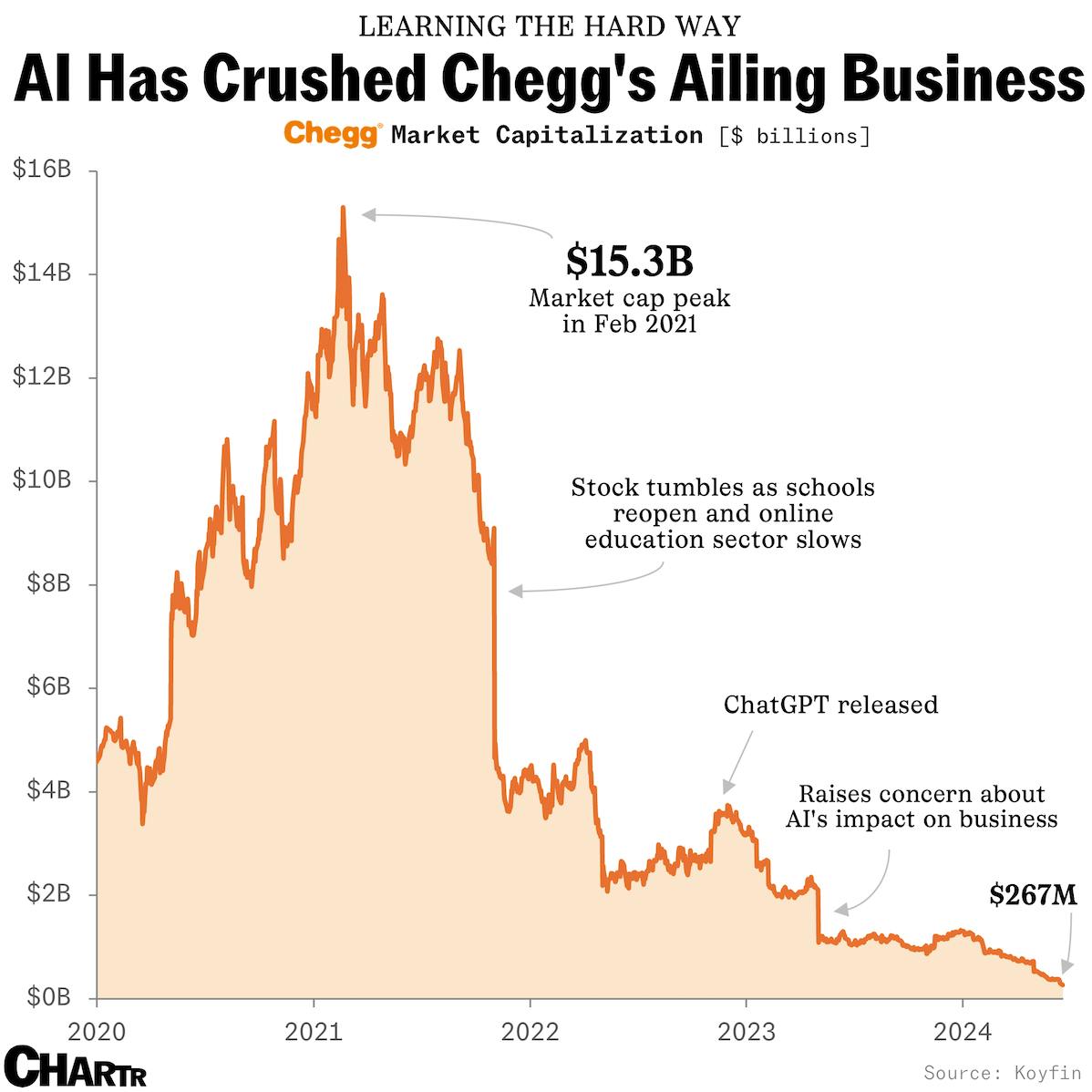
Chegg market cap

Can Chegg turn its fortunes around?

Like a student who starts the homework the morning that it’s due, digital education company Chegg is trying to adapt in the face of AI, with its April-appointed CEO announcing yesterday a major restructuring plan. The strategy includes cutting its headcount by 23%, as well as an ambition to build a “platform that incorporates artificial intelligence verticalized for education”. Investors appear to like the plan, with the stock currently up around 15% on the news, but some might be thinking it’s too little too late.

Textbook troubles

Renowned for providing homework help, Chegg is seeking to reinvent itself as students increasingly turn to free AI tools like ChatGPT for assistance, a trend that’s compounded a brutal 3 years for the company.

During the pandemic the company’s online platform became a lifeline for many as schools shut down and students "chegged" their way through homework and online tests by paying to access Chegg’s wide database of millions of textbooks to get the answers. Revenues at the company doubled between 2018 and 2020, turning Chegg into a business worth some $15 billion at its peak.

But, like so many pandemic-era trends, once schools opened back up, Chegg found itself losing ground. Shares lost an eye-watering 49% of their value in a single day in 2021. That misery was made worse when execs announced that ChatGPT's popularity was impacting customer growth — and its fortunes never really reversed. Once proclaimed “the most valuable edtech company in America” by Forbes, Chegg has lost some 98% of its peak market cap.

More Business

See all Business
Stacked Cars in Parking Lot

With gas prices soaring, the humble sedan is making a comeback

Recent US sales data reveals a “sedanaissance” among major automakers like Honda, Hyundai, and Toyota.

business

The Trump administration is reportedly planning a 50% made-in-America requirement for USMCA tariff relief

Qualifying for USMCA-related lower tariffs may soon require more US-made vehicle components, according to reporting by The Wall Street Journal.

The Trump administration is reportedly planning to introduce a 50% US content requirement for vehicles covered by the trade pact to receive lower tariffs. The content would be measured by cost, according to the WSJ.

There currently isn’t any US-specific requirement for those lower tariff rates, but in order to receive preferential tariffs, vehicles are must contain at least 75% regional content (components made in North America). Per Reuters reporting, the Trump admin is seeking to raise the regional requirement to 82%.

These reported plans are subject to change as the US negotiates USMCA terms with Mexico over the next few months.

Overall, Tesla will likely have the easiest time qualifying for any stricter requirements. The automaker’s vehicles contained the highest amount of US/Canadian content in 2025, according to American University research. Ford, GM, and Stellantis all scored lower.

Notably: the underlying government data that many domestic content measurements rely on intentionally combines US and Canadian components, so it’s difficult to know exactly how much of any given vehicle is specifically US-made.

There currently isn’t any US-specific requirement for those lower tariff rates, but in order to receive preferential tariffs, vehicles are must contain at least 75% regional content (components made in North America). Per Reuters reporting, the Trump admin is seeking to raise the regional requirement to 82%.

These reported plans are subject to change as the US negotiates USMCA terms with Mexico over the next few months.

Overall, Tesla will likely have the easiest time qualifying for any stricter requirements. The automaker’s vehicles contained the highest amount of US/Canadian content in 2025, according to American University research. Ford, GM, and Stellantis all scored lower.

Notably: the underlying government data that many domestic content measurements rely on intentionally combines US and Canadian components, so it’s difficult to know exactly how much of any given vehicle is specifically US-made.

Latest Stories

Sherwood Media, LLC and Chartr Limited produce fresh and unique perspectives on topical financial news and are fully owned subsidiaries of Robinhood Markets, Inc., and any views expressed here do not necessarily reflect the views of any other Robinhood affiliate, including Robinhood Markets, Inc., Robinhood Financial LLC, Robinhood Securities, LLC, Robinhood Crypto, LLC, Robinhood Money, LLC, Robinhood U.K. Ltd, Robinhood Derivatives, LLC, Robinhood Gold, LLC, Robinhood Asset Management, LLC, Robinhood Credit, Inc., Robinhood Ventures DE, LLC and, where applicable, its managed investment vehicles.