Business

SteppedUp

How Crocs became a clog-selling profit machine

Crocodilia

Crocodilia

The renaissance of Crocs continues.

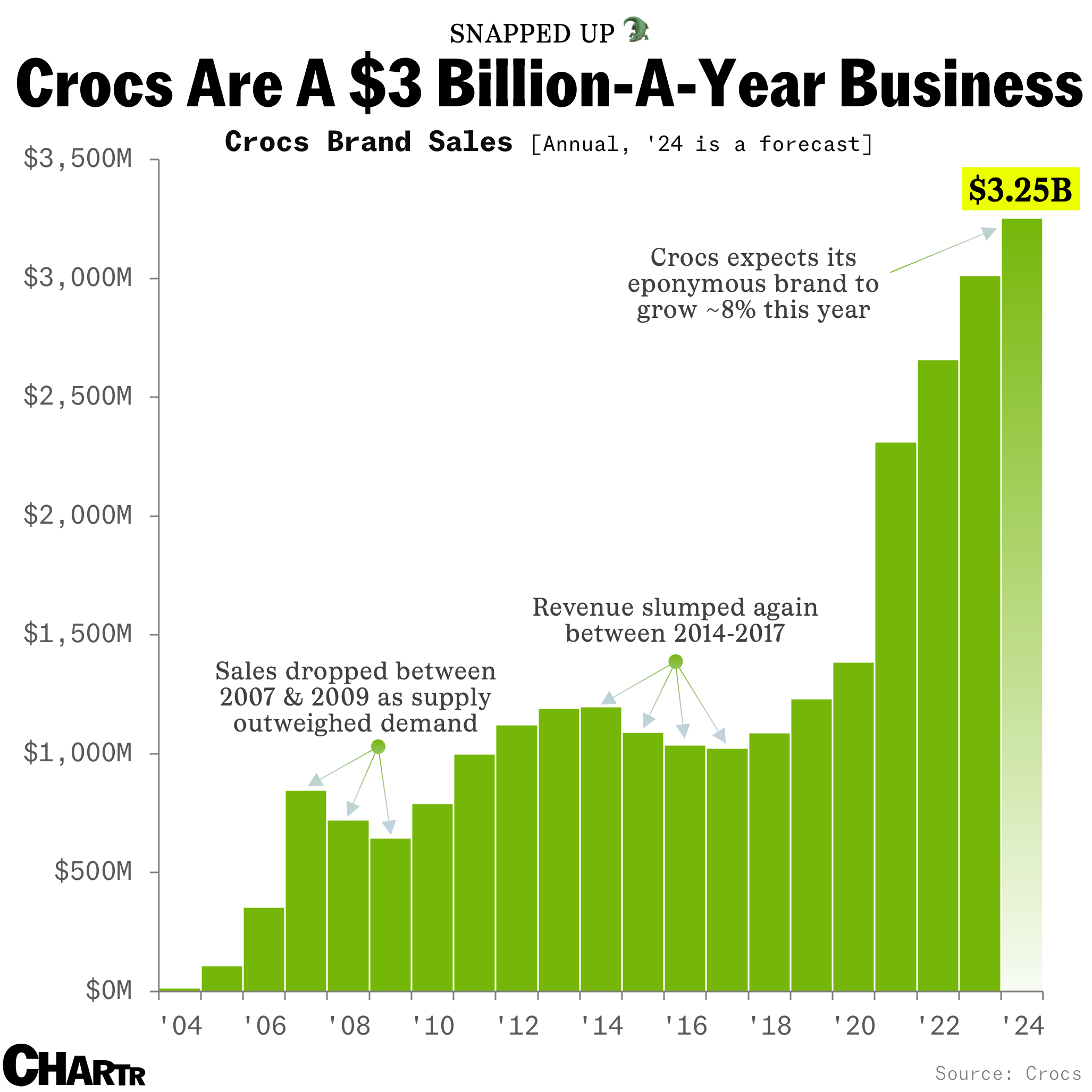
Two weeks ago, Crocs, Inc. reported that sales of its eponymous shoe brand were up ~15% year-on-year in the first quarter of 2024. That took revenues north of $740 million and puts the ugly-comfy shoe company on track to sell more than $3.2 billion worth of foam clogs and Crocs accessories this year, per company forecasts.

First invented 22 years ago, Crocs are no longer the funky new kid on the fashion block. Indeed, the brand has gone through two significant periods of strife, with sales falling for multiple years in a row before bouncing back in each case. Then, in 2021, sales exploded, and the company hasn’t looked back since — so how did Crocs do it?

Comfort mode

In the early days, Crocs sold itself on functionality over form, with the key selling point being the cushioning material they were made from: a proprietary foam resin that the company acquired in 2004 that it called Croslite.

Aesthetically the shoes were brazenly clunky, but that was almost the entire point. They were so not cool by early 2000s standards that just by looking at them the assumption most people made was “oh, they must at least be comfortable”. That selling point proved popular.

In the coming years the company shipped millions of pairs to people who spent a lot of time on boats, at the beach, looking after kids, being a kid, gardening, in kitchens, lounging around the house, or getting their feet wet. Indeed, in the first few years after their release the company’s supply struggled to keep up with demand, with sales growing more than 670% between 2005-2007.
Crocs Sales

But, by late 2007, it was demand that was struggling to keep up with supply. Sales slipped, mountains of unsold foam clogs started piling up — inventories on the company’s balance sheet quadrupled in one quarter in 2007 — and it looked like the swathe of similar shoes from Walmart, Skechers, and others, might sink the brand. Discounting Crocs to clear the inventory hurt the brand substantially, and the company was far from universally loved. There were anti-Crocs Facebook groups with millions of members and a website called “Ihatecrocs.com” that produced videos of people doing things like cutting up Crocs with scissors.

The company had to close manufacturing plants, with its forays into sports gear also ending in unspectacular fashion, and in 2008 the company lost $185M — sparking a series of shareholder lawsuits. In 2009, turnaround specialist John Duerden took the reins for just a year, helping get the company back on its feet. After Duerden stepped down, new management expanded into selling shoes that didn’t look a lot like the original clogs. But, the second slowdown was just around the corner… as sales slipped 3 years in a row and Crocs had to close hundreds of stores.

Perfect pair(s)

But, in late 2016, with sales still sinking, there were 2 glimmers of hope: sales of its Classic Clog were actually up… and the company’s experimental collaboration with luxury designer Christopher Kane had been a hit.

Those two bright spots ended up forming the foundations of a refreshed strategy under new CEO Andrew Rees, who took the top job in June 2017. From functionality to high-fashion-fun, Crocs was about to enter a whole new world.
Crocs searches

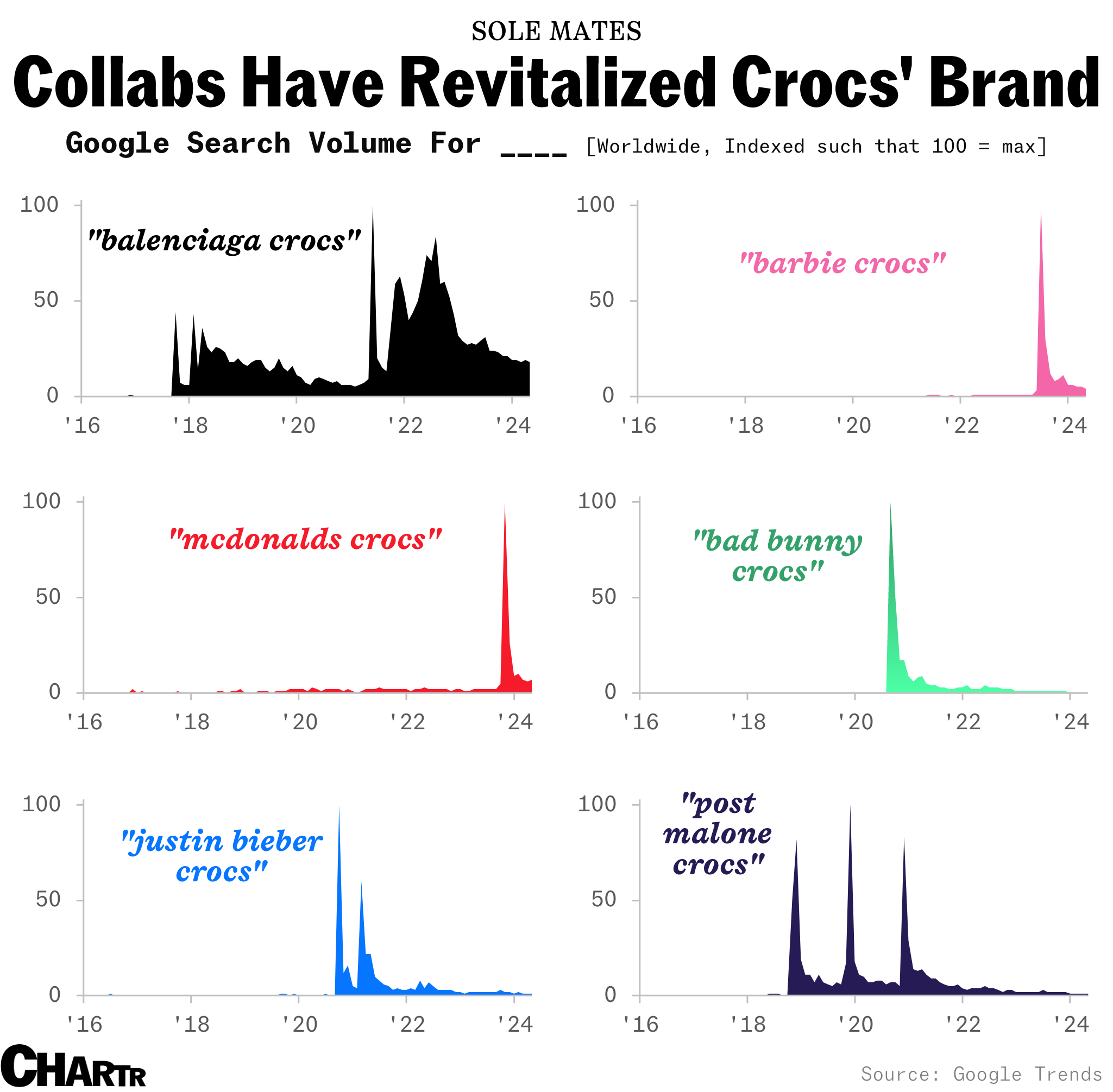
The partnership with Christopher Kane ended up being just the start, as Crocs began to release frequent collabs with major brands and celebrities, including Justin Bieber, Post Malone, McDonald’s, and recently Pringles (yes, the brand you’re thinking of). Arguably most important of all, was when Crocs teamed up with avant-garde fashion house Balenciaga — and so began a collaboration that took the humble Crocs into the world of high-fashion, with a series of rain boots, platform clogs, stilettos, and more.

Many of the collabs are easy to laugh at (do you want a pair of 7-Eleven Crocs?), but the amount of money Crocs is making is no joke, as Gen Z has learned to love the brand. Aided by a pandemic-induced craving for comfort, sales have exploded in the last 3 years, and profits have followed.

Sport mode

There are a lot of ways to measure “how strong is XYZ brand?” In fact, an entire industry of powerpoint-loving consultants have spent years answering that question for marketing executives, building “brand index” measures from a swathe of data. Some are useful, many are overcomplicated and unhelpful. One of the most powerful is simply asking people: “would you ever think of buying this brand”. That’s about as good a measure as any, and in those sorts of studies, such as this one from Morning Consult, Crocs has seen a renaissance.

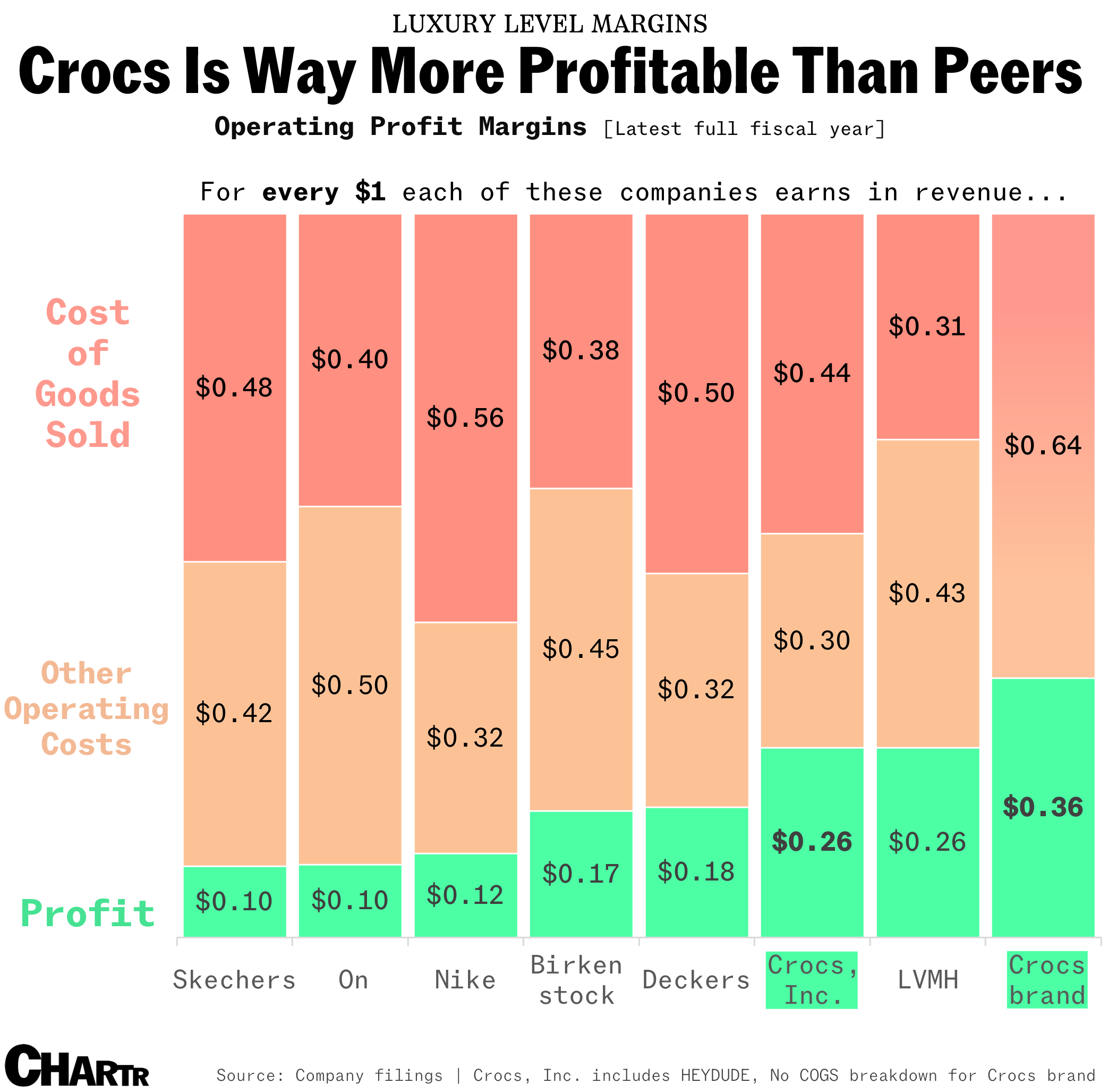
Another — arguably even easier — way to measure brand strength is to ask: how much profit can a company extract from every dollar of sales? Other factors are obviously important, but margins are, quite literally, the bottom line. After you built the thing, spent money on marketing, and sold it to customers, how much did you make? On that measure, Crocs is fierce competition.
Crocs margins

Crocs makes luxury goods level profit margins

Our analysis finds that Crocs is the most profitable of its largest shoe and apparel retail competition… by some distance. For the most recent financial year, Crocs, Inc. made a 26% operating profit margin. That blew shoe rivals like Nike, On Running and Skechers out of the water, and was even higher than what beloved brand Birkenstock managed. It even matches what luxury goods giant LVMH Moët Hennessy – Louis Vuitton (commonly known as LVMH) made last year… a company that sells handbags for $50K+.

In the chart above we’ve plotted Crocs, Inc., which includes the struggling HEYDUDE brand that the company acquired in 2021, and just the Crocs brand… which as a standalone division made an eye-watering 36% operating profit margin.

Crocs didn’t just dip its toe into the world of luxury goods, it dove feet first into the profit pool, and made a big splash.

More Business

See all Business
business
Tom Jones

Prime Day is here again and Amazon’s subscription service has never been more popular

Well, it’s that time of year again: many have made their wish lists, people are scraping together the money they’ve saved to pick out a perfect gift, some are presumably leaving out refreshments for the weary delivery drivers and, more and more, drones.

It’s Amazon Prime Day — meaning that it’s the second day of the four-day promotional event that Amazon still calls Prime Day — of course, and it’s even come early this year, with the company bringing the period into late June from July, when it’s been traditionally held for the last five years.

The Prime Age

Alongside the eyes and endless clicks that the arbitrary stream of listicles on “The Best Prime Day Deals” that almost every media outlet pours into, Amazon will also be cheering the fact that there’s now more Prime users than ever before to devour the retailer and its sellers’ sometimes-contested “discounts.” Indeed, according to the latest annual estimates from Consumer Intelligence Research Partners (CIRP), there were just over 200 million American shoppers using Amazon’s massive subscription service at the end of 2025.

business

Electronic Arts launches a platform to put more ads in its games

Video game publishing giant EA launched a new platform on Monday designed to make the process of selling immersive ad space in its popular games easier.

The company says the platform, called EA Advertising, allows brands to “integrate directly into gameplay through dynamic, real-time placements, from stadium signage to custom in-game content.”

More so than other studios, EA has incorporated advertising into its most popular titles. As Kotaku points out, the company’s ad efforts stretch as far back as 2006. Several of its sports franchises already feature partnerships with brands like Visa, Lowe’s, Red Bull, and PepsiCo.

In-game advertising hasn’t exactly been embraced by fans, but industry experts expect it to ramp up as companies seek more revenue to offset higher games budgets and surging memory costs. EA rival Take-Two has taken a different approach, with CEO Strauss Zelnick recently saying the company was “not at risk of doing brand partnerships” in the forthcoming “Grand Theft Auto VI,” and that ads in full-price games seems “unfair.”

The $55 billion deal to take EA private, led by Saudi Arabia’s Public Investment Fund, is set to close at the end of this month. Being the largest leveraged buyout in history, EA will likely look for more ways to boost revenue to cover interest payments.

More so than other studios, EA has incorporated advertising into its most popular titles. As Kotaku points out, the company’s ad efforts stretch as far back as 2006. Several of its sports franchises already feature partnerships with brands like Visa, Lowe’s, Red Bull, and PepsiCo.

In-game advertising hasn’t exactly been embraced by fans, but industry experts expect it to ramp up as companies seek more revenue to offset higher games budgets and surging memory costs. EA rival Take-Two has taken a different approach, with CEO Strauss Zelnick recently saying the company was “not at risk of doing brand partnerships” in the forthcoming “Grand Theft Auto VI,” and that ads in full-price games seems “unfair.”

The $55 billion deal to take EA private, led by Saudi Arabia’s Public Investment Fund, is set to close at the end of this month. Being the largest leveraged buyout in history, EA will likely look for more ways to boost revenue to cover interest payments.

business

JM Smucker says it sold $1 billion worth of Uncrustables in FY2026

After years of booming sandwich sales, JM Smucker has finally earned a billion-dollar crust.

On Tuesday, the company reported results for fiscal year 2026, highlighting better-than-expected profits driven by higher prices for coffee and sweet baked goods. However, at another point on the earnings call, CEO Mark Smucker pointed to one particularly jammy figure: in line with previous forecasts, the company sold $1 billion worth of its (almost always) crustless sandwiches, Uncrustables, in the last year alone.

business

Paramount reportedly offers concessions to resolve multistate antitrust investigation

Paramount has reportedly offered up some concessions in an effort to prevent an antitrust lawsuit by California and about 10 other states, according to Bloomberg reporting on Monday.

Reuters first reported on the potential suit from a group of unnamed states last week, which could throw a wrench in Paramount’s plans to buy rival Warner Bros. Discovery in a Hollywood megamerger.

The list of concessions is unknown, though Bloomberg previously reported that Paramount is open to divesting some of its kids TV assets to appease EU regulators.

Late last month, reports said US regulators appeared likely to approve the $110 billion merger, following a meeting between Paramount CEO David Ellison and DOJ antitrust staffers.

The list of concessions is unknown, though Bloomberg previously reported that Paramount is open to divesting some of its kids TV assets to appease EU regulators.

Late last month, reports said US regulators appeared likely to approve the $110 billion merger, following a meeting between Paramount CEO David Ellison and DOJ antitrust staffers.

$98B ⛽

The IATA released its latest financial outlook for the airline industry over the weekend, forecasting a $98 billion jump in the sector’s collective fuel bill. The world’s largest trade group representing airlines expects the oil spike to halve profits by 49% from last year to $23 billion.

The group also expects profit margins to halve year over year, falling from 2025’s 4.2% to 2%. Still, revenue is expected to climb to $1.17 trillion from $1.07 trillion.

A surge in the cost of jet fuel has rocked US and global airlines this year, leading Delta Air Lines, United Airlines, American Airlines, Southwest Airlines, JetBlue, and others to raise fares and ancillary charges like bag fees. Low-cost carriers, which operate on smaller margins, have been squeezed the hardest, resulting in Spirit’s shutdown.

“It’s a tough year for all airlines, especially those whose balance sheets had not yet recovered from COVID. And, of course, for those operating in the Gulf,” said IATA Director General Willie Walsh, who added that demand is holding up and about half of passengers expect to spend more on travel this year. “That bodes well for a strong northern summer peak season. The big unknown is how long travelers and shippers can tolerate the higher costs of connectivity.”

Latest Stories

Sherwood Media, LLC and Chartr Limited produce fresh and unique perspectives on topical financial news and are fully owned subsidiaries of Robinhood Markets, Inc., and any views expressed here do not necessarily reflect the views of any other Robinhood affiliate, including Robinhood Markets, Inc., Robinhood Financial LLC, Robinhood Securities, LLC, Robinhood Crypto, LLC, Robinhood Money, LLC, Robinhood U.K. Ltd, Robinhood Derivatives, LLC, Robinhood Gold, LLC, Robinhood Asset Management, LLC, Robinhood Credit, Inc., Robinhood Ventures DE, LLC and, where applicable, its managed investment vehicles.