Rageagainstthemachine

Games Workshop is at war with its biggest “Warhammer” fans
Roughly 5 million people play the tabletop RPG, and 3D printers have become a divisive weapon between the parent company and its most passionate gamers.
If you’ve been a teenage boy, are the parent of a teenage boy, or even just know someone with a teenage boy, chances are you’ve set foot inside one of the 500 or so Games Workshop stores worldwide or one of the 6,500 other hobby stores where its games are sold.
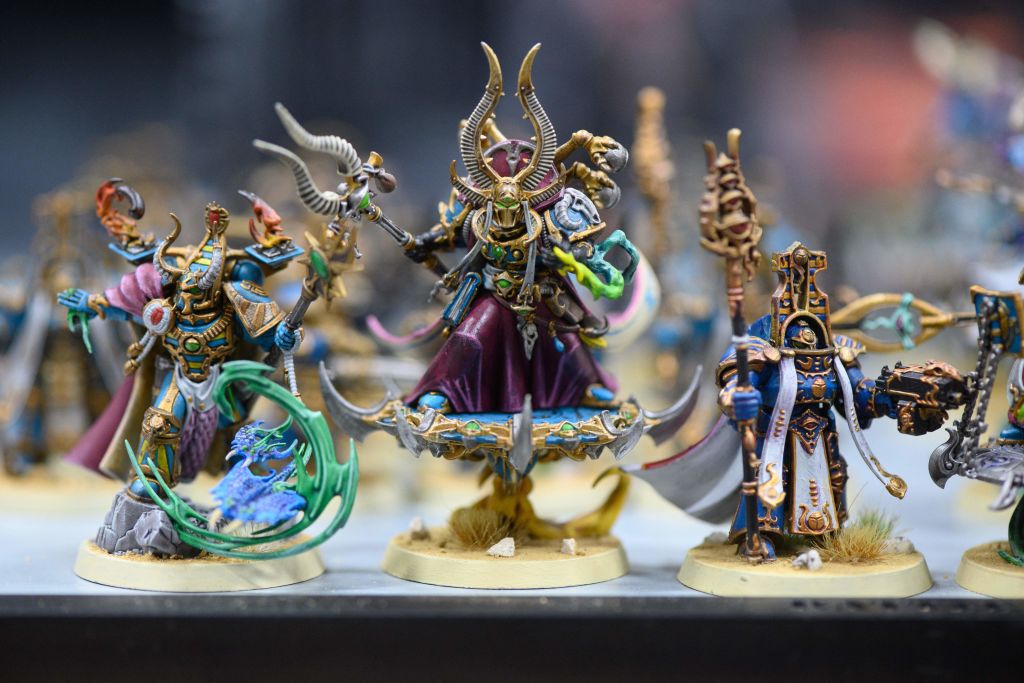
Its most popular is a game called “Warhammer” — and it’s not cheap. As many as 5 million people play the tabletop game, which involves buying small figurines, painting them, and then using them to wage war. A single plastic-and-resin soldier can cost as much as Americans spend on a trip to the grocery store.
Turns out, selling tiny pieces of plastic at premium prices makes for great margins. Games Workshop, the company behind “Warhammer,” made £170 million of profit (or about $215 million at today’s conversion rate) on £471 million ($596 million) of sales in 2023.
“You’ve got one expensive hobby in miniature war-gaming,” said Willard Foxton Todd, a former journalist and a confessed obsessive Warhammer player. Foxton Todd previously worked with Games Workshop in his role as a TV and audio producer.
The price of the hobby is the subject of heated debate among the “Warhammer” community. For some, it’s simply too expensive.
Enter the 3D printer.
Some keen — or copyright-ignoring, depending on who you ask — “Warhammer” players who own 3D printers have started producing versions of the costliest figures, created using models from platforms that sometimes charge subscription fees. Some use their printers to produce add-ons like cool armor, or they create modded soldiers to join their armies for the lols.
Naturally, Games Workshop does not look kindly on attempts to undercut its business.
Last year the England-based company filed 12 lawsuits with the Copyright Claims Board against Eamann M. Ghasemy, who goes by the moniker “EmanG” in the 3D-printing war-gaming community. Earlier this year, the suits were consolidated into a single case against Ghasemy, who Games Workshop alleges ripped detailed models of “Warhammer” figures from the “Total War: Warhammer” video game and converted them into 3D-printer-compatible files and offered them for sale.
“The copyrighted work retails for amounts between $100 and several hundred U.S. Dollars,” Games Workshop wrote in its claim against Ghasemy to the Copyright Claims Board last year. It added, “3D printing has had a significant impact on all forms of intellectual property.”
Platforms like Cults, a 3D-printing models database where users can upload files that tell 3D printers how to produce anything from modular boats to model cars, helped Ghasemy gain an audience, Games Workshop alleges in its complaint.
“Unfortunately we can’t answer any questions related to this topic as we have a confidentiality agreement with the Games Workshop company,” Hugo Fromont, cofounder of Cults, wrote in response to an interview request. “Just know that we work together on a daily basis and that things are running very smoothly.”
Ghasemy declined an interview request to speak for this story on the advice of his attorney. Two fellow 3D printers he recommended speaking to who he said shared his point of view on the situation also declined to comment.
They weren’t alone: the Ghasemy case has spooked the world of “Warhammer” printing enthusiasts, who fear that Games Workshop will crack down on their activities, even when they’re more innocuous.
A fourth 3D printer who produces tabletop-gaming models declined to speak, saying, “I would like to maintain a low profile in this area as it is a sensitive topic, and I do not want to compromise [my work] or draw excessive attention from GW.”
One person who was willing to speak was the pseudonymous Astro Knight Miniatures.
He said that copying miniatures was not a new concern for Games Workshop that arrived with the advent of 3D printers. “People have been molding and copying ‘Warhammer’ minis since before 3D printers,” he said. “What people did, prior to 3D resin printers, was they’d buy one set of a faction they wanted to play. Then they’d create molds of the product and pour a resin into the mold. It comes out very similar to the one they bought.”
Astro Knight Miniatures — who even under a pseudonym was hesitant to speak — said the methods aren’t exactly hidden. “There are videos like this all over YouTube,” he said. What’s more, it’s simpler and cheaper to produce resin molds of products than to 3D print them.
It all raises the question: why did Games Workshop target Ghasemy, and why now?
Games Workshop didn’t respond to a request to comment. But it comes down to two factors, reckons intellectual-property lawyer Marty Schwimmer, a partner at New York firm Leason Ellis.
“I don't see how the copyright owner could tolerate that very open commercial use, nor should they, whether they're in the market themselves or not,” Schwimmer said. Choosing not to intervene in what they thought was a breach of their copyright would open up the defense for any future infringers of Games Workshop copyright to claim it was permissible because the company didn’t pursue Ghasemy.
Games Workshop’s IP is one of its core assets — IP or intellectual property are mentioned 38 times in the company’s latest annual report. “In some ways, Games Workshop is a model-soldiers company, but it's also an intellectual-property company,” Foxton Todd said. “There's a lot of a premium on them to defend their intellectual property.”
Foxton Todd also ascribes to the idea of Games Workshop coming down hard on Ghasemy to set a precedent for any future infractions by others. “If they don't defend their intellectual property, then that creates problems for them, in particular in terms of the US legal system and how the US protection of intellectual property works,” he said. “Almost by definition, by being a company that is heavily invested in its own intellectual property, they have got an obligation to defend it.”
Another potential factor is the moneymaking aspect of the situation. In their complaint to the Copyright Claims Board, Games Workshop alleged Ghasemy was making around $6,600 a month from Patreon subscriptions that would allow users to “directly print exact replicas of the copyrighted works of the Claimant.” The number was even higher in January this year, when Ghasemy was making more than $9,000 a month from his Patreon, according to one report.
While that’s small change for Games Workshop, which has a market cap of around $4 billion, it’s still a lot to be making off the back of intellectual property you don’t own the rights to.
The breach is “pretty open and shut” based on what we know, Schwimmer said. “It seems that the fellow here was charging for these figures. It was maybe in a subscription manner, but he was still making commercial use.”
The scale of the enterprise probably won’t make a material difference to Games Workshop’s bottom line — and Foxton Todd, who specialized in 3D printing in his time as a journalist, thinks it never will. He said: “The vast majority of people don't have a 3D printer, the vast majority of people don't want a 3D printer, the vast majority of people don't have the space or patience for a 3D printer.”
As long as that remains the case, Foxton Todd believes Games Workshop’s concerns with 3D printing are more theoretical than practical — at least at the scale the company is alleging. “I think where it is a problem is on the margins,” he said. Recently, Games Workshop has struggled to maintain stock levels at its stores. “If you want to buy Games Workshop models, they are regularly sold out,” he says, which could push some into 3D printing to get copies of the models they want but can’t buy.
The supply shortages are happening for a number of reasons, chief among them a failure to scale production to meet increased demand after lapsed gamers returned to the hobby during the pandemic. The company assumed that once the pandemic ended, those older gamers would give up again. They haven’t.
As a result, 3D-printed alternatives have filled the gap.
Or had filled the gap. In January 2024, Ghasemy posted a message to his Patreon subscribers titled “A Farewell.” He said the copyright case had effectively bankrupted him. Because of requirements put on him by the legal case, he was shutting down his business and removing all the materials that Games Workshop alleges infringed its copyright. “The removed content will not be returning,” he said. Others still print pieces, of course, but they’re much more under the radar now.
“Money was never my first concern,” he wrote, “as creating miniatures and scale models for printing was not only my passion” but a “dream job.”
Looking forward, Ghasemy still has hope.
“Perhaps, some time in the future, the wargaming companies will adapt to these new innovations in the market, but that is unlikely to happen for at least another decade,” he said. “The demand for new models exists, but so does their bottom line. It is unfortunate, but that is the reality that we must all come to terms with.”