
Business

Toy Story

KEEP ON TRUCKIN’
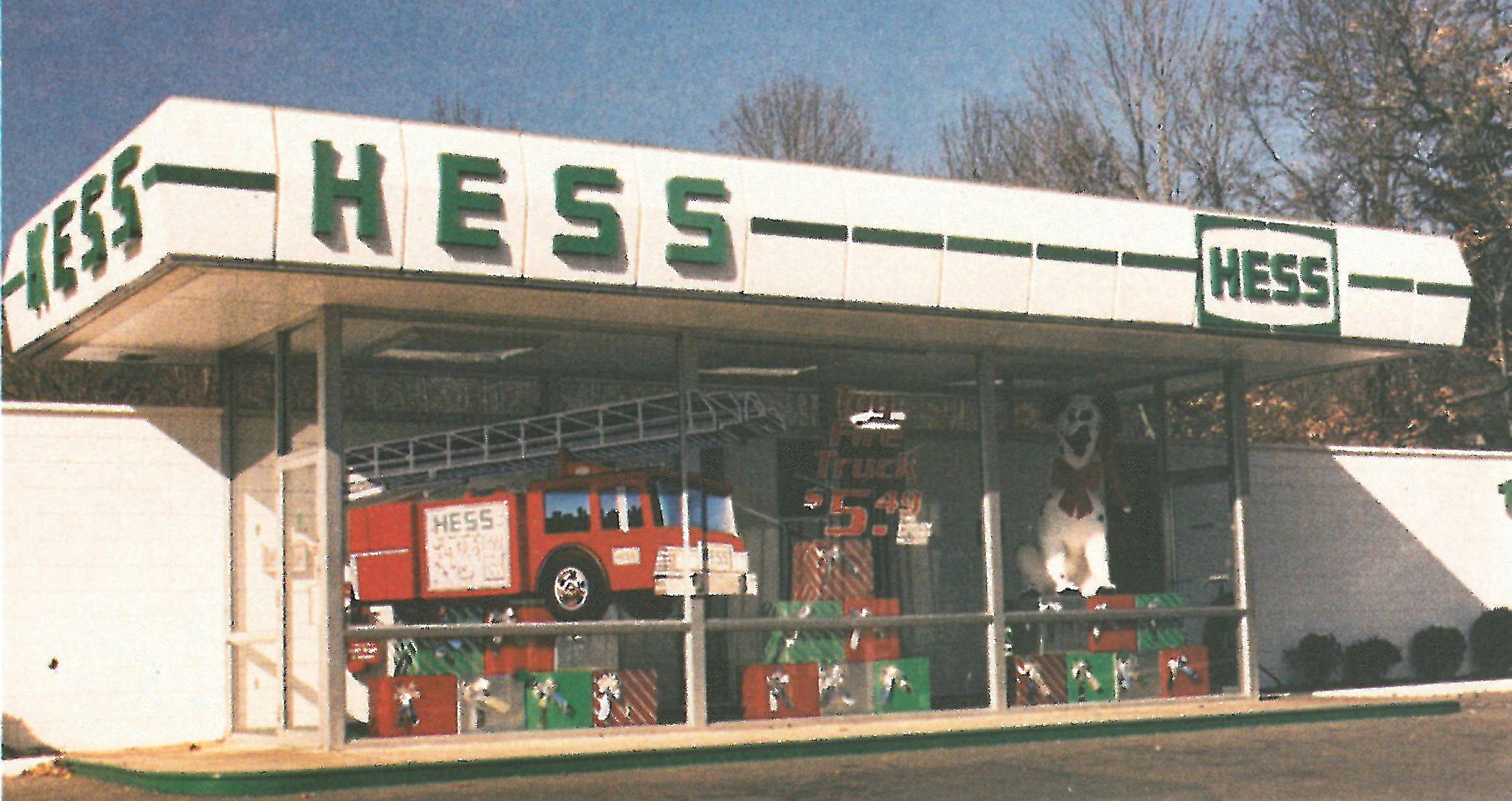
Hess fire truck gas station
A Hess station selling a toy fire truck decades ago (Courtesy of Hess Toy Truck)

How a massive oil-drilling company sells a million kids’ toys a year

Hess trucks remain one of the hottest Christmas toys on the planet, delighting children and fueling a rabid collectors’ market.

John Kell

On the day that oil giant Chevron disclosed it would acquire Hess in a merger deal valued at $53 billion, Hess issued a separate but equally significant press release.

“An Important Hess Announcement,” read the October 2023 statement, which wasn’t filed with the Securities and Exchange Commission but could move the market — the toy-collectibles market, that is. “We want to assure all of you that the Hess Toy Truck, a long-standing, cherished tradition, will continue on for future years!”

For its everyday business, Hess is a huge oil and gas producer that ranks 378th on the Fortune 500. It jams gargantuan drills into the ground and builds towering steel rigs offshore in the Gulf of Mexico to extract crude oil and natural gas from the ground. It even explores for petroleum products in places like Guyana and Malaysia. 

Oh, and it also makes some of the hottest Christmas toys on the planet.

Every year, Hess sells over 1 million toys, largely around the holiday season, and it claims to be the largest direct-to-consumer toy seller in America. Doing some back-of-the-envelope math, with a selling price of $46 each for the flagship Hess toy truck, you could ballpark the company at around $46 million in revenue from toys each year — much lower than what it gets from drilling, but still not an insignificant chunk of change. 

Hess trucks are its best-known product, but the company has also made helicopters, trains, space shuttles, and basically any vehicle that rolls or flies. 

“It’s not competitive with anything else,” said Christopher Byrne, a toy-industry expert known as “The Toy Guy.” Hess trucks sit somewhere between Tonka, Green Toys, and branded construction toys from John Deere, Caterpillar, and corporate offshoots from the likes of McDonald’s, which launched Happy Meal toys in 1979.

Credit for this unusual side business goes to the energy producer’s founder, Leon Hess, who grew up during the Great Depression and began a heating-oil delivery company in New Jersey in 1933. In 1960 the company opened its first Hess-branded gas station and four years later began selling its first toy, a Hess Tanker Trailer. Every year since, in time for the holidays, Hess rolls out a new truck. 

Hess got the idea to begin making toys after a meeting with toy manufacturer Louis Marx and Co., which later sold to Quaker Oats and was liquidated in 1980. Hess trucks, despite being wildly popular, have remained quite distant from the rest of the toy world. They’ve never been connected to the industry’s titans, Mattel and Hasbro, nor sold in any retailer — not even Toys R Us. For the first 50 years, the only way to buy a Hess Toy Truck from the company was to visit a local gas station.

“He thought it would be a really great way to thank his gas-station customers,” Justin Mayer, general manager of Hess Toy Trucks, said. “One of the reasons I love the job is because I feel a little bit like Santa.”

The original 1964 Hess Tanker Trailer, a replica of the company’s B61 Mack truck and trailer, had working headlights and a rubber hose, rare for toys sold at the time. It sold for $1.29 (some collectors say $1.39), which is worth roughly $13 today. Hess’ marketing evolved from newspaper ads to television commercials that began to air in 1980. The toy even got a jingle: “The Hess Truck’s back and it’s better than ever!” 

The annual release proved so popular that each Thanksgiving weekend, traffic would engulf Hess stations across New Jersey. It became such a hassle that the Garden State’s then governor, Thomas Kean, asked Leon Hess to move the launch date. He wanted to avoid paying state troopers overtime.
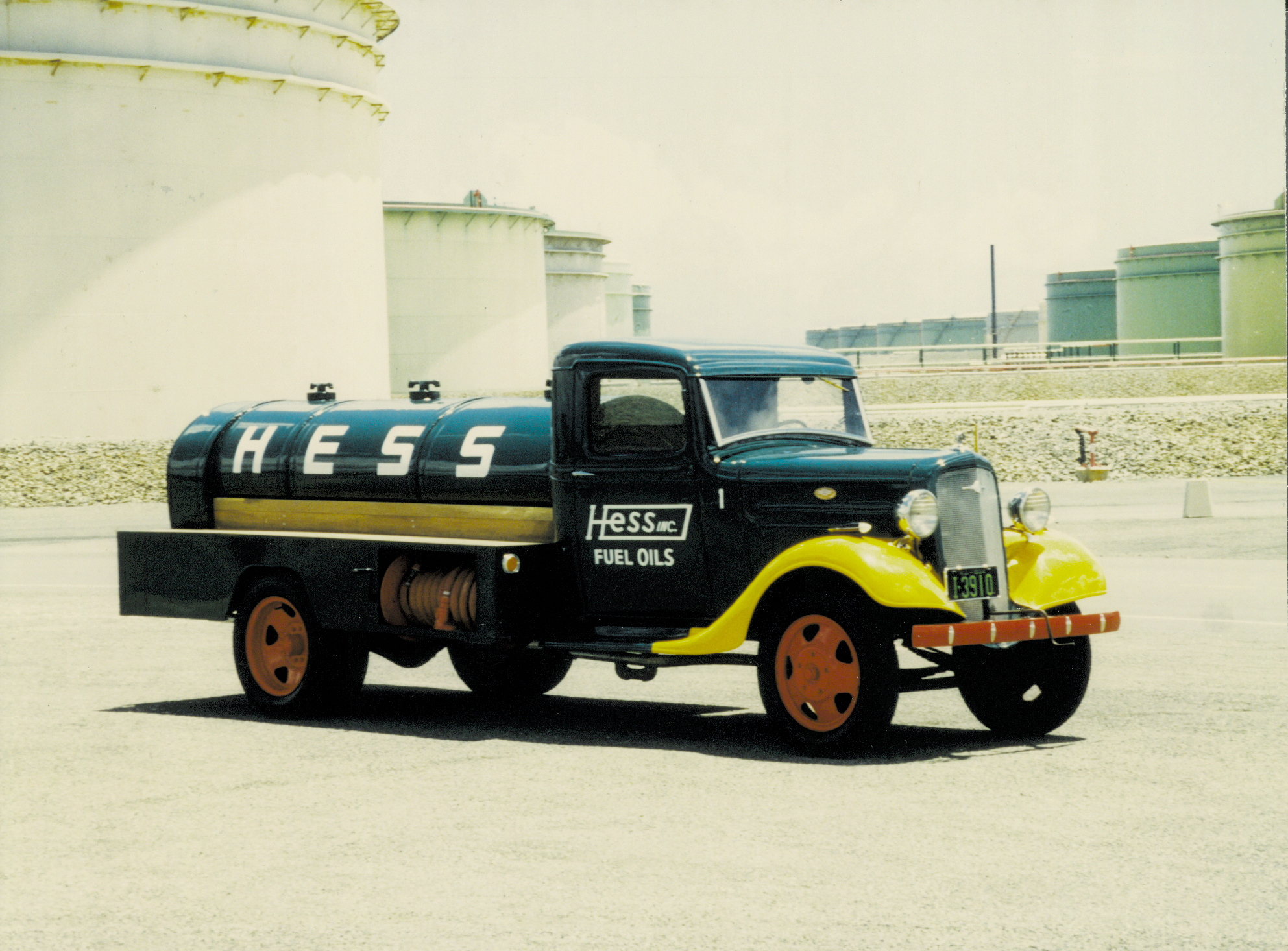
Original Hess truck
The original Hess truck, which toys have been modeled after (Courtesy of Hess)

Hess now launches the holiday toy in October, and this year is selling a Hess fire truck that comes with a car and motorcycle and retails for $45.99. The newest rig comes as Hess’ deal with Chevron is trucking along, winning conditional Federal Trade Commission approval in late September.

Since 1998, Hess expanded the toy portfolio and now sells a miniature collection, plush toys meant for younger children, and premium-priced toys for collectors. “When they’re sold out, that’s it,” Mayer said.

Mayer has worked at Hess since 2007, primarily in marketing roles associated with the gas-station and convenience-store businesses, but he became fully focused on the toy trucks after Hess sold the company’s gas stations to Speedway. That led to another freak-out among fans, resulting in Hess having to publicly offer reassurance that the toy trucks would retain their branding even after the gas stations were renamed.

If Mayer is Hess’ Santa, then Michael Roberto is “Father Hess.” Roberto’s the author of a self-published Hess Toy Truck encyclopedia that’s meant to guide collectors. “We’re all still kids inside,” Roberto said. 

His introduction to the brand was a cherished memory with his father, who took him to a Hess station in the Bronx and bought him the toy truck that would remain his lifetime favorite, the 1977 Hess Tanker Truck. 

“Little did my dad know that that one little, simple act of taking me to go get a Hess truck would shape my life,” Roberto said. 
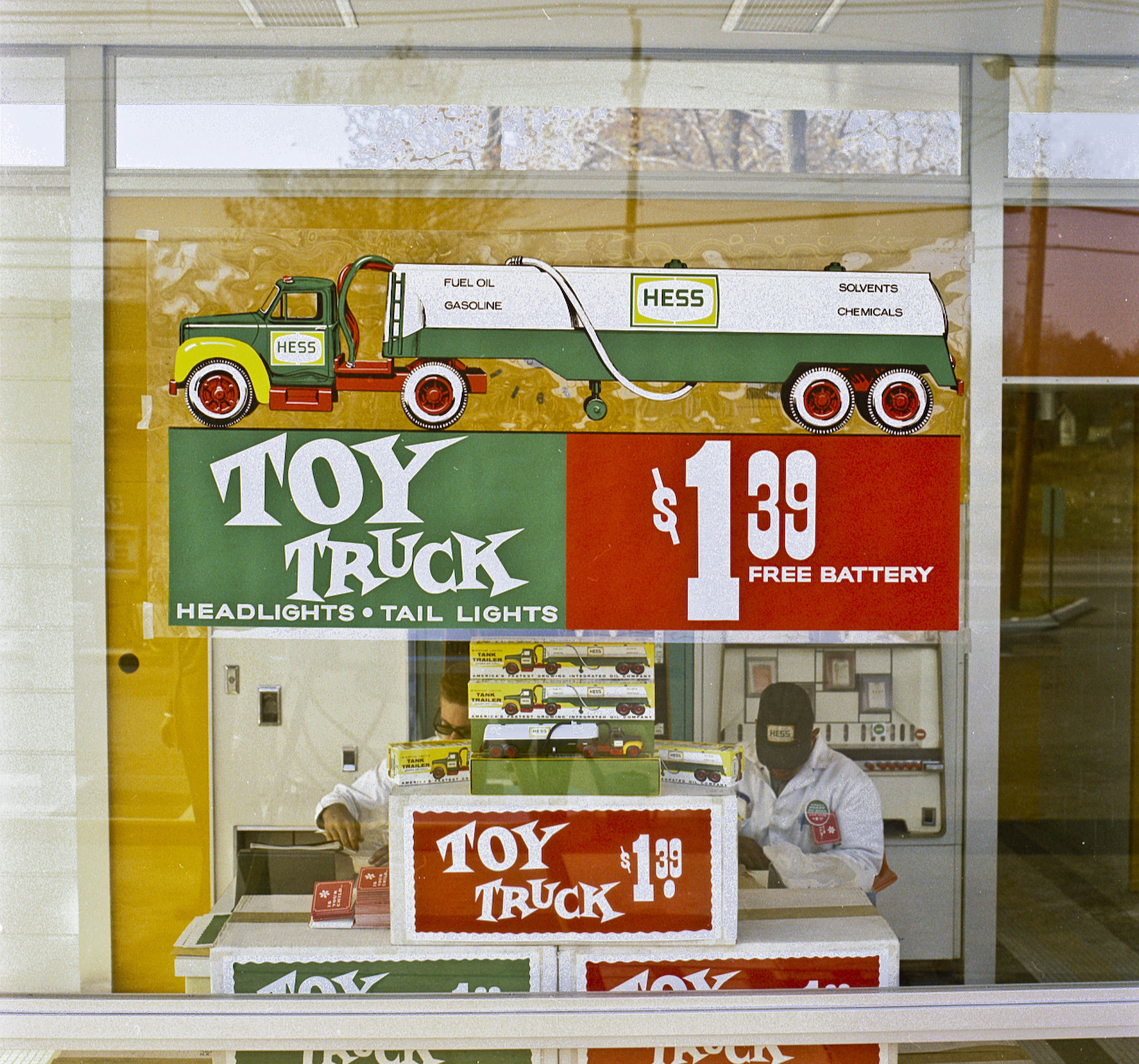
An old ad for Hess trucks.
(Courtesy of Hess)

At one point Roberto owned three versions of every annual release from Hess. One toy would remain untouched in the box, another would be placed in an airtight display case, and a third would be opened for his children to play with. But when Roberto was stung badly by the 2008 financial crisis, he was forced to sell some of his prized possessions to cover expenses.

There’s also a rabid market for Hess truck collectors. The highest known price for a Hess toy truck sold online between two collectors is $12,000, for a rare 2003 Hess truck and racer set. 

Jack McCaffrey, a 25-year-old schoolteacher in New Jersey, recalled that he once had an opportunity to complete his Hess toy collection, but at a staggering price of $3,000. McCaffrey received his first Hess toy in 1999, the year of his birth, and has collected every holiday truck ever since. One glaring omission from the collection he’s amassed so far: the original 1964 Hess Tanker Trailer.

“There’s something oddly charming about Hess,” McCaffrey said. “It appeals to that part of all of us that doesn’t want to grow up.” 

He has backfilled his collection and now owns every holiday launch since 1980, as well as the 1977 Hess Tanker Truck. McCaffrey also runs a Hess fan page on YouTube, where he reviews each Hess toy he owns.

Completing his collection is only a matter of time. But the more pressing issue is that he would like to move out of the home he shares with his parents. 

McCaffrey said, “It’s really a question of, where does my toy collection go when I move out?”

John Kell is a New York-based freelance writer, covering consumer trends, technology, leadership, and sustainability. He has reported for Fortune Magazine, Business Insider, Fast Company, Forbes, and The Wall Street Journal.

More Business

See all Business
business
Tom Jones

Prime Day is here again and Amazon’s subscription service has never been more popular

Well, it’s that time of year again: many have made their wish lists, people are scraping together the money they’ve saved to pick out a perfect gift, some are presumably leaving out refreshments for the weary delivery drivers and, more and more, drones.

It’s Amazon Prime Day — meaning that it’s the second day of the four-day promotional event that Amazon still calls Prime Day — of course, and it’s even come early this year, with the company bringing the period into late June from July, when it’s been traditionally held for the last five years.

The Prime Age

Alongside the eyes and endless clicks that the arbitrary stream of listicles on “The Best Prime Day Deals” that almost every media outlet pours into, Amazon will also be cheering the fact that there’s now more Prime users than ever before to devour the retailer and its sellers’ sometimes-contested “discounts.” Indeed, according to the latest annual estimates from Consumer Intelligence Research Partners (CIRP), there were just over 200 million American shoppers using Amazon’s massive subscription service at the end of 2025.

business

Electronic Arts launches a platform to put more ads in its games

Video game publishing giant EA launched a new platform on Monday designed to make the process of selling immersive ad space in its popular games easier.

The company says the platform, called EA Advertising, allows brands to “integrate directly into gameplay through dynamic, real-time placements, from stadium signage to custom in-game content.”

More so than other studios, EA has incorporated advertising into its most popular titles. As Kotaku points out, the company’s ad efforts stretch as far back as 2006. Several of its sports franchises already feature partnerships with brands like Visa, Lowe’s, Red Bull, and PepsiCo.

In-game advertising hasn’t exactly been embraced by fans, but industry experts expect it to ramp up as companies seek more revenue to offset higher games budgets and surging memory costs. EA rival Take-Two has taken a different approach, with CEO Strauss Zelnick recently saying the company was “not at risk of doing brand partnerships” in the forthcoming “Grand Theft Auto VI,” and that ads in full-price games seems “unfair.”

The $55 billion deal to take EA private, led by Saudi Arabia’s Public Investment Fund, is set to close at the end of this month. Being the largest leveraged buyout in history, EA will likely look for more ways to boost revenue to cover interest payments.

More so than other studios, EA has incorporated advertising into its most popular titles. As Kotaku points out, the company’s ad efforts stretch as far back as 2006. Several of its sports franchises already feature partnerships with brands like Visa, Lowe’s, Red Bull, and PepsiCo.

In-game advertising hasn’t exactly been embraced by fans, but industry experts expect it to ramp up as companies seek more revenue to offset higher games budgets and surging memory costs. EA rival Take-Two has taken a different approach, with CEO Strauss Zelnick recently saying the company was “not at risk of doing brand partnerships” in the forthcoming “Grand Theft Auto VI,” and that ads in full-price games seems “unfair.”

The $55 billion deal to take EA private, led by Saudi Arabia’s Public Investment Fund, is set to close at the end of this month. Being the largest leveraged buyout in history, EA will likely look for more ways to boost revenue to cover interest payments.

business

JM Smucker says it sold $1 billion worth of Uncrustables in FY2026

After years of booming sandwich sales, JM Smucker has finally earned a billion-dollar crust.

On Tuesday, the company reported results for fiscal year 2026, highlighting better-than-expected profits driven by higher prices for coffee and sweet baked goods. However, at another point on the earnings call, CEO Mark Smucker pointed to one particularly jammy figure: in line with previous forecasts, the company sold $1 billion worth of its (almost always) crustless sandwiches, Uncrustables, in the last year alone.

business

Paramount reportedly offers concessions to resolve multistate antitrust investigation

Paramount has reportedly offered up some concessions in an effort to prevent an antitrust lawsuit by California and about 10 other states, according to Bloomberg reporting on Monday.

Reuters first reported on the potential suit from a group of unnamed states last week, which could throw a wrench in Paramount’s plans to buy rival Warner Bros. Discovery in a Hollywood megamerger.

The list of concessions is unknown, though Bloomberg previously reported that Paramount is open to divesting some of its kids TV assets to appease EU regulators.

Late last month, reports said US regulators appeared likely to approve the $110 billion merger, following a meeting between Paramount CEO David Ellison and DOJ antitrust staffers.

The list of concessions is unknown, though Bloomberg previously reported that Paramount is open to divesting some of its kids TV assets to appease EU regulators.

Late last month, reports said US regulators appeared likely to approve the $110 billion merger, following a meeting between Paramount CEO David Ellison and DOJ antitrust staffers.

$98B ⛽

The IATA released its latest financial outlook for the airline industry over the weekend, forecasting a $98 billion jump in the sector’s collective fuel bill. The world’s largest trade group representing airlines expects the oil spike to halve profits by 49% from last year to $23 billion.

The group also expects profit margins to halve year over year, falling from 2025’s 4.2% to 2%. Still, revenue is expected to climb to $1.17 trillion from $1.07 trillion.

A surge in the cost of jet fuel has rocked US and global airlines this year, leading Delta Air Lines, United Airlines, American Airlines, Southwest Airlines, JetBlue, and others to raise fares and ancillary charges like bag fees. Low-cost carriers, which operate on smaller margins, have been squeezed the hardest, resulting in Spirit’s shutdown.

“It’s a tough year for all airlines, especially those whose balance sheets had not yet recovered from COVID. And, of course, for those operating in the Gulf,” said IATA Director General Willie Walsh, who added that demand is holding up and about half of passengers expect to spend more on travel this year. “That bodes well for a strong northern summer peak season. The big unknown is how long travelers and shippers can tolerate the higher costs of connectivity.”

Latest Stories

Sherwood Media, LLC and Chartr Limited produce fresh and unique perspectives on topical financial news and are fully owned subsidiaries of Robinhood Markets, Inc., and any views expressed here do not necessarily reflect the views of any other Robinhood affiliate, including Robinhood Markets, Inc., Robinhood Financial LLC, Robinhood Securities, LLC, Robinhood Crypto, LLC, Robinhood Money, LLC, Robinhood U.K. Ltd, Robinhood Derivatives, LLC, Robinhood Gold, LLC, Robinhood Asset Management, LLC, Robinhood Credit, Inc., Robinhood Ventures DE, LLC and, where applicable, its managed investment vehicles.
