America loves instant noodles
We started slurping more during the pandemic. Now two titans of the instant-noodle industry can’t stop building new factories in the US.
Grant MacGillivray has a noodle problem. Well, it’s less a problem and more just a habit of slurping down noodles.
A solutions architect from Portland, Oregon, he has avoidant/restrictive food intake disorder. “Essentially, imagine if your kid entered their picky-eating phase and never left,” he said. “My brain simply would not let me try new foods without a full-on panic attack.”
MacGillivray has spent a lot of time trying to retrain his brain’s response to unusual foods and has managed to diversify his diet somewhat, but he still largely sticks to a handful of the same, safe foods he eats every day.
“One of those foods is specifically chicken instant ramen,” he said. “I eat it probably at least every other day, usually as a quick-and-easy snack to satisfy my eternal craving for salty carbs.”
MacGillivray isn’t picky about the brand but prefers Nissin Foods’ noodles — though he won’t turn down Maruchan, made by competitor Toyo Suisan. He said Nissin’s noodles come out a little less slimy.
“Mostly I just like how cheap and easy it is,” he said. “It’s a very fast way to satisfy a salty, savory craving.”
He’s not alone. One in four US consumers — and three in 10 Canadians — eats instant noodles, market-research company Mintel said. Euromonitor International said the US instant-noodles market has grown 36% in the past five years, and was a $2.7 billion market in 2023. The US sits sixth on the World Instant Noodle Association’s demand rankings table, which measures the number of servings consumed per country. The US is behind China, Indonesia, India, Vietnam, and Japan, but ahead of the Philippines and South Korea.
Noods are big business, with Toyo Suisan and Nissin vying for supremacy among American palates. They’re joined by upstart competitors, including South Korea’s Nongshim, which splits the two Japanese manufacturers that sit in first and third place. And while the majority of customers for instant noodles remain in Japan and Asia more widely, there’s a booming market in the US that both companies are trying to keep on top of.
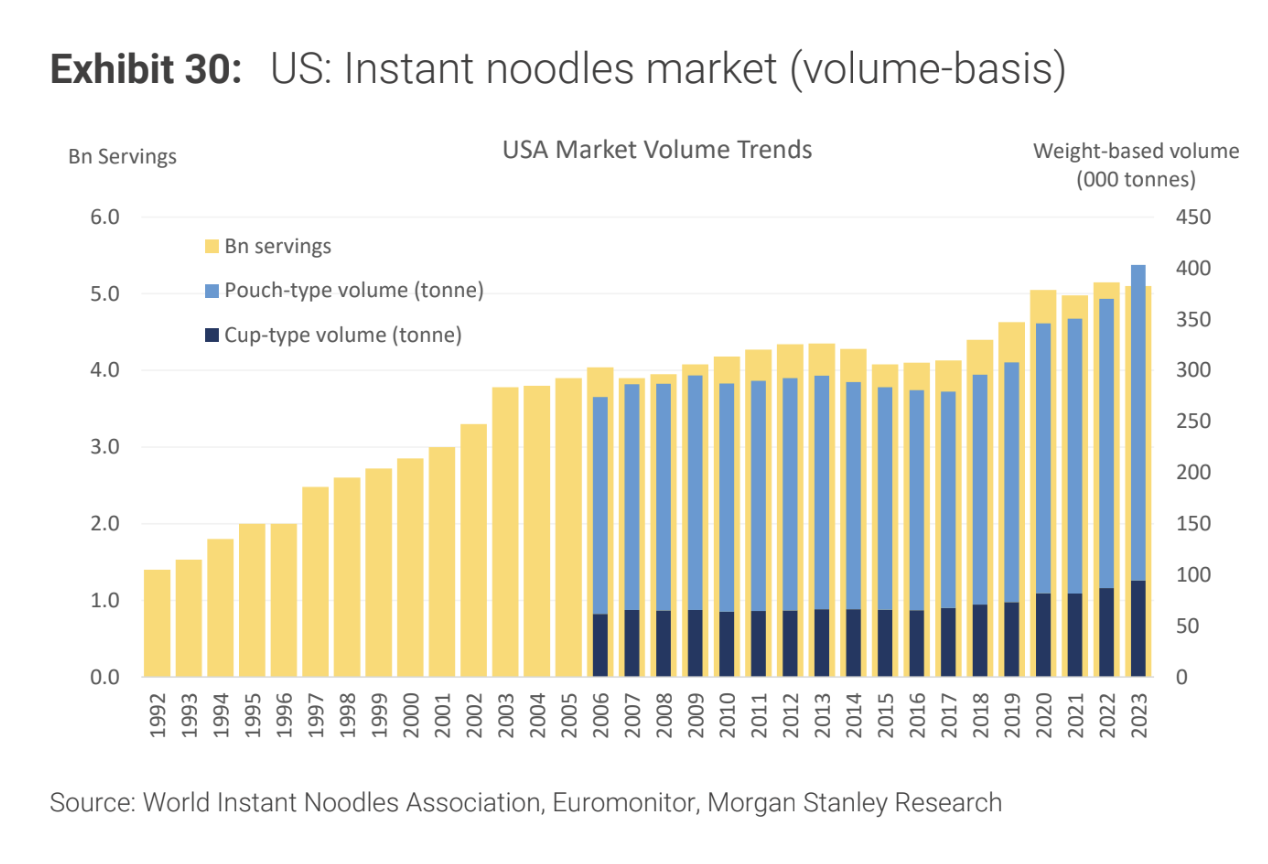
The US is a big consumer of instant noodles. More than 5 billion servings of noodles a year are eaten here, Euromonitor found, up from fewer than 3 billion in 2000. And this chart from Morgan Stanley shows just how much the market is growing in America.
Taylor Rioux, a gamer, dad, and husband, has eaten instant noodles for as long as he can remember.
“I grew up poor in a very small town with a big family,” said Rioux, who was one of five children. “We were kind of left to tend for ourselves in that regard.”
The habit of boiling water and making a pack of noodles — always a bulk package of Maruchan, with Rioux preferring the chicken flavor over beef — continued through college, though it dropped off when he started earning more money.
“Not out of principle or anything,” Rioux was quick to clarify. “I just had more time and funds to cook and experiment with food.”
That changed again when Rioux’s son was born a few years ago. Time became short. Rather than returning to Maruchan, Rioux began buying packets of Buldak, a spicy instant noodle made by another competitor, South Korea’s Samyang Foods. Samyang is South Korea’s largest noodle company, but its smaller competitor, Nongshim, holds a top-three place in the US market, with roughly a 25% market share.
“We don’t really get to make very spicy food at home anymore, and I really love spicy food,” he said. Now he’s back to three or four packets of noodles a week. “It’s so quick to make, and really convenient,” Rioux said. “It allows me to get something spicy while navigating the demands of my work and fatherhood.”
The already booming noodle business took off even more during the pandemic era, as consumers turned to noodles as a quick, satisfying way to fill themselves at a time when everyone’s pep took a hit. The fact that instant noodles are cheap also helped as folks lost work and struggled to make ends meet. As lockdowns took hold and grocery shelves grew sparse, instant noodles’ affordability and long shelf life made them an ideal choice for many.
The number of servings per capita in the US rose from 13.4 in 2018 to 14 in 2019, before ballooning to 15.2 servings a year in 2023, suggesting Americans stuck with instant noodles after trying them. Recent research by YouGov showed that 69% of Americans have heard of Maruchan (made by Toyo Suisan), and 45% of them have heard of Nissin’s cup noodles.
On top of that, the portion of American adults who would consider dropping a packet or two of Maruchan into their shopping cart has increased from 16.9% in 2019 to 21.9% in 2024 — a 30% jump.
Nissin has seen similar growth in interest, albeit from a smaller base: 8.8% of consumers who would consider them in 2019 has become 11.3% today. For manufacturers, the surge in demand wasn’t just a temporary spike, but represented a significant expansion of the market base. Many of the consumers who turned to instant noodles during the pandemic became repeat customers, a trend that’s persisted even as the world has returned to some sense of normality.
Popularity bred success for some of the world’s biggest noodle manufacturers, and price increases for customers. The average sales price for 100 grams of noodles in the US has risen nearly 50%, Euromonitor data showed, from about $0.46 to $0.66. Noodle cups are a more premium product, costing about $1.20 per 100 grams, compared to $0.50 per 100 grams of pouch-based product. That cost disparity matters: roughly 75% of noodle sales by volume are from pouches rather than cups.
Recognizing that American palates have become a major source of income, big manufacturers have started catering more to the US market. About 29% of Toyo Suisan’s sales are made in the US, Morgan Stanley estimated, with an additional 17% of their sales coming from Mexico and Central and South America.
Toyo Suisan is a bigger name outside its native Japan than it is inside the country: while 46% of sales come from the Americas, just 20% of the company’s sales come from the domestic market. Nissin Foods is less reliant on the US for its income, with Morgan Stanley estimating that 22% of its total income comes from the Americas — far less than the 37% it makes from instant noodles in its home market. Neither of the big two noodle companies elected to speak for this story.

Traditionally, both companies have shipped their noodles from manufacturing facilities around the world to the US. But as we’ve become more accustomed to slurping down noodles, both companies have felt more confident onshoring their production to the States.
Toyo Suisan, whose Maruchan brand dominates much of the American market, has been expanding its California plant, aiming to increase capacity by 20%.
Its plant in Irvine, California, spans over 400,000 square feet and runs two shifts for 482 employees working on six production lines, the firm disclosed in response to an attempt to block the expansion. It wants to add 227,000 square feet to the factory floor, which would make space for three additional production lines and 191 new employees.
The company’s strategic move is intended to serve both the US and the growing Mexican market, where its products are also in high demand. Operations on the new production lines could begin in the first half of 2026, once construction is complete.
Meanwhile, Nissin started construction last December on a third US facility in South Carolina, complementing its existing plants in California and Pennsylvania. The new factory, set to open next August, will feature advanced automation technologies and specialized equipment for producing premium noodle varieties. Spreading its factories across the country is expected to improve logistics efficiency for the company, which is firmly behind Toyo Suisan in the US, and boost production capacity, making it easier for Nissin to keep up with continued demand. The $228 million facility will have a 640,000-square-foot factory floor.
Those plants will be needed.
“Instant noodles demand surged during the pandemic and sales volume has since been solid thanks to a broad perception of instant noodles as an affordable meal in globally inflationary times,” wrote Haruka Miyake, an equity analyst at Morgan Stanley who studies the instant-noodles market.
“Demand in the US has remained elevated amid an inflationary environment, suggesting that new customers for instant noodles have become repeat customers.”.
The fact that prices are rising hints at a change in perception of instant noodles, too.
“The stigma surrounding them has lessened over time,” Rioux said. “I remember when I was young, it was almost exclusively considered ‘poor-people food,’ but I don’t hear much of that language anymore.”
Instead, they’re a food product to meet the modern American adult’s needs — though that in itself isn’t always a good thing.
“Americans today work longer hours for less relative pay. Our lives have shifted to a more on-the-go style, and we’re always connected via the internet,” Rioux said.
“Instant noodles being quick and easy fits in really well with the lifestyles we live, and they’re incredibly cheap to buy.”
So we’ll keep on buying them.
Chris Stokel-Walker is a UK-based journalist. His latest book is How AI Ate the World.