“Magic: The Gathering” is just the tip of a $1 billion digital iceberg
Hasbro’s gaming ambitions are the key to its future success
Hasbro recently celebrated its 100th anniversary, cementing its position as one of the country’s most venerable brands. Toy lines like Mr. Potato Head, G.I. Joe, Play-Doh, My Little Pony, and Transformers helped power it through the 1960s, ’70s, ’80s, and beyond. But now the company is in the midst of a dramatic expansion of its focus, a transition that may change the historic brand fundamentally from a “toy and game company” to a game and toy company.
Under the leadership of Chris Cocks, who was promoted to CEO in 2022, Hasbro’s toy business has continued to take it on the chin. In July, during a Q2 earnings call with investors, the company reported a year-to-date decline in adjusted revenues for its Consumer Products division of about 16%, an even worse result than the 4% decline in the previous quarter. That wasn’t entirely due to the ongoing tariffs debacle, but it certainly didn’t help any. It’s just that parents aren’t buying as many traditional physical toys for their kids as they used to.
Nevertheless, Hasbro is adapting reasonably well. Cocks actually raised his top- and bottom-line guidance for 2025 on that same Q2 call. The reason for his bullishness? Hasbro’s gaming division — dubbed Wizards & Digital — is absolutely crushing it, with a total revenue increase for that division of 28% year to date, driven in no small part by hit trading card game “Magic: The Gathering,” which now appears to account for a tremendous portion of the company’s quarterly profits.

But Hasbro’s Wizards & Digital division has even more cards up its sleeve, specifically a massive strategic investment in four high-end video game studios. It represents something like a $1 billion play, according to a GamesIndustry.biz story from last year.
Here’s how Hasbro is beginning to chart a new course — both in tabletop and online gaming — and what to keep an eye out for in its next report.
“Magic: The Gathering” continues to grow with Universes Beyond
“Magic” is, at its core, both a complex strategy game and a compelling storytelling engine. Players put cards onto the table representing spells that they cast, either offensively or defensively, against their opponents. Traditionally, those spells have always had their origins in the game’s ongoing storyline, which pits powerful mythical characters against one another for the fate of its massive multiverse. Those characters are in turn supported by additional content, including novels, short stories, and an upcoming Netflix animated series. To be a fan of the game is therefore to be a fan of building decks with specific tactical approaches to the game, and also a fan of consuming all that delicious lore. But that lore is getting a bit cluttered thanks to an initiative called Universes Beyond.
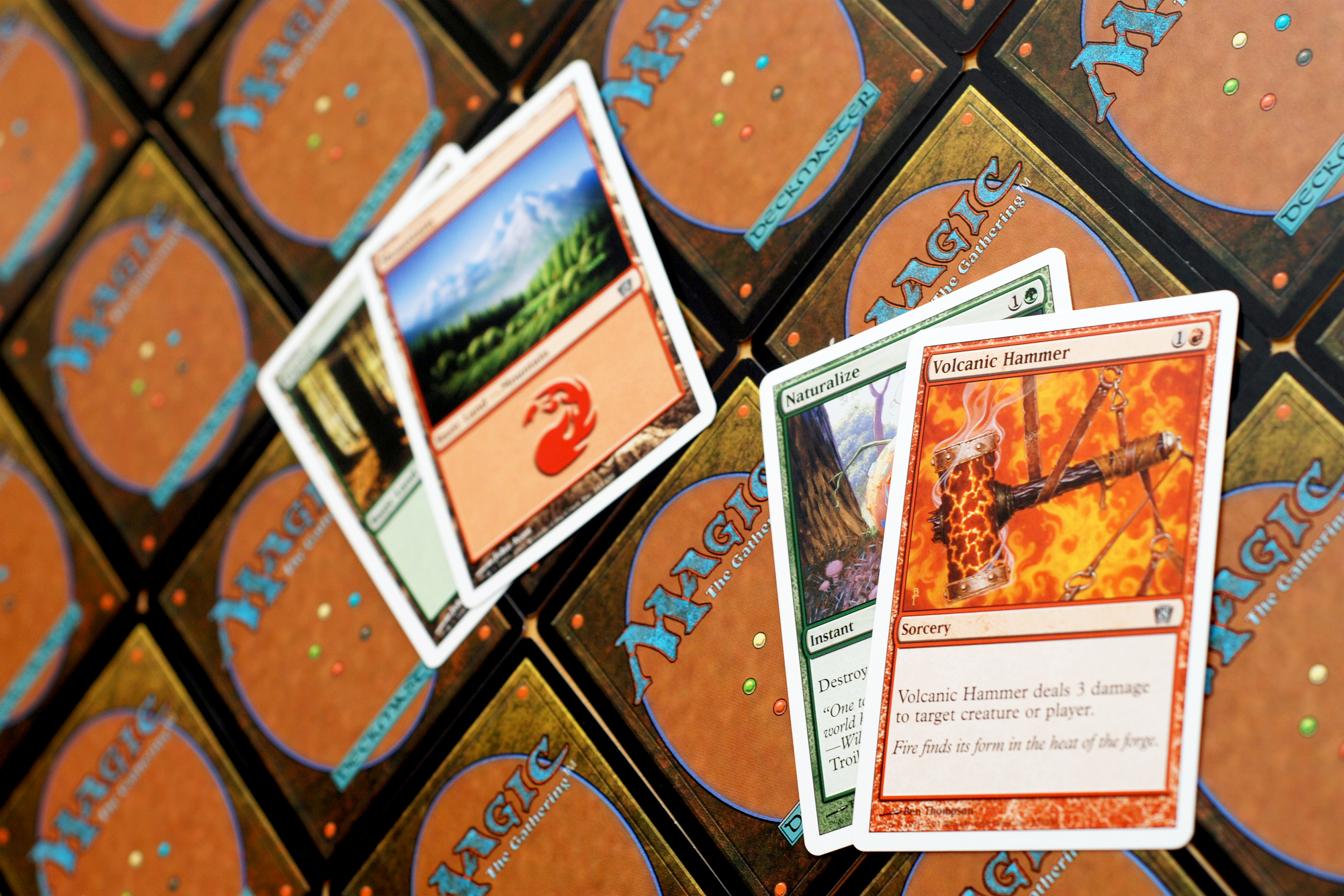
Announced in February 2021, Universes Beyond adds cards to “Magic” that don’t originate from its own native storyline. Instead, these licensed sets include characters and narratives from other brands entirely. So far that’s included everything from the “Assassin’s Creed” and “Fallout” video game franchises to television series like “Doctor Who” and most recently Marvel’s “Spider-Man.” Today, fans of the original trading card game can put classic characters like Chandra Nalaar and Jace Beleren to work against Inquisitor Gregor Eisenhorn of “Warhammer 40,000” and Galadriel from “The Lord of the Rings.” It’s added up to a nasty bit of fatigue for longtime players — something that even the game’s head designer, Mark Rosewater, made a nod to in a recent blog post.
Nevertheless, the initiative has been wildly successful at bringing in big money and new customers for Hasbro. The “Lord of the Rings” set earned some $200 million in sales over six months. A set from this year, based on Square Enix’s globally popular “Final Fantasy” video games, sold more than $200 million of product in a single day. Cocks said it delivered more new players in its first two weeks “than any prior set posted over an entire season.”
To keep clearing a way for its Consumer Products unit to bounce back, Hasbro needs Universes Beyond to keep bringing in new customers and increased profits, while simultaneously managing the expectations of legacy players. Its next big Universes Beyond set, based on “Avatar: The Last Airbender,” is poised to blow up when it releases in November, while a recent three-day fan convention in Atlanta teased sets based on more Marvel superheroes, characters from J.R.R. Tolkien’s “The Hobbit,” and even “Star Trek.” But the jury is still out on how they’ll be received — especially since the vibe on the most recent “Spider-Man” release was decidedly so-so.
Hasbro’s investment in video games has yet to prove itself out
The company’s gamble on internally produced digital games is much less mature. Its licensed games have so far been a huge success, and Hasbro is currently enjoying a long tail from two massive agreements. Mobile game “Monopoly Go” is a standout in its category, having generated some $5 billion in revenues for developer Scopely as of this May, Forbes reported — an astonishing number for a mobile game released two years ago. Similarly, the “Dungeons & Dragons”-based “Baldur’s Gate 3” role-playing game, released to great fanfare on PC and consoles in 2023, is another best-in-class offering, winning the coveted Game of the Year award that year.
While other licensed offerings are in the works — including a title by “Space Marine 2” developer Saber Interactive — all eyes are on the four internal Hasbro studios that are currently churning away:
Atomic Arcade, based in North Carolina, is led by Ames Kirshen, who previously held roles at Warner Bros. Interactive, Marvel Studios, and DC Comics. His team is working on a game based on G.I. Joe’s mute masked ninja, Snake Eyes. But all that’s been shared with the public so far are some close-up images of a high-resolution render from May of this year.
Then there’s Invoke Studios, based in Montreal, which is said to be working on a game inspired by “Dungeons & Dragons.” While nothing has been shown or shared, we do know that Hasbro is investing heavily in Canada, announcing just this week that it wants to fill 200 seats for “a new hub for legendary games” up north.
Skeleton Key, based in Austin, Texas, is the biggest unknown. Its primary project was rumored to have been wound down earlier this year in a report from the team at 80 Level. But it hired Corinne Busche, the former game director on BioWare’s “Dragon Age: The Veilguard,” around the same time, so maybe it’s just pivoting to a new project.
The team furthest along is also based in Austin. Called Archetype, it’s led by James Ohlen, another veteran from BioWare who worked on the original “Baldur’s Gate,” “Dragon Age: Origins,” and “Star Wars: Knights of the Old Republic.” The studio’s big AAA offering, called “Exodus,” has a scheduled release window for PC and consoles in the second half of 2026, and a lot depends on how it’s received by critics and consumers.
Trailers released so far have fans hopeful for the return of “Mass Effect”-style gameplay. It appears to include third-person action, a party of allies, and a host of exotic aliens. In a nod to the team’s position organizationally adjacent to “Dungeons & Dragons,” you can even snag hardcover sourcebooks filled with lore and compatible rules for tabletop play. There’s even a multipart actual play series (a performance in the style of “Dimension 20” or “Critical Role”) on YouTube led by Ohlen himself.
As the recent release of “Silksong” and the delay of “Grand Theft Auto 6” have shown, a video game’s release window and release date can be incredibly impactful waypoints on the larger gaming calendar. They’re also two very different things. Something as big as “Exodus” sliding from one quarter into another could have repercussions across Hasbro’s entire balance sheet — especially with “Magic: The Gathering” currently bearing so much of the financial load.
But if even one of these new video games is a hit with its intended audience, it could be the start of big things for Hasbro’s gaming ambitions. “Exodus” looks quite different than Mr. Potato Head, but with the potential for tens of millions of unit sales as an ongoing franchise, it certainly holds a lot of potential.
Charlie Hall is a journalist who has covered the economics of gaming for more than a decade. He specializes in embedded reporting, telling compelling stories of creators and creatives in video games and tabletop games. He makes his home in far northern Illinois.