
Business
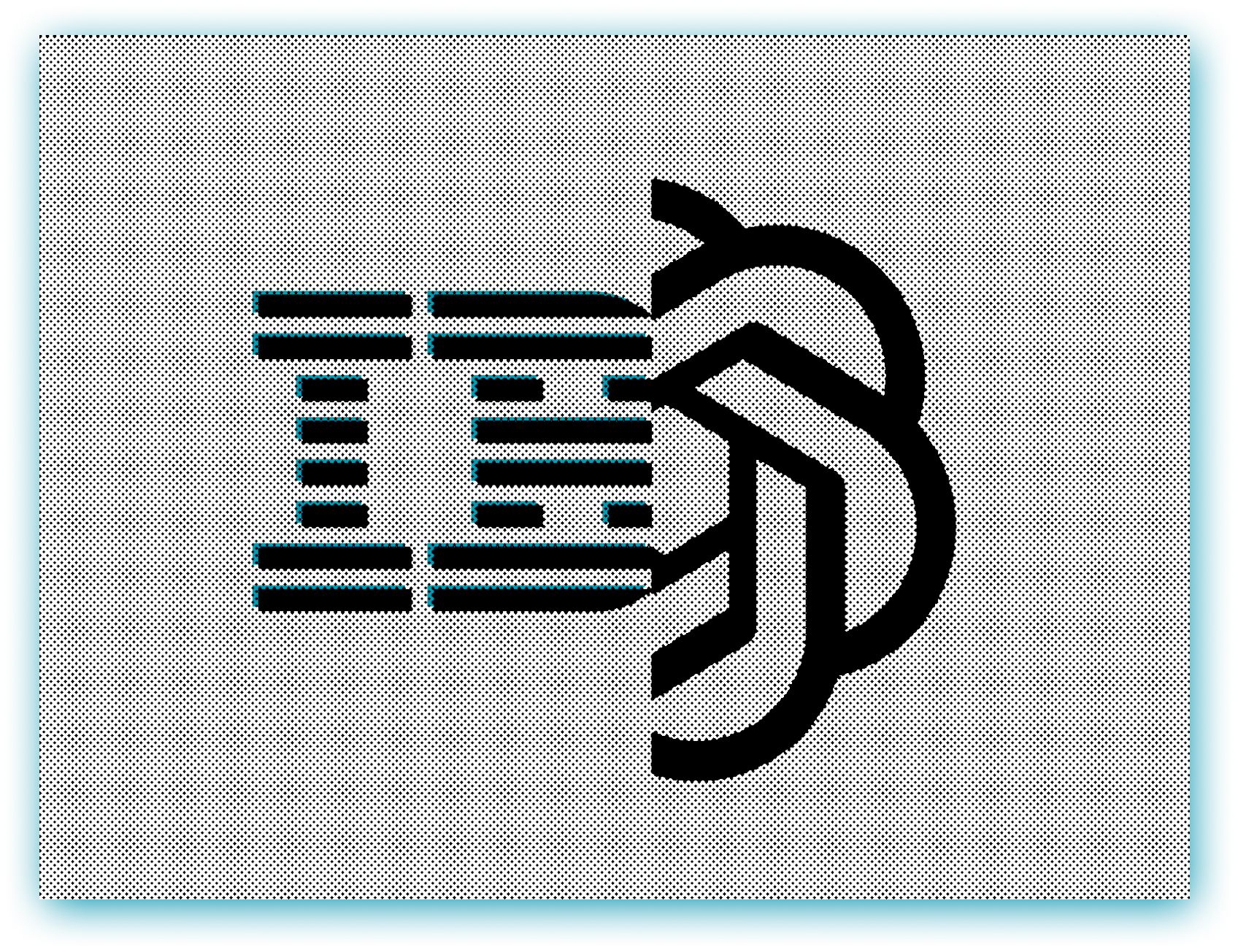
IBM/OpenAI logos
(Bronson Stamp for Sherwood Media)

OpenAI is IBM

IBM was first to market in a new area, but lost to fierce competition.

Jack Raines

Who are the biggest cloud players today? Amazon, Google, and Microsoft, three companies all worth more than $2 trillion in market capitalization. All three were early to the cloud, launching AWS, Google Cloud, and Azure in 2006, 2008, and 2008, respectively.

Yet another technology company, IBM, rolled out “the cloud” four years before AWS.

In 2002, IBM announced a new service called Linux Virtual Services, which would allow customers to run their own software on IBM computers in its data centers. Clients would be charged per usage instead of having to sign long-term contracts. In a 2002 Wall Street Journal story, IBM executive James Corgel said the company saw “a huge opportunity going forward,” estimating that the on-demand computing market would be worth between $100 billion and $150 billion in five years. Corgel didn’t know just how right he was: in 2024, AWS alone had annualized revenue exceeding $100 billion. And the market is still growing.

Yet despite IBM’s early entrance to the cloud market, it lost. In 2023, IBM generated $62 billion in revenue. Meanwhile, AWS alone generated $91 billion for Amazon. While IBM may’ve been the first to launch “the cloud,” it failed to win the market because it couldn’t find product market fit. Today, IBM is worth roughly the same valuation it had in 1999 and 2000.

In the future, when we look back at all these AI companies, we may end up viewing OpenAI as the IBM of the AI wave: the first mover that failed to capture all the economic value.

There are a few reasons why.

First, AI-scaling laws appear to be providing diminishing returns. Until November, the consensus was that AI would continue to improve as computing power increased. But OpenAI, Google, and Anthropic have begun to see smaller marginal returns on further increasing compute. As a result, OpenAI’s new model, Orion, fell short of the company’s desired performance.

On top of slowing performance gains, customers don’t need frontier-edge models to accomplish their goals now that “normal,” cheaper models are quite powerful. Most companies just need an AI model to do a few specific tasks, and super-powerful, all-reaching models are unnecessarily large and expensive. 

Even if OpenAI’s Orion model proves to be the most powerful model on the market, its utility to customers may be only marginally higher than a much cheaper alternative.

When you combine plateauing improvements with a plateauing customer need for improvements, models quickly grow commoditized as they converge to the same performance level. When models are commoditized, customers will choose the cheapest option, eroding OpenAI’s margins.

Fintech unicorn Ramp provides a good example of this commoditization in practice. It’s been using responses from OpenAI’s GPT-4 to help it fine-tune open-source models from Mistral and Meta, and the resulting custom models are cheaper and better than GPT-4.

Another risk facing OpenAI is a talent outflow: thanks to tender offers from outside investors, early employees have sold their now very valuable OpenAI stakes, and at least nine key executives have stepped down. In a competitive AI marketplace, where Meta and Musk are gunning for you, competition is cutthroat and losing top talent could be fatal.

That brings us to the last point: competition is fierce. Meta, xAI, and Anthropic are spending billions to keep scaling their AI models, and open-source models, which companies can fine-tune to address their own needs more cheaply, continue to improve. As baseline AI tech keeps getting better, customers will likely opt for cost efficiency over anything else, in a shift that doesn’t bode well given that OpenAI’s models are more expensive to run than open-source alternatives.

It’s possible that in 20 years we’ll live in a world where AI is ubiquitous, but OpenAI won’t be the big winner because the technology got commoditized. OpenAI is worth $157 billion today. Could it, like IBM, still be worth the same valuation in 20 years? Maybe.

Read the other arguments for OpenAI's future here.

More Business

See all Business
business

Demis Hassabis, Google DeepMind’s CEO and founder, was also an early Anthropic investor

A chess prodigy, and an actual a knight of the realm in the UK, it's perhaps no surprise that Demis Hassabis has made some strategic moves about his exposure to AI upside. According to people familiar with the matter, the influential AI architect became an angel investor in Anthropic, currently behind many of the leading AI models, per Arena AI leaderboards.

The Nobel Prize winner’s position in the Claude creator was previously undisclosed and, according to the Financial Times, highlights Hassabis’ “growing influence across the AI industry.”

Google, which bought DeepMind, the company that Hassabis cofounded and heads to this day, for a reported ~$400 million in 2014, is also a key Anthropic investor. The tech giant reportedly plans to invest up to $40 billion in the AI company as part of the mutually beneficial relationship the pair have forged, with reports that Anthropic has committed to spend $200 billion in the other direction on Google’s cloud services over the next five years.

I'm playing all sides, so I always come out on top

In addition to his financial support for Anthropic, Hassabis has also invested in a range of AI startups launched by colleagues, such as Inflection AI, a company set up by his DeepMind cofounder Mustafa Suleyman (who is now CEO of Microsoft AI), as well as efforts from other collaborators, like David Silver’s Ineffable Intelligence.

Hassabis also emerged as recurring figure on the fringes of the recent Elon Musk v. Sam Altman trial, cropping up repeatedly in testimonies and court documents and appearing to live, as The Verge put it, “rent-free” in Musk’s head.

Founded in 2021, Anthropic has recently raised funding at a reported $900 billion valuation, sending it soaring ahead of competitor OpenAI.

The Nobel Prize winner’s position in the Claude creator was previously undisclosed and, according to the Financial Times, highlights Hassabis’ “growing influence across the AI industry.”

Google, which bought DeepMind, the company that Hassabis cofounded and heads to this day, for a reported ~$400 million in 2014, is also a key Anthropic investor. The tech giant reportedly plans to invest up to $40 billion in the AI company as part of the mutually beneficial relationship the pair have forged, with reports that Anthropic has committed to spend $200 billion in the other direction on Google’s cloud services over the next five years.

I'm playing all sides, so I always come out on top

In addition to his financial support for Anthropic, Hassabis has also invested in a range of AI startups launched by colleagues, such as Inflection AI, a company set up by his DeepMind cofounder Mustafa Suleyman (who is now CEO of Microsoft AI), as well as efforts from other collaborators, like David Silver’s Ineffable Intelligence.

Hassabis also emerged as recurring figure on the fringes of the recent Elon Musk v. Sam Altman trial, cropping up repeatedly in testimonies and court documents and appearing to live, as The Verge put it, “rent-free” in Musk’s head.

Founded in 2021, Anthropic has recently raised funding at a reported $900 billion valuation, sending it soaring ahead of competitor OpenAI.

business

Jury rules against Musk in lawsuit against OpenAI and Altman

Jurors in Tesla CEO Elon Musk’s lawsuit against Sam Altman, Greg Brockman, and OpenAI found the defendants not liable on all claims on Monday.

In a unanimous verdict reached after less than two hours of deliberation, the Oakland jury found that Musk had waited too long to bring his case forward, exceeding the statute of limitations.

Musk had alleged that OpenAI abandoned its founding mission as a nonprofit dedicated to developing AI for humanity and instead became a profit-driven company closely tied to Microsoft.

The verdict caps off a three-week blockbuster tech trial that could have seen Altman and Brockman removed from OpenAI leadership.

Musk had alleged that OpenAI abandoned its founding mission as a nonprofit dedicated to developing AI for humanity and instead became a profit-driven company closely tied to Microsoft.

The verdict caps off a three-week blockbuster tech trial that could have seen Altman and Brockman removed from OpenAI leadership.

Daily Life In Warsaw

Smartphones are 12% cheaper than last year, according to the latest inflation data... except they’re not

Phones are one of a few important categories that get quality, or “hedonic,” adjustments in the Consumer Price Index — which make their price go down in the official statistics.

Latest Stories

Sherwood Media, LLC and Chartr Limited produce fresh and unique perspectives on topical financial news and are fully owned subsidiaries of Robinhood Markets, Inc., and any views expressed here do not necessarily reflect the views of any other Robinhood affiliate, including Robinhood Markets, Inc., Robinhood Financial LLC, Robinhood Securities, LLC, Robinhood Crypto, LLC, Robinhood Money, LLC, Robinhood U.K. Ltd, Robinhood Derivatives, LLC, Robinhood Gold, LLC, Robinhood Asset Management, LLC, Robinhood Credit, Inc., Robinhood Ventures DE, LLC and, where applicable, its managed investment vehicles.
