Business
US-TECHNOLOGY-AI-MICROSOFT-COMPUTERS
OpenAI CEO Sam Altman (Jason Redmond/Getty Images)
Weird Money

OpenAI isn't selling equity — it's selling shares of profits that may never come. Investors can’t get enough.

OpenAI's weird corporate structure has investors and employees owning shares of future profit distributions instead of traditional equity.

Jack Raines

Much has been written about OpenAI’s unique corporate structure: basically, OpenAI was initially a nonprofit, and the company wanted to raise money to fuel more capital-intensive projects, but it didn’t want the pursuit of financial gains to overshadow its nonprofit mission of “safe AGI that is broadly beneficial.”

The board’s solution was to create a for-profit subsidiary that would be controlled by the nonprofit parent company through a separate manager entity, OpenAI GP LLC. The for-profit unit can raise capital from outside investors (such as Microsoft), but there are caps on the maximum financial returns for investors and employees in the company’s for-profit arm. Here’s a diagram of OpenAI’s current structure:
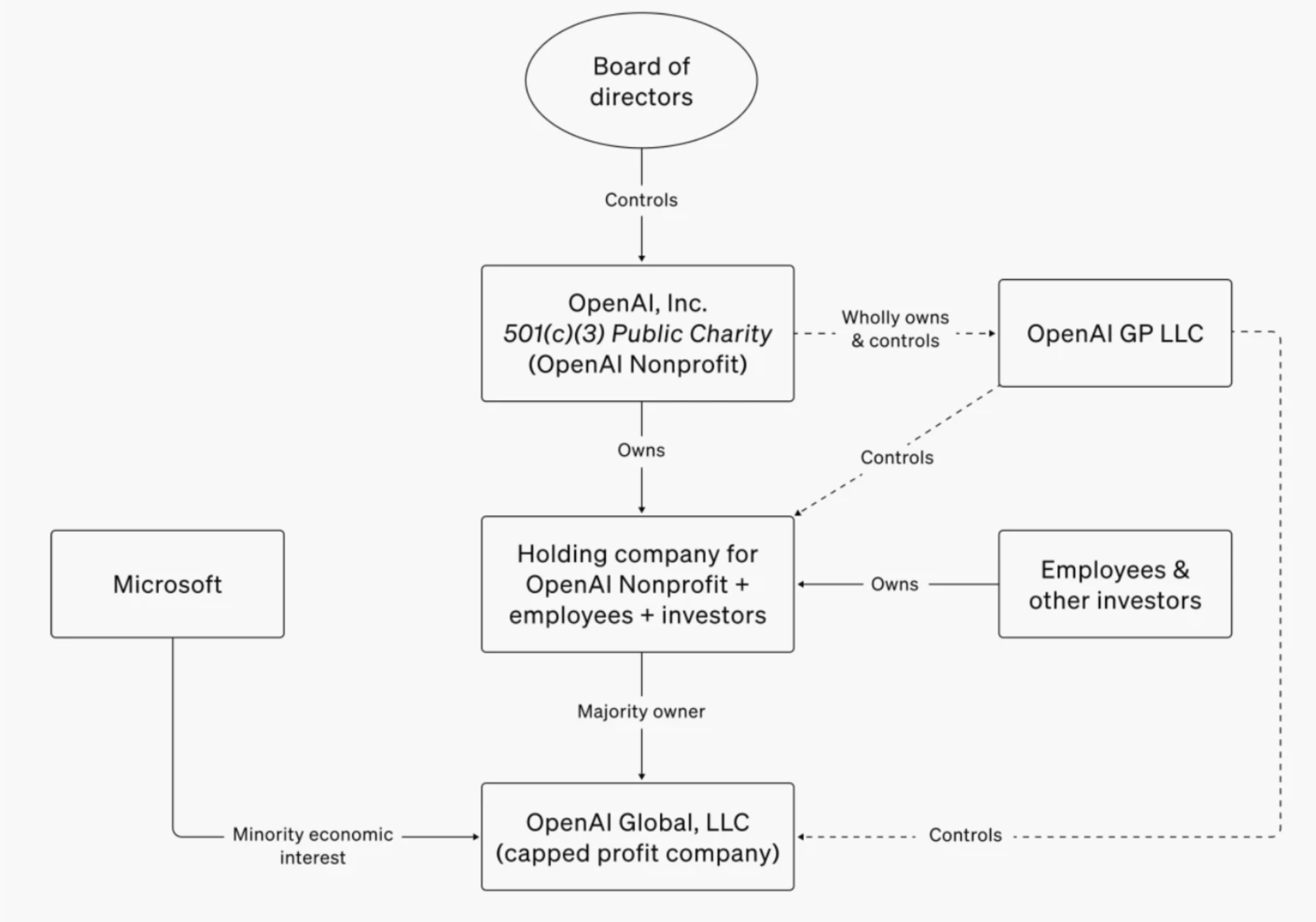
OpenAI Structure
Source: OpenAI

Despite the weird corporate structure, OpenAI has no problems raising outside capital, with the company now in talks to raise “several billion” dollars from Thrive Capital, Microsoft, and other investors in a funding round that would value it at more than $100 billion. The Wall Street Journal also noted that “one or more current OpenAI stockholders have been negotiating to sell their shares at a price that would value the company at $103 billion.”

However, due to OpenAI’s weird corporate structure, this isn’t a normal fundraise. Investors don’t actually own OpenAI equity — they instead invest money in its for-profit subsidiary, and they are “entitled to a share of the entity’s profits.”

OpenAI’s “equity” compensation for employees is structured similarly. Per employee compensation site levels.fyi, OpenAI employees are offered “profit participation units,” or PPUs, instead of traditional restricted stock units (RSUs) and stock options. These PPUs are functionally similar to “profit interest units,” or PIUs, a form of equity-like compensation sometimes offered by private companies.

Regarding PIUs, compensation platform Carta said:

There are very limited requirements for profits interest units, though a liquidation threshold is often assigned to profits interests on their grant date, meaning that the LLC has to achieve profits at or above a certain amount for the profits interest to participate in exit proceeds.

Levels.fyi also noted:

What if the company never turns a profit or is not currently turning a profit? Well, if you’ve held on to the PIU then you won’t redeem any value from it. That doesn’t mean the PIU doesn’t have any value per se. Someone that expects the company to generate a profit eventually may value the PIU and be willing to purchase it from you.

Back to OpenAI’s compensation structure. OpenAI’s PPUs entitle their holders to a percentage of the company’s future profits, not an equity stake in the company. This, of course, assumes that the company will, at some point, turn a profit.

More from Levels.fyi on OpenAI’s comp:

When giving candidates an offer, OpenAI will state what they believe to be the value of PPUs given. These PPUs vest evenly over 4 years (25% per year). Unlike stock options, employees do not need to purchase PPUs. PPUs all have the same value associated with them and, during a tender offer, investors purchase PPUs directly from employees. OpenAI makes offers and values their PPUs based on the most recent price investors have paid to purchase employee PPUs…

It’s important to reiterate that the PPUs inherently are not redeemable for value if OpenAI does not turn a profit. That said, there are investors that have been willing to pay for these PPUs and that’s where the value being told to candidates is derived from.

The Information noted in July that OpenAI is far from profitable, and it could lose as much as $5 billion this year due to heavy data processing costs for its large language models and hefty price tags to attract top talent in a competitive job market, and the company is reliant on outside capital to continue fueling its growth. But that capital isn’t buying a stake in the company, it’s buying the right to future profit distributions (of which Microsoft controls 49%) and the company is far from showing any profits.

While equity of an unprofitable startup could still have value (unprofitable companies can still IPO or be acquired. Uber IPO’d without having ever turned a profit, for example), PPUs for a company that never turns a profit have zero intrinsic value. If you own OpenAI PPUs, and the company never turns a profit and you don’t sell them to someone who thinks OpenAI eventually will turn a profit, your PPUs are worthless.

Of course, because demand for AI is so hot, and OpenAI is the market leader in generative AI, investors are still willing to invest billions via PPUs, and, as of June 2024, current and former employees can now sell some of their stakes in tender offers. If I were an OpenAI employee, and my “equity” compensation was actually profit share units, and outside investors were willing to buy those profit share units from me for a $100 billion + valuation… I would probably want to sell, no?

More Business

See all Business
business

Electronic Arts launches a platform to put more ads in its games

Video game publishing giant EA launched a new platform on Monday designed to make the process of selling immersive ad space in its popular games easier.

The company says the platform, called EA Advertising, allows brands to “integrate directly into gameplay through dynamic, real-time placements, from stadium signage to custom in-game content.”

More so than other studios, EA has incorporated advertising into its most popular titles. As Kotaku points out, the company’s ad efforts stretch as far back as 2006. Several of its sports franchises already feature partnerships with brands like Visa, Lowe’s, Red Bull, and PepsiCo.

In-game advertising hasn’t exactly been embraced by fans, but industry experts expect it to ramp up as companies seek more revenue to offset higher games budgets and surging memory costs. EA rival Take-Two has taken a different approach, with CEO Strauss Zelnick recently saying the company was “not at risk of doing brand partnerships” in the forthcoming “Grand Theft Auto VI,” and that ads in full-price games seems “unfair.”

The $55 billion deal to take EA private, led by Saudi Arabia’s Public Investment Fund, is set to close at the end of this month. Being the largest leveraged buyout in history, EA will likely look for more ways to boost revenue to cover interest payments.

More so than other studios, EA has incorporated advertising into its most popular titles. As Kotaku points out, the company’s ad efforts stretch as far back as 2006. Several of its sports franchises already feature partnerships with brands like Visa, Lowe’s, Red Bull, and PepsiCo.

In-game advertising hasn’t exactly been embraced by fans, but industry experts expect it to ramp up as companies seek more revenue to offset higher games budgets and surging memory costs. EA rival Take-Two has taken a different approach, with CEO Strauss Zelnick recently saying the company was “not at risk of doing brand partnerships” in the forthcoming “Grand Theft Auto VI,” and that ads in full-price games seems “unfair.”

The $55 billion deal to take EA private, led by Saudi Arabia’s Public Investment Fund, is set to close at the end of this month. Being the largest leveraged buyout in history, EA will likely look for more ways to boost revenue to cover interest payments.

business

JM Smucker says it sold $1 billion worth of Uncrustables in FY2026

After years of booming sandwich sales, JM Smucker has finally earned a billion-dollar crust.

On Tuesday, the company reported results for fiscal year 2026, highlighting better-than-expected profits driven by higher prices for coffee and sweet baked goods. However, at another point on the earnings call, CEO Mark Smucker pointed to one particularly jammy figure: in line with previous forecasts, the company sold $1 billion worth of its (almost always) crustless sandwiches, Uncrustables, in the last year alone.

business

Paramount reportedly offers concessions to resolve multistate antitrust investigation

Paramount has reportedly offered up some concessions in an effort to prevent an antitrust lawsuit by California and about 10 other states, according to Bloomberg reporting on Monday.

Reuters first reported on the potential suit from a group of unnamed states last week, which could throw a wrench in Paramount’s plans to buy rival Warner Bros. Discovery in a Hollywood megamerger.

The list of concessions is unknown, though Bloomberg previously reported that Paramount is open to divesting some of its kids TV assets to appease EU regulators.

Late last month, reports said US regulators appeared likely to approve the $110 billion merger, following a meeting between Paramount CEO David Ellison and DOJ antitrust staffers.

The list of concessions is unknown, though Bloomberg previously reported that Paramount is open to divesting some of its kids TV assets to appease EU regulators.

Late last month, reports said US regulators appeared likely to approve the $110 billion merger, following a meeting between Paramount CEO David Ellison and DOJ antitrust staffers.

$98B ⛽

The IATA released its latest financial outlook for the airline industry over the weekend, forecasting a $98 billion jump in the sector’s collective fuel bill. The world’s largest trade group representing airlines expects the oil spike to halve profits by 49% from last year to $23 billion.

The group also expects profit margins to halve year over year, falling from 2025’s 4.2% to 2%. Still, revenue is expected to climb to $1.17 trillion from $1.07 trillion.

A surge in the cost of jet fuel has rocked US and global airlines this year, leading Delta Air Lines, United Airlines, American Airlines, Southwest Airlines, JetBlue, and others to raise fares and ancillary charges like bag fees. Low-cost carriers, which operate on smaller margins, have been squeezed the hardest, resulting in Spirit’s shutdown.

“It’s a tough year for all airlines, especially those whose balance sheets had not yet recovered from COVID. And, of course, for those operating in the Gulf,” said IATA Director General Willie Walsh, who added that demand is holding up and about half of passengers expect to spend more on travel this year. “That bodes well for a strong northern summer peak season. The big unknown is how long travelers and shippers can tolerate the higher costs of connectivity.”

Hollywood Exteriors And Landmarks - 2025

1 year into the Switch 2, we might’ve seen the top of the console market

The Switch 2 launched on this day in 2025. Amid a rough year for consoles, Nintendo has logged a good one.

Latest Stories

Sherwood Media, LLC and Chartr Limited produce fresh and unique perspectives on topical financial news and are fully owned subsidiaries of Robinhood Markets, Inc., and any views expressed here do not necessarily reflect the views of any other Robinhood affiliate, including Robinhood Markets, Inc., Robinhood Financial LLC, Robinhood Securities, LLC, Robinhood Crypto, LLC, Robinhood Money, LLC, Robinhood U.K. Ltd, Robinhood Derivatives, LLC, Robinhood Gold, LLC, Robinhood Asset Management, LLC, Robinhood Credit, Inc., Robinhood Ventures DE, LLC and, where applicable, its managed investment vehicles.