Business
Juniper Jill Cannabis Co.
Cannabis flowers (Lori Van Buren/Albany Times Union via Getty Images)
Alright alright alright

People are smoking more weed than ever, so why have pot companies been such lousy investments?

Weed stocks are reaching their lowest point, but some think the market can only get higher.

J. Edward Moreno

Cannabis stocks reached new lows in 2024 as the regulatory landscape in the US failed to get friendlier and no new states legalized recreational use, despite a general trend consistently pointing toward greater acceptance of marijuana and people overall smoking more pot. 

AdvisorShares Pure US Cannabis ETF, the largest weed ETF by market cap, is down over 40% this year. Companies like Tilray and Canopy Growth are each down nearly 40% as well. 

“The year was not gentle to US cannabis investors,” analysts at ATB Capital Markets wrote in a December research note.

Weed stocks got a bump after the Department of Justice announced in late April that it would recommend reclassifying marijuana from a Schedule I drug (like heroin and LSD) to a Schedule III drug (like Tylenol and testosterone). But that was about the only bit of good news they got this year, and the process of making that proposal a reality has dragged on. 

In November, voters in Florida failed to pass an amendment that would have made recreational marijuana legal in the country’s third-most-populous state. While over 55% of the state voted in favor, Florida requires a 60% majority to ratify new amendments. The industry expected that amendment to be adopted and had their balance sheets geared toward growth to prepare to enter a new market, said Morgan Paxhia, managing director of Poseidon Investment Management, a cannabis hedge fund. 

“That left a lot of investors thinking, ‘Where is growth going to come from?’” he said. 

More legal cannabis consumption ≠ more profit for pot companies

Running a legal weed company isn’t easy. Finding banking and capital is difficult because marijuana is still illegal on a federal level. Tax bills are high because unlike most companies, they can’t deduct business expenses. And, while these companies are selling higher volumes, the retail price keeps falling down.

Particularly in more mature markets, the supply of weed has caught up to the amount of retail demand. In Oregon, which legalized recreational pot more than a decade ago, the wholesale price per pound of marijuana went from $1,750 in 2017 to less than $600 in 2023, according to the state’s Liquor and Cannabis Commission. But the retail price for a gram of weed also dropped by about half during that period, keeping the profit margins basically the same. 

Legal weed companies also have to compete with the illicit market and new hemp-derived products like Delta-9, which offers a similar high and operates in a legal gray area. Those competitors don’t face the same costs that come with being a compliant weed business. 

Under those pressures, few cannabis companies are consistently profitable and most are heavily in debt. Many have not made it through 2024 scot-free. MedMen filed for bankruptcy in April. Several others — including StateHouse, Herbl, Blue Arrow, and RevClinics — have gone into receivership.

Paxhia said the industry expects more bankruptcies and defaults before the regulatory landscape gets friendlier. “It’s a survivor’s game for sure right now,” Paxhia said. 

If you hit rock bottom, the only way to go is up. Right?

There are some glimmers of optimism that don’t appear to be priced in at the moment. 

First, as far as consumer trends go, marijuana is better positioned in the long term than traditional booze companies. According to the US National Survey on Drug Use and Health, as of 2022, more people reported using cannabis on a daily or near-daily basis than alcohol. 
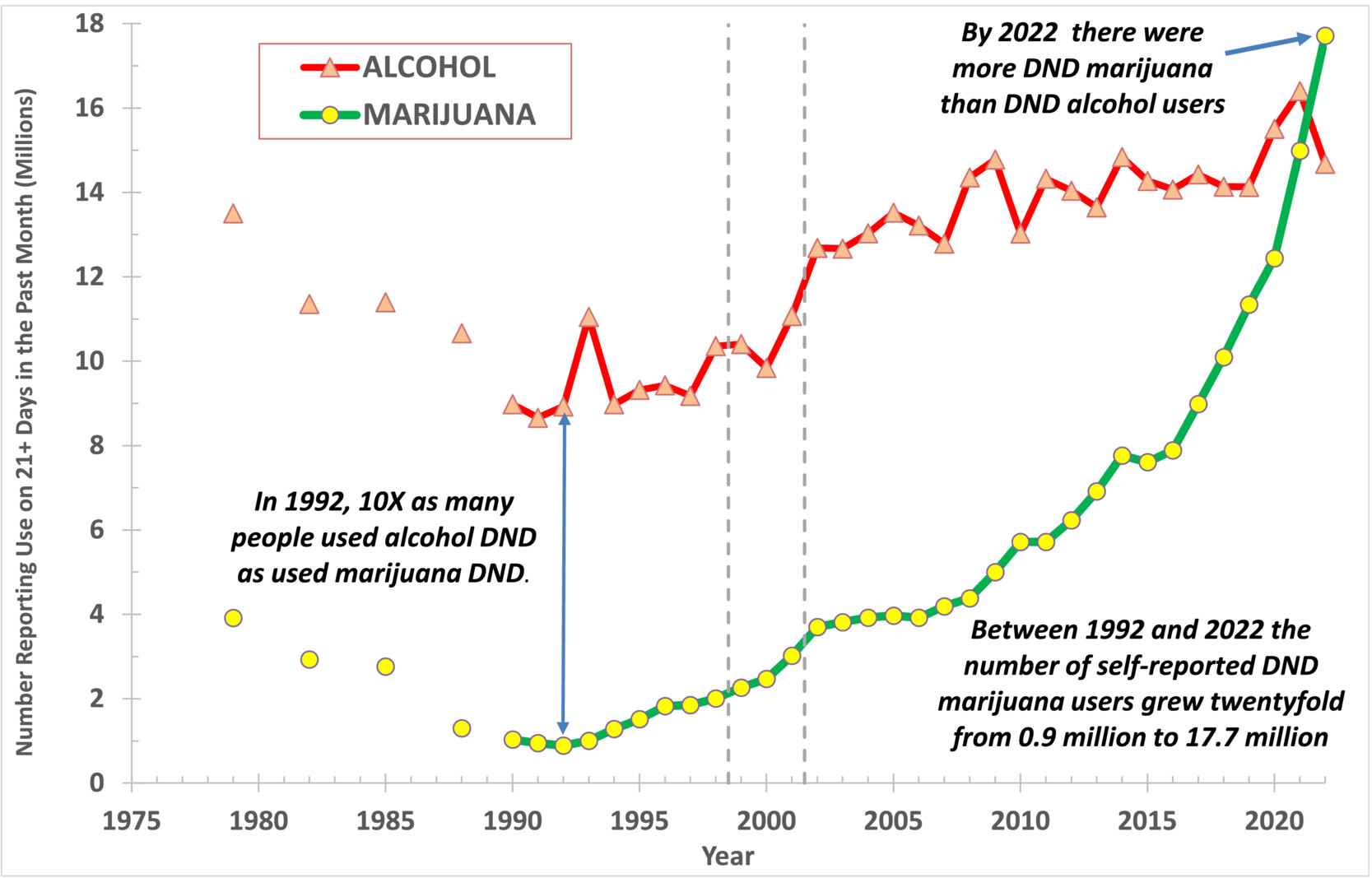
Weed vs. Alcohol daily use
Source: US National Survey on Drug Use and Health, Society for The Study of Addiction

Both ATB Capital Markets and Paxhia think the weed bears may be overpricing bad news. 

“The market is aggressively overweighting near-term regulatory setbacks and underweighting the long-term trend of an industry that will (maybe slowly but surely) march towards full legalization,” ATB wrote. 

A few things may happen in the next year that could trigger a price surge: 

  1. The federal government may finalize its rescheduling of marijuana. 

  2. Pennsylvania lawmakers are again attempting to legalize marijuana for recreational use, adding another market. 

  3. The incoming administration brings uncertainty, which some see as more promising than the stalemate under the current administration. 

In a recent interview with The Dales Report, Canopy Growth CEO David Klein gave his pitch for cannabis stocks, including his company:

“If you are an investor — and I appreciate the frustration, trust me, I very much share it myself — if you believed in investing in the industry and in Canopy in 2017 and 2018, you should love the ability to invest in it today where you now have a clean business, a clean balance sheet, a solid operating environment, with a strong foothold in the markets that matter, and a beat-up stock. This is the opportunity time.”

In his view, weed stocks are cheap and the fundamentals are there they’re just missing something to spark the fire, so to speak.

More Business

See all Business
business

The Trump administration is reportedly planning a 50% made-in-America requirement for USMCA tariff relief

Qualifying for USMCA-related lower tariffs may soon require more US-made vehicle components, according to reporting by The Wall Street Journal.

The Trump administration is reportedly planning to introduce a 50% US content requirement for vehicles covered by the trade pact to receive lower tariffs. The content would be measured by cost, according to the WSJ.

There currently isn’t any US-specific requirement for those lower tariff rates, but in order to receive preferential tariffs, vehicles are must contain at least 75% regional content (components made in North America). Per Reuters reporting, the Trump admin is seeking to raise the regional requirement to 82%.

These reported plans are subject to change as the US negotiates USMCA terms with Mexico over the next few months.

Overall, Tesla will likely have the easiest time qualifying for any stricter requirements. The automaker’s vehicles contained the highest amount of US/Canadian content in 2025, according to American University research. Ford, GM, and Stellantis all scored lower.

Notably: the underlying government data that many domestic content measurements rely on intentionally combines US and Canadian components, so it’s difficult to know exactly how much of any given vehicle is specifically US-made.

There currently isn’t any US-specific requirement for those lower tariff rates, but in order to receive preferential tariffs, vehicles are must contain at least 75% regional content (components made in North America). Per Reuters reporting, the Trump admin is seeking to raise the regional requirement to 82%.

These reported plans are subject to change as the US negotiates USMCA terms with Mexico over the next few months.

Overall, Tesla will likely have the easiest time qualifying for any stricter requirements. The automaker’s vehicles contained the highest amount of US/Canadian content in 2025, according to American University research. Ford, GM, and Stellantis all scored lower.

Notably: the underlying government data that many domestic content measurements rely on intentionally combines US and Canadian components, so it’s difficult to know exactly how much of any given vehicle is specifically US-made.

business
Tom Jones

The $640,000 Luce makes the average Ferrari look like a bargain

Put aside the shape; put aside the smoothing out of Ferrari’s iconic sharp edges; put aside, even, the calls from former Chairman and President Luca Cordero di Montezemolo to “take the Prancing Horse off.” On the grounds of price alone, Luce detractors might have a point.

By now, many of us will have read the criticisms of Ferrari’s first fully electric vehicle, as the Luce — which was unveiled to the world earlier this week and promptly saw the company’s shares crash out in New York and Milan — gets subtly shaded by competitors online and not-so-subtly shaded by basically everyone else.

What makes all of this worse for Ferrari is that, even by the luxury car maker’s notoriously high standards, they’ve slapped a pretty hefty price tag on the Luce, and the company’s CEO, Benedetto Vigna, has already been forced to defend the €550,000 ($640,000) price point, saying yesterday that it’s “fair to pay for innovation,” per Reuters.

While Ferrari’s cars have been getting more expensive of late, as recently as 2022, Ferrari’s average revenue per car sold was around $340,000. At nearly twice that price, this new electric model is obviously proving a little much (visually, conceptually, and financially) for many loyal and long-standing fans of the Prancing Horse to stomach.

Ferrari Luce cost chart
Sherwood News

By now, many of us will have read the criticisms of Ferrari’s first fully electric vehicle, as the Luce — which was unveiled to the world earlier this week and promptly saw the company’s shares crash out in New York and Milan — gets subtly shaded by competitors online and not-so-subtly shaded by basically everyone else.

What makes all of this worse for Ferrari is that, even by the luxury car maker’s notoriously high standards, they’ve slapped a pretty hefty price tag on the Luce, and the company’s CEO, Benedetto Vigna, has already been forced to defend the €550,000 ($640,000) price point, saying yesterday that it’s “fair to pay for innovation,” per Reuters.

While Ferrari’s cars have been getting more expensive of late, as recently as 2022, Ferrari’s average revenue per car sold was around $340,000. At nearly twice that price, this new electric model is obviously proving a little much (visually, conceptually, and financially) for many loyal and long-standing fans of the Prancing Horse to stomach.

Ferrari Luce cost chart
Sherwood News

Latest Stories

Sherwood Media, LLC and Chartr Limited produce fresh and unique perspectives on topical financial news and are fully owned subsidiaries of Robinhood Markets, Inc., and any views expressed here do not necessarily reflect the views of any other Robinhood affiliate, including Robinhood Markets, Inc., Robinhood Financial LLC, Robinhood Securities, LLC, Robinhood Crypto, LLC, Robinhood Money, LLC, Robinhood U.K. Ltd, Robinhood Derivatives, LLC, Robinhood Gold, LLC, Robinhood Asset Management, LLC, Robinhood Credit, Inc., Robinhood Ventures DE, LLC and, where applicable, its managed investment vehicles.