Sony's had the year from hell, with high profile flops on every screen imaginable
In 2024, it had the worst video game failure since the ’80s and “Madame Web” defined their cinematic output. Can Sony recover?
Call it an existential crisis, a harbinger of things to come, or the year from hell, but the past year at Sony has been what can only be described as a roller coaster designed to nauseate both PlayStation fans and investors.
On the surface things seem fine. Sony is not in financial trouble, it makes money, and it will be around for a long time. But there are underlying problems that have caused the stock to whipsaw. It’s down about 5% over the year while broader markets have risen nearly 40%.
Bad optics and weird decision-making are cause for concern about the direction of Sony’s movie and gaming divisions. There’s been a flood of downright disastrous news and announcements, a dredging of the bottom of the creative barrel for movies and games, and a slew of high-profile layoffs and retirements.
Let’s recap the drama and the madness step by step.
The case for this gruesome examination began a year ago, when Sony Interactive Entertainment laid off a hundred employees following its $3.7 billion acquisition of Bungie, the studio behind the legendary sci-fi shooter franchises “Halo” and “Destiny.” The reasoning came weeks afterward in a Bloomberg report that revenue was 45% lower than projected, which led to a culling of the talented staff Sony brought in just a year before. Buyer’s remorse?
Shortly after, Sony Pictures Entertainment CEO Tony Vinciquerra stepped down from his role and retired. The torch was passed to Ravi Ahuja, the COO of SPE, who’s been at the helm for such cinematic masterpieces as “Madame Web” and “Harold and the Purple Crayon.” (Just kidding — both bombed.)
The very next month, SPE laid off 900 employees across several studios, citing a need to restructure operations in response to changing product development, launch strategies, and distribution of their games. PlayStation’s famous London Studio was closed permanently. It came at a brutal moment for the industry as short-term profits and dreams of infinite growth led to thousands of workers losing their jobs.
Nothing says everything is OK like investing in cryptocurrency followed by appointing an interim CEO! In March, journalists discovered Sony had filed a patent for incorporating “super-fungible tokens” into their video games, something you’d think you’d read years ago, when NFTs were actually popular. CFO Hiroki Totoki then began his role as interim CEO of PlayStation after former CEO Jim Ryan left the company in September 2023. Totoki will remain in the driver’s seat until a more permanent successor can be found.
May wasn’t kind to Sony either as both the gaming division and the movie business took hits. In an effort to cling to the “Spider-Man” movie rights, Sony Pictures and Columbia have to keep producing films with “Spidey”-adjacent characters so that Marvel/Disney don’t get their IP back. Because of this, Sony has to endure flop after flop — first with living-meme-turned-corporate-joke “Morbius,” and then February’s bomb “Madame Web” forced another delay to the upcoming “Kraven the Hunter” release. Don’t expect that to be a world-beater, either.
The same month, Sony’s bestselling game of the year, “Helldivers 2,” caused headaches for fans with some notably confusing controversies that were easily foreseeable, including making the game unplayable on PC in several countries. It didn’t help that PlayStation 5 console sales failed to meet the lofty goal of 25 million units shipped by the end of the fiscal year, and the reduced the target to 21 million, which could be its own story on the stagnating gaming-console market.
Tough data from Circana: the share of the U.S. population that plays video games is still declining - and is now below pre-COVID levels.
— Matthew Ball (@ballmatthew) October 17, 2024
Avg weekly playtime among gamers is up from 2022, nearly back to 2020, and is well above pre-COVID... but probably because fewer are playing pic.twitter.com/6WRGkbHZPy
The summer was mixed for Sony. First came the acquisition of the Alamo Drafthouse chain of cinemas, which was big news considering the Justice Department had just recently struck down a 70-year-old antitrust rule about distributors not being able to own theaters. The deregulation now allows Sony to highlight its own content over that of its competitors, favoring Sony films over the likes of Universal and Disney.
But the addition of Alamo came with another blow in the form of more layoffs, as Sony cut another 220 jobs from Bungie and reallocated 155 employees to other PlayStation Studios. Bungie CEO Pete Parsons acknowledged that the company had been operating at a loss and had exceeded its financial grasp. Projects were canceled internally, and the upcoming “Marathon” had better deliver, or else there might not be a Bungie for much longer.
If all this sounded bad, the worst was yet to come, as this year’s Q3 for Sony was a real downer for shareholders and PS fans. The comedic force of Phil Lord and Chris Miller, the writer-director duo known for hits like “21 Jump Street,” “The Lego Movie,” and the “Into the Spider-Verse” films, left Sony after a battle over budgets and creative differences.
A Puck investigation found that tensions rose between the two and Sony over several “Spider-Man” TV shows and films, which caused delays, cancellations, fights, and a quickly evaporating contract signed by Lord and Miller (five years, nine figures). It doesn’t help that the biggest moneymaker for Sony Pictures — the animation department — has been under siege by allegations of bad working conditions and being a toxic workplace.
The biggest blow to PlayStation this year is the worst failure the video-game industry has seen since the early ’80s. In fact, it might be the biggest write-down of all time, which is staggering once you jump into the numbers — most of which are either reported offhand or leaked, since gaming companies are notorious for refusing to reveal game budgets or the number of copies sold. For months, PlayStation brass has tripled down on making live-service games, trying to retain players spending money on microtransactions to compete with the likes of “Fortnite” and “Roblox.”
The first of their gambles was a big-budget, long-gestating game called “Concord,” a new IP that can be summed up as, “What if ‘Guardians of the Galaxy’ were a multiplayer first-person competitive hero shooter?” It took close to a decade to make, cost hundreds of millions of dollars, and was heavily marketed. PlayStation frequently featured the game in its advertising plans as one of the few console-exclusive games being released this year, a relatively light year otherwise.
The results were catastrophic. About 25,000 copies were sold across PlayStation 5 and Steam, which earned Sony only $1 million in revenue. Reports indicate “Concord” cost between $200 million and $400 million to make. Two weeks later, the game was shut down, pulled from store shelves, delisted on digital storefronts, and refunds were given to everyone who played it. A somber press release announced the decision to just obliterate the game off its servers, which is wild considering players and critics seemed to like it. This is borderline unprecedented in the industry (unless you count millions of copies of “E.T.” for the Atari 2600 being buried in the Nevada desert, which we do). It was shocking to see the game revealed, and then, not even three months later, it’s as if it never existed.
Weeks after Sony pulled the plug on Firewalk Studios, it announced that the entire team was being let go. Over 200 more people were laid off, and Sony co-CEO Hermen Hulst said the company had spent a while exploring all its options for “Concord.”
“After much thought,” he said, “we have determined the best path forward is to permanently sunset the game and close the studio.”
If that wasn’t enough, Sony unveiled its big holiday gift and next PlayStation hardware upgrade: the PS5 Pro. Unfortunately, it could not have come at a worse time, and at a worse price, as the $700 sticker shock led to scratched heads and a lack of preorders. The inventory will most likely sit on shelves for years, as that’s exorbitantly expensive for a home gaming console. In fact, it’s Sony’s most expensive one ever and one of the most expensive consoles of all time (not accounting for 40 years of inflation).
The PS5 Pro hasn’t come out yet, but it’s perhaps the most memed-on and clowned-on news story of the year, as far as industry members and gamers are concerned. That’s an astronomical achievement, considering the blunders already outlined so far. Anecdotally, the consensus is that it’s far too expensive, not necessary, barely an upgrade, and just another example of out-of-touch execs trying to milk people’s wallets.
For Sony, it’s a gamble to simply try to recoup the cost of production, when traditionally you’re supposed to lose money on making hardware to then sell the software, which is where the profits come from. Sony clearly has no interest in losing any more money, as shown by the fact that this is the first time in gaming history that a console maker is increasing prices years into the generation instead of reducing them to move units off shelves.
The most crucial context to understand when laying out the numbers and looking at the millions of units Sony’s other first-party games sell is that the AAA video-game industry is facing a looming crisis. Games are taking much longer to make now, sometimes close to a decade (like “Concord”), when it used to take one to four years max. That means more employees, higher wages, and bigger budgets, which means you can’t place as many bets by releasing dozens of games in a year. You only get a few, and if one doesn’t pop off and recoup its costs (like “Concord”), you’ve blown through hundreds of millions of dollars chasing an impossible ghost. Audiences are also buying fewer games, sticking to fewer titles as “forever games,” and dumping tons into microtransactions in one place. “League of Legends” and “PUBG” have been around a long time and will never see a sequel, and that pulls away potential buyers of newer experiences (like “Concord”).
Sorry to dump on “Concord,” but it really is the most egg on a publisher’s face we’ve ever seen. It was a game created eight years ago, so those ideas are no longer in vogue and “Concord” released DOA to a demographic that was no longer around. It also didn’t help that most of the competition in multiplayer-centric blockbusters are free to play and “Concord” was released at a $40 price point.
Seems like a glaring mistake Sony could have avoided if it hadn’t been so keen, or greedy, to make this new franchise work.
Coupled with the increasing billions of mobile phones and tablets compared to the millions of console owners, it’s hard not to see the industry slowly shift away from the traditional model where you plug a box into a television. The future might just be streaming something to your laptop or phone and going around the need for a dedicated machine built to play only high-end games. Sony doesn’t have a pipeline, either, to get PlayStation titles onto more platforms the way Microsoft and Xbox do (not that it’s helping them).
Considering Sony publicly stated that its future is in making live-service games to compete with the likes of “GTA V” and “FIFA,” “Concord” is a crushing example of just how seemingly improbable it is to get people into a new ecosystem to spend money on skins, costumes, and emotes already in their favorite games like “Call of Duty” and “Madden.”
Speaking of chasing trends, remember when Sony patented NFTs for their games? Just this month it patented another trendy buzzword to save the ship, this time in the form of AI being used for game-asset creation. Surely this will replace the role of workers and save the company millions, but we’ll see how far that actually lasts as the AI bubble begins to burst (another article for another day).
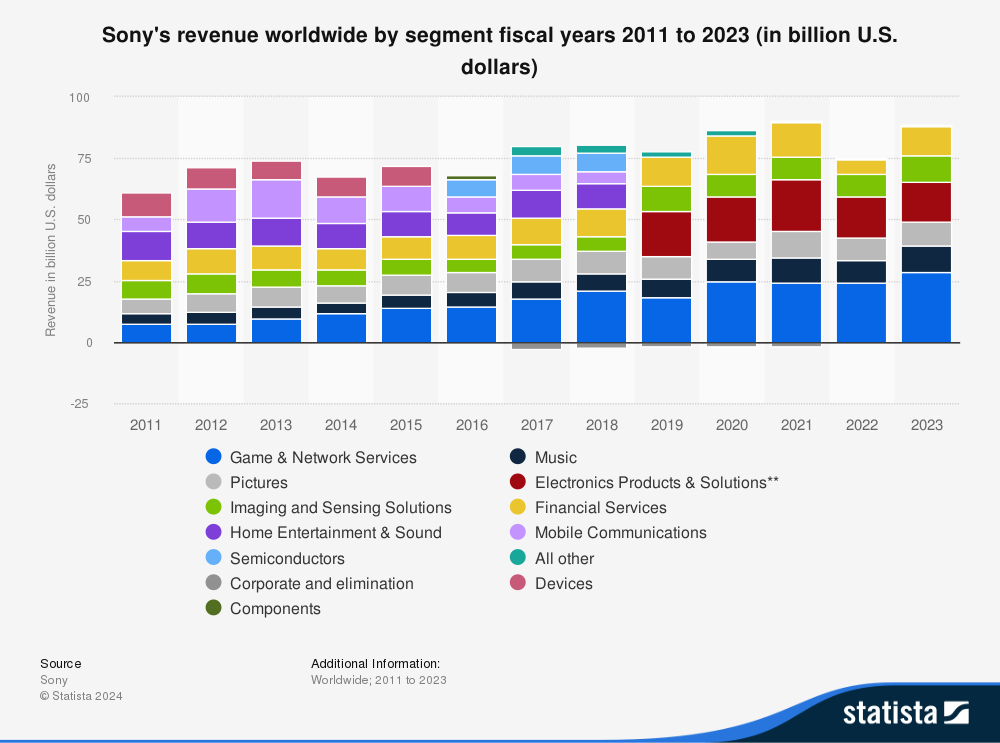
So, what is the good news, exactly? Well, there are a number of exciting games to look forward to, as long as they sell to recoup the rising cost of development. Sony’s IP is also successfully being used to create TV shows and movies that make bank, particularly “Twisted Metal,” “Uncharted,” and the award-winning “The Last of Us” on HBO. Sony owns Crunchyroll, one of the few profitable streaming services on the market, and, of course, Sony-branded consumer electronics are always around to bolster the company.
“We’re pretty bullish” on streaming, former SPE CEO Tony Vinciquerra said, “and would love to do more genre-based, targeted, passionate-audience-centered streaming services. And we’re working on that right now. But it’s going to take some time for the market to shake out.” Vinciquerra said that eventually, streaming “is going to be a profitable business.”
Sony is one of the only entertainment producers without its own big streaming service, and instead opts to sell its movies and shows à la carte. That might end up being a winning strategy, considering Disney+ just turned a profit after years of hemorrhaging money. The goal seems to be simply producing shows for other big streamers, selling to the highest bidders, and turning its own gaming IP into gigantic hits that can draw millions of people to purchase a PlayStation and become hardcore gamers. There’s precedent for these adaptations to spike game sales (“Cyberpunk,” “Fallout”), so it’s not the worst idea in the world.
However, during the writing of this article, two more setbacks happened in Sony’s plans to dominate gaming by expanding their properties to a global audience of non-gamers: both the “Horizon” and “God of War” adaptations have lost their showrunners and had to start the writing process over from scratch, which casts serious doubt whether either project will ever see the light of day. As long as you don’t read these two tweets back to back, maybe you’ll come away thinking Sony is not doomed to shoot itself in the foot until it bleeds to death in a world becoming less interested in playing AAA games on a TV or seeing “Spider-Man” spin-offs in theaters.
Don’t get it twisted: Greedy, ruthless, and gleefully unknowledgeable leadership is single-handedly killing the creative heart of games. All other conversations are moot until this changes, as demands the 30K+ laid off in the last year, and the many more being added daily. https://t.co/oSSg5y02ta
— Liana Ruppert (@DirtyEffinHippy) October 17, 2024
Just don’t come crying once you find out the plot details of season 2 of “The Last of Us” and how devastatingly terrible that show is going to get if it’s directly based on the game. And, considering the dormant IP at Sony’s disposal that it refuses to use, I’m not sure it can crank out enough “The Last of Us” games to fill the void.
The takeaway from this story shouldn’t be, “Sony is going down the tubes!” It just released “Astro Bot,” a Game of the Year contender that’s one of the best platformers of all time. The question we should be left with is, “Why can’t a release like that be the thing that lifts a company to profitability?” and “Where is this company going that releasing a critical hit is a blip on the radar to the people running it?”
The earnings report from a few days ago showed that profits slipped $124 million over the last three months, which is a 39% decrease from this time last year. This notably came from the writers and actors’ strike, which led to production delays. Coupled with a “grim”-looking holiday season, one could make the case that 2025 can only go up from here for Sony.
Jared Russo is a writer from New York who spends his days online covering the tech industry, ranting about sports, and playing video games.