ThredUp’s CEO dishes on its AI-first mentality and what’s driving the resale gold rush
Shares are up more than 500% so far this year as Gen Z, tariffs, and AI help supercharge the secondhand fashion market.
ThredUp is having a huge main character moment.
After spending much of the last two years trading below a buck, shares of the online consignment platform have surged more than 300% — outpacing nearly every other name in retail — as secondhand shopping hits the mainstream and growth last year outpaced the broader retail clothing market by 5x.
The company has become a magnet for Gen Z’s thrift obsession and budget-conscious shoppers trading fast fashion for quality secondhand goods.
A 2025 Capital One Shopping Research report found that nearly one in three clothing purchases in the US last year was secondhand. Meanwhile, ThredUp’s own 2025 Resale Report predicts US online resale will nearly double to $40 billion by 2029, growing at an average annual rate of 13%.
But CEO James Reinhart says the rally isn’t just about riding the vibes. In a Q&A with Sherwood News, he breaks down how the company got its groove back.
This interview has been edited for length and clarity.
Sherwood News: How much of ThredUp’s recent success stems from the thrifting renaissance versus a shift toward more budget-conscious shopping?
James Reinhart: Our recent success is a direct result of a powerful synergy between a major consumer shift and our proprietary technology. I do think we’re at the forefront of a thrifting renaissance, with a new generation of shoppers embracing secondhand for both sustainability and value. This trend is amplified by a macroeconomic environment where consumers are increasingly budget-conscious.
Simultaneously, we’ve focused on our core US business and doubled down on innovation, embedding an AI-first mentality to completely reshape the customer experience. For example, we’ve launched AI-powered features like Image Search and Style Chat, which help customers find exactly what they’re looking for.
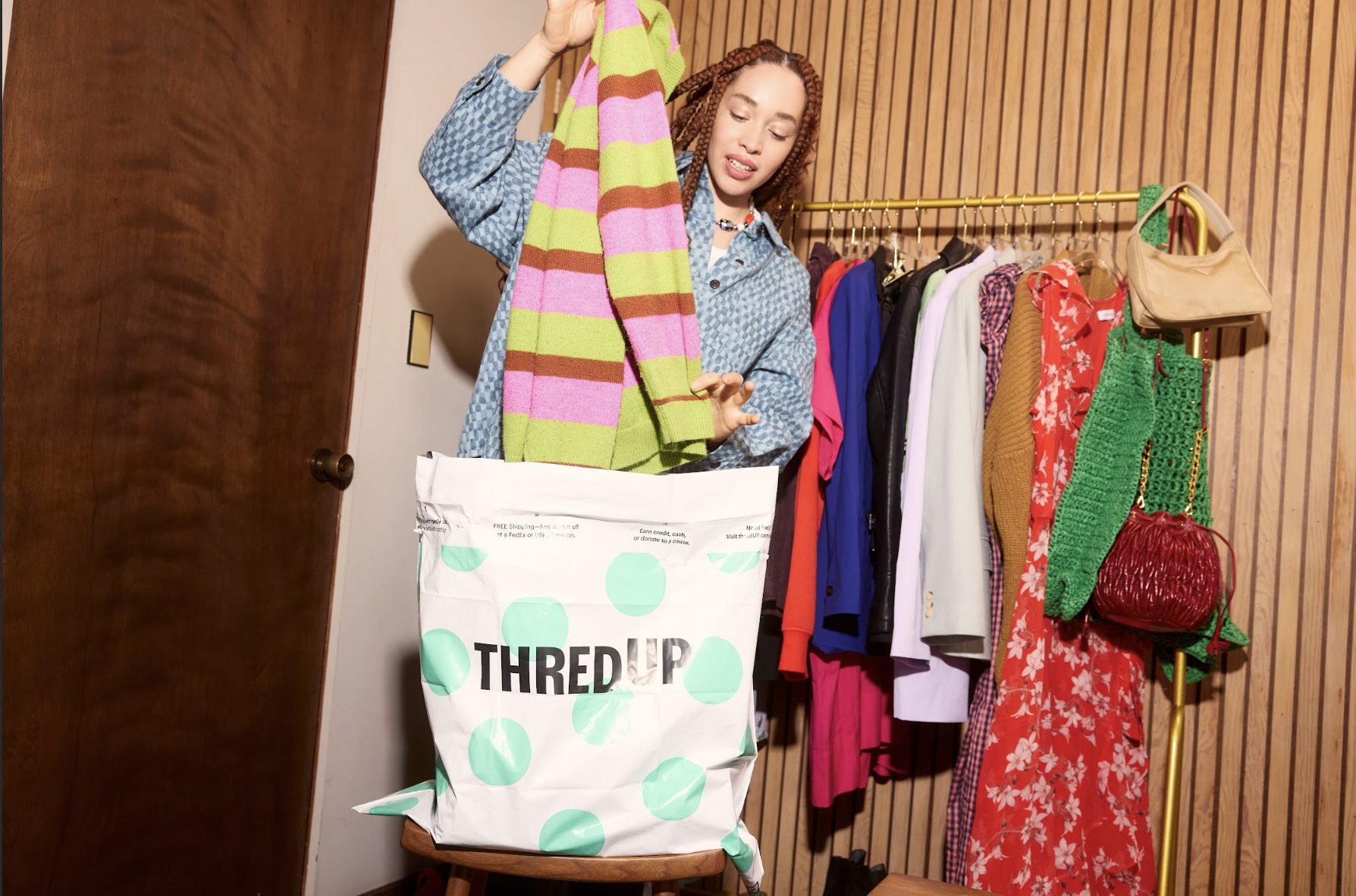
Our new Shop Social feature allows customers to upload inspiration links from social platforms, and we’ve upgraded our recommendation engine to deliver fully personalized product pages. These innovations make our vast catalog of over 4 million items feel like a personal boutique, transforming the thrifting experience to be as easy as buying new. This combination of a strong market tailwind and our technology-led operational efficiency is the true engine of our success.
Sherwood: You’ve narrowed losses significantly — what were the key operational moves that made the difference?
Reinhart: Before we divested Remix, our global earnings were reported on a consolidated basis. Because of this, many investors didn’t fully realize that our core US business had been adjusted EBITDA positive for seven consecutive quarters (almost two years). While our European operations, Remix, had previously weighed on our overall profitability, divesting that business has allowed us to drive positive free cash flow.
The divestment not only clarified our track record of profitability in the US, but also allowed us to finally achieve positive free cash flow and focus our resources entirely on the continued growth of our successful US business.
Our AI-led product innovations have been a key driver of this success. Over time we have processed more than 200 million items, and by leveraging our robust, proprietary dataset, AI helps us optimize everything from product search to dynamic pricing
Sherwood: With resale booming, how do you stay competitive against platforms like Poshmark, Depop, or brands launching their own resale arms?
Reinhart: In today’s on-demand economy, people want convenience, which is why services like Uber and DoorDash have become so popular. We’ve built our business around this insight. By making it easy for consumers to participate in the circular economy, we can attract and retain a broader customer base than our competitors.
We see brands launching their own resale programs not as a threat, but as a significant opportunity. We help our partners engage with new customers and grow their revenue, while making it even easier for consumers to keep more items in circulation and out of landfills.
Sherwood: You’ve said in past earnings calls that tariffs could actually help ThredUp. How is that?
Reinhart: The sweeping tariffs on apparel are a macroeconomic factor that we believe could create a major tailwind for resale. As the cost of new fast fashion increases, the value proposition of high-quality secondhand apparel becomes even more compelling for consumers.
With the recent federal legislation eliminating the de minimis loophole, the playing field for domestic resale is rebalanced against cheap, imported fast fashion that has flooded the US market in recent years. With a unique supply chain of apparel that is basically immune to tariffs, ThredUp is even more positioned to be a destination for shoppers seeking both value and sustainability.
By tapping into secondhand supply, brands can reduce their reliance on potentially volatile overseas supply chains, all while building authentic circularity into their core business model.
Sherwood: You’ve also mentioned a pullback in ad spend from Shein and Temu. Is that lowering your customer acquisition costs?
Reinhart: We have observed a pullback in ad spend from some of the fast-fashion giants, which has contributed to a more favorable advertising landscape, allowing us to acquire new customers more efficiently. But regardless of how others spend, we continue to focus on a balanced and efficient marketing strategy and are investing in a diversified set of channels that deliver strong returns.
Sherwood: How do you balance growth with caution in this economy?
Reinhart: The days of growth at all costs are long gone. But with durable momentum in the business, we continue to focus on profitable growth through operational discipline. Our recent strategic moves, including exiting Europe and optimizing our US operations, were all about creating a leaner, more efficient business that could scale up profitably.
We are not spending just to spend; specifically, our approach is to maintain our gross margin and bottom-line efficiency and reinvest the incremental dollars we generate back into growing new buyers and sellers in our marketplace. This means being smart about our capital allocation, continuing to drive operational efficiencies, and remaining laser-focused on the US market.
Sherwood: Your Resale-as-a-Service model has been a major differentiator. How is it evolving, and what role will automation or AI play in scaling it?
Reinhart: In Q1 of this year, we announced the next generation of branded resale by open-sourcing our front-end technology and back-end logistics. We’re now offering free customized branded resale shops paired with our clean-out programs to significantly reduce the barriers to entry. Our core competitive advantage — a profitable, managed marketplace — is what makes this possible. We have already invested hundreds of millions of dollars into purpose-built infrastructure that powers our platform.
With this approach, our brand partners can also take advantage of our continuous investment in automation and AI technology. For example, AI powers the white-labeled resale experiences for our partners and automates the physical processing of items with incredible speed and accuracy. This includes using our proprietary AI tools for image recognition, product categorization, and dynamic pricing, which is crucial for managing our high-volume inventory and onboarding new partners quickly.
Sherwood: If 2024 and 2025 were your turnaround years, what’s the headline for 2026 and beyond?
Reinhart: There are two headlines: “ThredUp’s renewed focus proved that resale can be profitable and sustainable,” and, “Resale is still a HUGE industry!”