Two hours reading opinions on sprinkles: How online reviews devour our lives
We’ve reached peak product review — and ironically, it’s turned online shopping into an oppressive drudgery.
Earlier this year, Alex Hart, a Seattle mother of two, set out on a seemingly straightforward task: she logged on to Amazon to buy-blue sprinkles, the finishing touch for cupcakes she planned to bake for her son’s elementary class. Soon, however, she found herself “sucked in” — something that happens often when Hart shops online. Before she knew it, she’d spent more than an hour reading reviews about blue sprinkles.
“You start looking through reviews and it’s like, ‘Oh, I’m learning new things,’” she said. For instance, Hart hadn’t considered many of the potential issues that reviewers brought to her attention: the sprinkles had a slightly chemical aftertaste, melted too quickly, or didn’t taste like sugar. “It got a little frustrating because I was like, ‘Why can’t I find sprinkles that just taste like sprinkles?’” she said.
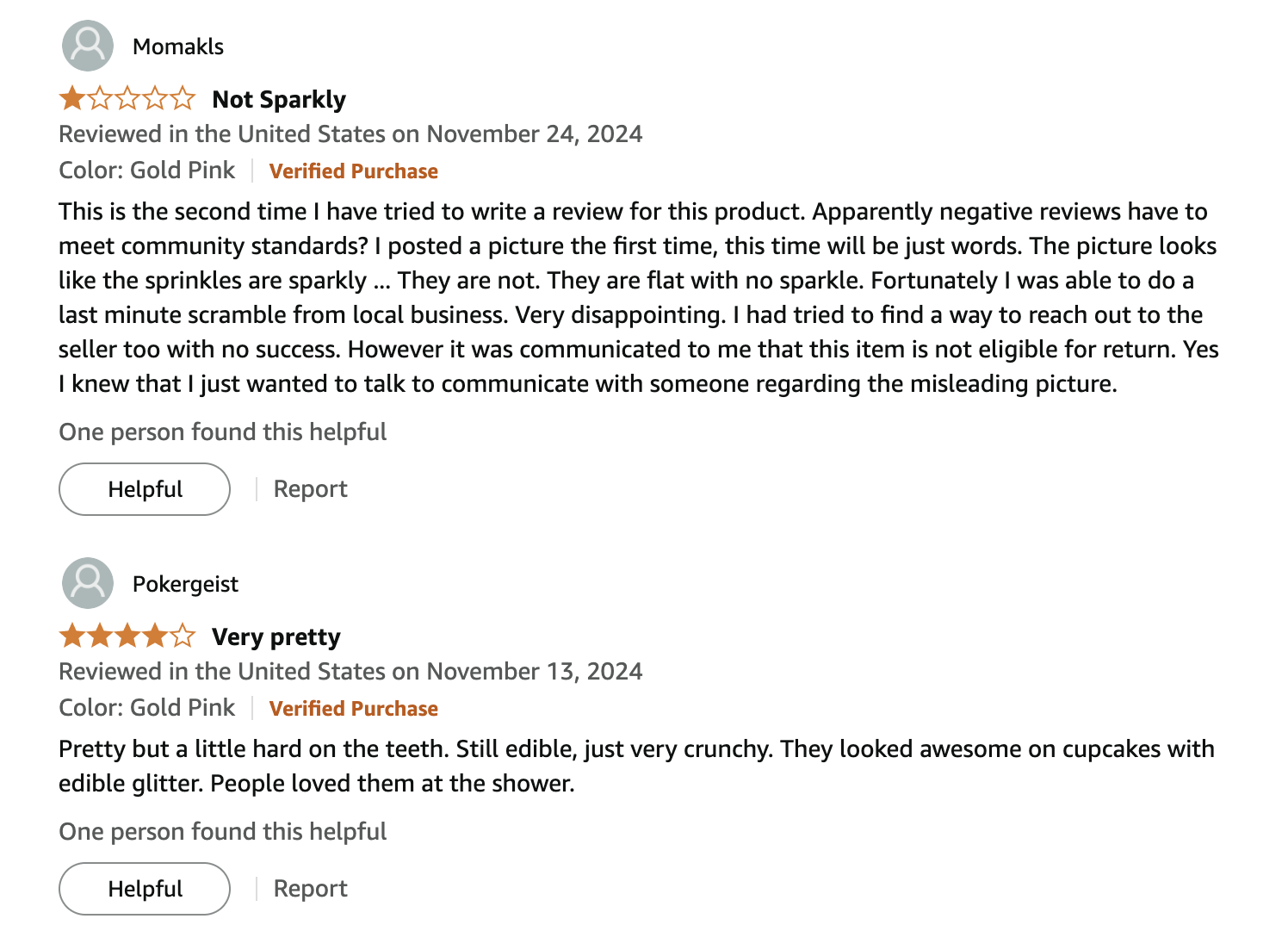
This process is not entirely unfamiliar to Hart, who, by her own estimate, spends five or six hours each week reading reviews on Amazon, often hunting for products with the highest possible rating. “These are not big-ticket items,” she said. “I’ll just need hairbands or whatever and I’m like, ‘Why am I looking at reviews?’”
Hart is not alone, either. Sifting through this glut of competing information has now become the way we shop: 93% of consumers take reviews into consideration before buying, while 58% read online reviews almost weekly. From garbage bags to flyswatters, buyers now have more products to decide from and more information available about them than at any other point in history. Rather than streamlining purchasing decisions, this saturation of information has unintended consequences. A survey this spring found that 85% of consumers reported feeling dissatisfied with their online-shopping experience, with a third saying that online shopping made them feel frustrated and anxious.
In interviews with people who shop online, many said they felt more confused about the products they bought than ever before. In addition to spending countless hours researching bath towels, bedsheets, and toasters, they felt increasingly uncertain about their own individual taste and style.
In the age of online shopping, the time it took to commute to a store and pick out items in person has been replaced with hours spent on product research. It’s also completely changed the way we shop: last fall, Rachel Chudoba, an Oklahoma-based system administrator, gathered her three children around the family computer to browse back-to-school supplies on Amazon, where they compared different backpacks and read reviews. “I used to buy backpacks at Target,” she said. “Now my kids and I sit down to read reviews about backpack straps. That took two hours.”
Miriam Glucksmann, a professor of sociology at the London School of Economics, described the hours of tedious scrutiny consumers put into researching trivial products as “the work of consumption.” With the advent of online shopping, “the market research is being transferred onto the customer,” she said. Salespeople have been replaced by crowdsourced information, making customers feel that they must become an expert on every purchase. “It is an oppressive task,” she said.
In the highly visual, intangible world of online shopping where thousands of products are available in any one category, it’s obvious why we read reviews: they give us a sense for a product that we haven’t touched, tasted, or tested out for ourselves. For many, reading reviews feels like a trustworthy, objective way to get a feel for something we’re interested in buying. Don’t take an advertiser’s word for granted; investigate it yourself.
“The irony is that we live in an age where there is so much information at our fingertips, but there’s less trust,” Marta Tellado, president of the consumer-advocacy nonprofit Consumer Reports, said.
A big reason for this lack of trust is that consumers have no way of knowing whether a review is authentic. As high as 40% of online reviews are deceptive or fake, and it’s often impossible to tell whether a positive review was written by an enthusiastic customer or someone incentivized by free products or cash. It’s a widespread problem on platforms like TikTok, where influencers shill everything from beauty products to furniture and often don’t disclose if they are paid or will benefit from your purchase.
It’s a lack of trust that extends to even longtime vetted authorities. The New York Times’ product-review site, Wirecutter, which launched in 2013 with a reviewing process so meticulous it bordered on absurdity. One notable example was its assessment of the best toilet paper, a process that took 10 months to determine. Today, readers regularly complain about the quality of recommendations on the site, which has been under pressure to produce many more product reviews, rapidly, at the expense of the formerly fastidious process.
It’s not only positive recommendations that are a problem. Negative reviews can be equally misleading, with business owners complaining about one-star reviews from vindictive employees or competitors. In the media and entertainment space, tactics like “review bombing” involve reviewers leaving scores of negative comments when they anticipate a movie, book, or video game to be offensive or off-putting — often without even watching the movie or reading the book. It’s a problem known to affect sales so adversely that Take-Two Interactive, the parent company of Rockstar Games, the publishers of “Grand Theft Auto” included a warning to its stockholders in a 2023 financial filing that review bombing might affect its revenue.
Adding to the complexity are chatbots like ChatGPT, which have made generating fake reviews even easier. “We’re seeing a new type of warfare emerging,” said Saoud Khalifah, the founder of Fakespot, a tool that flags fake reviews. “Generative AI allows you to do all these things at a different level.”
As an example, Khalifah showed me one of the first results for a Bluetooth headset on Amazon, a category notorious for fake reviews. A closer look at the reviews revealed that they had all been written within several days of each other in the same dense, essay-style prose. “Normal consumers don’t do this,” Khalifah said. “If everything is painted so perfect, then there’s something off.”
All this bad behavior comes at a steep cost to the consumer. “The burden is on the consumer to decode what is good information versus what is bad,” Tellado said.
Many people told me they spent more time reading online reviews for trivial products like sunscreen and flyswatters than they did researching big purchases like a dishwasher or a new car. Buying big-ticket items is less confusing because these products are often reviewed in vetted guidebooks and there are fewer options available. Basically, there are simply fewer hybrid, all-wheel-drive hatchbacks than there are brands of no-slip socks.
This was true for Chudoba, who said she spent more time investigating the best type of shoes she should buy for her toddler than she did researching the Chevy Highlander she bought seven years ago. The process of shopping for her toddler’s shoes was “a multiple-weeks-long” undertaking that involved consulting different websites, reading Amazon reviews, and trying on shoes at different department stores.
Again and again, people mentioned a sense of creeping anxiety when shopping online: the need to buy the best product with the highest rating all the time, whether they were shopping for confetti, hairbrushes, or plastic cutlery — even if it cost more. Aaliyah Damoussi, a 29-year-old in London, said that if she finds a product that has 4.7 stars she’ll often keep searching, thinking, “I’m sure I can find one that is 4.8 stars or 4.9 stars,” she said.
Hart said that if she buys a product with fewer than five stars on Amazon, her husband will invariably glance at their shared account and ask why she bought something with a low rating. “He’ll say, ‘You need to do your research.’”
In psychology, people like Damoussi and Hart who seek to maximize the benefit from every purchase they make are called “maximizers.” On the other side of the spectrum are “satisficers,” people who make decisions based on fewer criteria who report greater satisfaction with their purchases, even if what they buy is only “good enough” rather than “the best.” Psychologists have shown that maximizers tend to be more dissatisfied with the choices they make.
“Having the standard that only the best will do is a recipe for misery,” Barry Schwartz, a psychologist and author of the book “The Paradox of Choice: Why More Is Less,” said. “No matter how good things get, you will always wonder if there’s something better.”
The internet is hardwired to manufacture this particular brand of buyer’s remorse. Despite hours of research, many people said they felt dissatisfied with the products they bought online and frequently made returns. Several recounted being served ad after ad of versions of the very product they’d spent so much time scrutinizing — a persistent reminder that an even better version might still be out there. This, Schwartz said, is all by design. “The animating energy of commerce is dissatisfaction,” he said.
Damoussi, who consults the internet’s opinion for nearly everything she buys, said that she feels this way of shopping has not only made her less decisive, but caused her to lose sight of her own individual taste. “I need constant confirmation from other people,” she said.
Reviews can cultivate dissatisfaction, even after purchasing a product. Philipp, a 35-year-old public-relations manager in New York, said that reviews influenced him to return a new Apple MacBook. After reading that the laptop ran slightly slower than other MacBooks, Philipp exchanged the computer the next day for a different model, even though he hadn’t actually noticed any issues with the computer himself. “I don’t ever want to feel like my laptop is slower,” he said. “It doesn’t matter if it’s just in my mind.”
The mere existence of reviews can make people doubt their decisions when making purchases. This was something that Danielle Baskin, an Oakland-based entrepreneur, experienced when she bought groceries online for the first time. At the grocery store, Baskin said she often selects the cheapest version of an item — in this case, canned beans. But when shopping online, she noticed that the cheapest brand of beans available had only four out of five stars.
“Why isn’t it five stars?” she asked herself. Upon reading the reviews, she found that some users complained that the four-star beans had a slightly metallic flavor. In the end, she bought a more expensive brand of beans with a higher rating. “It’s like I need to have a five-star experience all the time, even when it comes to canned beans,” she said. “It’s totally dystopian to me how much reviews matter.”
There is an antidote to the constant quest for seeking out better and better products, Schwartz said, and it’s this: learn to settle. “Being a satisficer is all about looking for ‘good enough’ rather than ‘the best,’” he said. “People often feel they’re doing something wrong when they settle because settling feels un-American. But settling is not a neutral decision. Sometimes you just have to decide that you’re going to get a toaster that’s ‘good enough’ and move on with your life.”
Zoë Bernard is a journalist in LA who writes about culture and tech. She previously covered technology for The Information and Business Insider.