Business
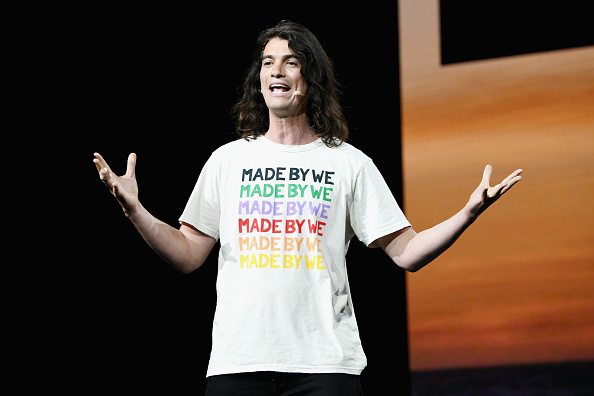
WeWork Presents Second Annual Creator Global Finals At Microsoft Theater
Michael Kovac / Getty Images
WeBack

Welcome back, Adam Neumann

Five years after stepping down as CEO, Neumann wants to buy back WeWork.

Jack Raines

Nobody is better at capitalism than Adam Neumann. A month after his attorneys published a letter detailing Neumann’s desire to purchase WeWork out of bankruptcy, the ousted founder made a $500 million offer to buy his former company.

While the source of the financing is not yet known, Adam Neumann has extracted enough money from SoftBank, WeWork’s biggest investor who ultimately incinerated $16 billion trying to save the company, that he could afford to finance it himself.

A brief timeline of Neumann’s wealth accumulation:

  • In 2017, Neumann sold a $361 million stake in WeWork to SoftBank as part of the Japanese firm’s initial investment in the company. (Benchmark, one of WeWork’s first investors, also sold $315.5 million of shares to SoftBank between 2017 and 2019).

  • In September 2019, Neumann stepped down as WeWork’s CEO as the company’s IPO was pulled due to mounting investor pressure stemming from disclosures in its IPO filing.

  • In October 2019, SoftBank, determined to save its crown jewel, crafted an $8 billion dollar financing round that would have paid Neumann $970 million for his shares, $185 million in a consulting fee, and a $500 million line of credit.

  • In April 2020, SoftBank bailed on the deal (in which the equity proceeds would have gone to existing shareholders).

  • In May 2020, Neumann sued SoftBank for not paying him his roughly $1.7 billion.

  • In February 2021, SoftBank settled its its legal dispute with Neumann, paying him $480 million for half of his shares, as well as a $185 million payment for a non-compete agreement, $106 million in other settlement fees, and an extension on a $432 million loan, which (very important detail!) was secured by his remaining 48.5 million WeWork shares.

  • In October 2021, WeWork went public through a SPAC, finishing the day at $11.38. Neumann’s remaining 48.5 million shares, as well as his 19.9 million converted  “WeWork Partnerships Profits Interest Units,” were worth a combined $778 million.

  • In November 2023, WeWork filed for bankruptcy, sending the value of Neumann’s loan collateral to near-zero, effectively allowing him to keep the hundreds of millions that he still owed SoftBank. 

SoftBank, in total, paid Neumann approximately $1.5 billion between share purchases, legal fees, and a now collateral-free loan for the privilege of destroying their $16 billion dollar investment. And now Neumann could buy the whole company back for 1% of its peak valuation.

Not to be forgotten, in August 2022, Neumann also raised $350 million at a billion-dollar valuation from Andreessen Horowitz for Flow, his residential real estate startup aiming to craft community-driven living experience. Public information about Flow, which was set to launch in 2023 but has yet to publish a functioning website, is scarce, but some of its properties appear to be having cash flow issues.

Stay winning, Adam.

More Business

See all Business
business

The Trump administration is reportedly planning a 50% made-in-America requirement for USMCA tariff relief

Qualifying for USMCA-related lower tariffs may soon require more US-made vehicle components, according to reporting by The Wall Street Journal.

The Trump administration is reportedly planning to introduce a 50% US content requirement for vehicles covered by the trade pact to receive lower tariffs. The content would be measured by cost, according to the WSJ.

There currently isn’t any US-specific requirement for those lower tariff rates, but in order to receive preferential tariffs, vehicles are must contain at least 75% regional content (components made in North America). Per Reuters reporting, the Trump admin is seeking to raise the regional requirement to 82%.

These reported plans are subject to change as the US negotiates USMCA terms with Mexico over the next few months.

Overall, Tesla will likely have the easiest time qualifying for any stricter requirements. The automaker’s vehicles contained the highest amount of US/Canadian content in 2025, according to American University research. Ford, GM, and Stellantis all scored lower.

Notably: the underlying government data that many domestic content measurements rely on intentionally combines US and Canadian components, so it’s difficult to know exactly how much of any given vehicle is specifically US-made.

There currently isn’t any US-specific requirement for those lower tariff rates, but in order to receive preferential tariffs, vehicles are must contain at least 75% regional content (components made in North America). Per Reuters reporting, the Trump admin is seeking to raise the regional requirement to 82%.

These reported plans are subject to change as the US negotiates USMCA terms with Mexico over the next few months.

Overall, Tesla will likely have the easiest time qualifying for any stricter requirements. The automaker’s vehicles contained the highest amount of US/Canadian content in 2025, according to American University research. Ford, GM, and Stellantis all scored lower.

Notably: the underlying government data that many domestic content measurements rely on intentionally combines US and Canadian components, so it’s difficult to know exactly how much of any given vehicle is specifically US-made.

business
Tom Jones

The $640,000 Luce makes the average Ferrari look like a bargain

Put aside the shape; put aside the smoothing out of Ferrari’s iconic sharp edges; put aside, even, the calls from former Chairman and President Luca Cordero di Montezemolo to “take the Prancing Horse off.” On the grounds of price alone, Luce detractors might have a point.

By now, many of us will have read the criticisms of Ferrari’s first fully electric vehicle, as the Luce — which was unveiled to the world earlier this week and promptly saw the company’s shares crash out in New York and Milan — gets subtly shaded by competitors online and not-so-subtly shaded by basically everyone else.

What makes all of this worse for Ferrari is that, even by the luxury car maker’s notoriously high standards, they’ve slapped a pretty hefty price tag on the Luce, and the company’s CEO, Benedetto Vigna, has already been forced to defend the €550,000 ($640,000) price point, saying yesterday that it’s “fair to pay for innovation,” per Reuters.

While Ferrari’s cars have been getting more expensive of late, as recently as 2022, Ferrari’s average revenue per car sold was around $340,000. At nearly twice that price, this new electric model is obviously proving a little much (visually, conceptually, and financially) for many loyal and long-standing fans of the Prancing Horse to stomach.

Ferrari Luce cost chart
Sherwood News

By now, many of us will have read the criticisms of Ferrari’s first fully electric vehicle, as the Luce — which was unveiled to the world earlier this week and promptly saw the company’s shares crash out in New York and Milan — gets subtly shaded by competitors online and not-so-subtly shaded by basically everyone else.

What makes all of this worse for Ferrari is that, even by the luxury car maker’s notoriously high standards, they’ve slapped a pretty hefty price tag on the Luce, and the company’s CEO, Benedetto Vigna, has already been forced to defend the €550,000 ($640,000) price point, saying yesterday that it’s “fair to pay for innovation,” per Reuters.

While Ferrari’s cars have been getting more expensive of late, as recently as 2022, Ferrari’s average revenue per car sold was around $340,000. At nearly twice that price, this new electric model is obviously proving a little much (visually, conceptually, and financially) for many loyal and long-standing fans of the Prancing Horse to stomach.

Ferrari Luce cost chart
Sherwood News

Latest Stories

Sherwood Media, LLC and Chartr Limited produce fresh and unique perspectives on topical financial news and are fully owned subsidiaries of Robinhood Markets, Inc., and any views expressed here do not necessarily reflect the views of any other Robinhood affiliate, including Robinhood Markets, Inc., Robinhood Financial LLC, Robinhood Securities, LLC, Robinhood Crypto, LLC, Robinhood Money, LLC, Robinhood U.K. Ltd, Robinhood Derivatives, LLC, Robinhood Gold, LLC, Robinhood Asset Management, LLC, Robinhood Credit, Inc., Robinhood Ventures DE, LLC and, where applicable, its managed investment vehicles.