
The Glass Backboard
The mysterious finances of the WNBA
The league is doing better than ever — so why is it losing so much money?
This past spring, the WNBA underwent a transformation. It was not the arrival of mega-talented new players — the highest-profile class of rookies in the league’s 28-year history, including Caitlin Clark, Angel Reese, and Rickea Jackson, though that was part of it. Nor did this change have to do with the explosion in attendance and TV viewership, giving the league — which headed into the playoffs this week — its most-watched regular season in 21 years. Though that played a role too. The change had less to do with the game or the greater spectacle than it did with a boring logistical concern: transit.
For years, WNBA teams had been begging for charter flights, a common perk in the NBA (imagine LeBron flying commercial). The WNBA, founded in 1996, a half century after the NBA, has long been seen as the latter’s money-losing little sister. Though many of the 12 WNBA teams share owners with their NBA counterparts, they’ve never shared the same viewership, TV ratings, or revenue. The yawning gap in their popularity made the league a punchline about pay equity, where rookies like Clark could still expect the salaries of a middle-school principal. While the average NBA salary clocks in at just over $12 million, the average WNBA player takes home about $119,600. (Clark’s base pay is still lower: $76,000 for her first year.) Even the league’s top talent maxes out at about $250,000. The per-team salary cap sits at just $1.46 million — compared to the NBA’s cap of $136 million.
Because the WNBA has never been much of a profit generator, its players long lacked many of the luxuries of professional sports. Its stars spend the offseason playing overseas in places like Turkey, Egypt, and Russia — where Phoenix Mercury center Brittney Griner was detained for 10 months over a hash-oil vape. It seemed to some like an added indignity that, while their male equivalents flew in private jets, the female players had to squeeze into economy plus.
Yet the request had always been written off as an unaffordable expense. Team owners tried to come up with work-arounds. In 2022, Sports Illustrated reported that one WNBA owner floated an “unofficial proposal” to independently fund three years of charter flights, but it never passed. (The WNBA denied such a plan existed. Later, the owner in question, the New York Liberty’s Joe Tsai, was fined $500,000 for arranging such flights for his own team.) The league’s refusal to consider the question, even when someone offered to foot the bill themselves, amounted to something of a mystery, all the more so because the cost of such an investment — $25 million a year — would have been little more than a rounding error for the NBA, which generates about $10 billion in revenue annually. It wouldn’t be charity for the NBA to subsidize some of the cost, either; the men’s league owns 42.1% of the WNBA, while the 12 team owners control another 42.1% (the remaining 15.8% was sold off to independent investors during a 2022 capital raise). Despite their equal equity share, the NBA seems to have more weight than the W owners. As Atlanta Dream co-owner Suzanne Abair once put it: “If the 12 WNBA owners say they want to do something and the NBA says no, the answer is no.”
But in May, Commissioner Cathy Engelbert stunned players by suddenly announcing that the league had decided it could afford charter flights. In fact, it would start funding them right away, allocating some $50 million to cover the cost for two years. Commentators speculated that the about-face had to do with superstar Caitlin Clark, who had been flying private on her college team and claimed in interviews that the transition to commercial would be “an adjustment.” The abrupt shift seemed to take even players by surprise: the rollout was so last-minute that many teams had already booked commercial travel.
“That illustrates exactly how the W makes its decisions, because it’s pretty clear that they made the decision that day,” David Berri, an economics professor at Southern Utah University, told Sherwood. Berri and former college-basketball player Nefertiti Walker wrote about the WNBA’s finances in their recent book, “Slaying the Trolls: Why the Trolls are Very, Very Wrong About Women and Sports.” “Suddenly the WNBA goes, ‘You know what? Turns out we have the money. I thought we didn’t have the money, but we looked under the cushion in our offices and there was the money,’” he said.
The incident seemed to sum up the WNBA’s situation today: a young league with relatively undisclosed finances, adjusting in real time to a massive surge in interest. “We’ve seen such tremendous interest,” said Tamika Tremaglio, the former executive director of the National Basketball Players Association and managing partner at TA Sports Ventures, “not only because of Caitlin Clark and Angel Reese, but just the game is getting more viewership in general.”
“This is a year like no other for the league in terms of their growth,” Nola Agha, a professor of sport management at the University of San Francisco, said. “If you chart their revenues over time, it’s been up and down, but relatively flat or slow growth. And obviously this year is an explosion in terms of the rate of growth.”
The WNBA has been on a gradual ascent over the past few years. In 2020, the league launched WNBA Changemakers, a revamped sponsorship program that courted mainstays like Nike and Google for multiyear investment deals. Two years ago, Engelbert announced what was then the league’s “largest-ever capital raise”: a pot of $75 million backed by a group of current NBA and WNBA owners as well as an eclectic mix of investors, including Emerson Collective’s Laurene Powell Jobs, two-time NBA All-Star Baron Davis, and former Secretary of State Condoleezza Rice.
But that $75 million is almost quaint. Last spring, the New York Liberty became the league’s first team to rake in $2 million on a single game. A 13th team, the Golden State Valkyries, backed by the Warriors, is set to join the league next year, injecting another $50 million over the next decade. Three more expansion teams, including additions in Portland and Toronto, are expected to join by 2028. New sponsors seemed to emerge faster than the league could manage. In May, the Las Vegas Tourism Board announced a sponsorship for the Las Vegas Aces that would have given each player $100,000 — only for the league to turn around and open an investigation into the deal, out of concern it could give players “an undue advantage in free agency.” Other sponsorships have been more warmly received: Kim Kardashian’s Skims, the “Official Underwear Partner of the WNBA,” earned $3.8 million in media exposure from a photo campaign over its first 10 days.
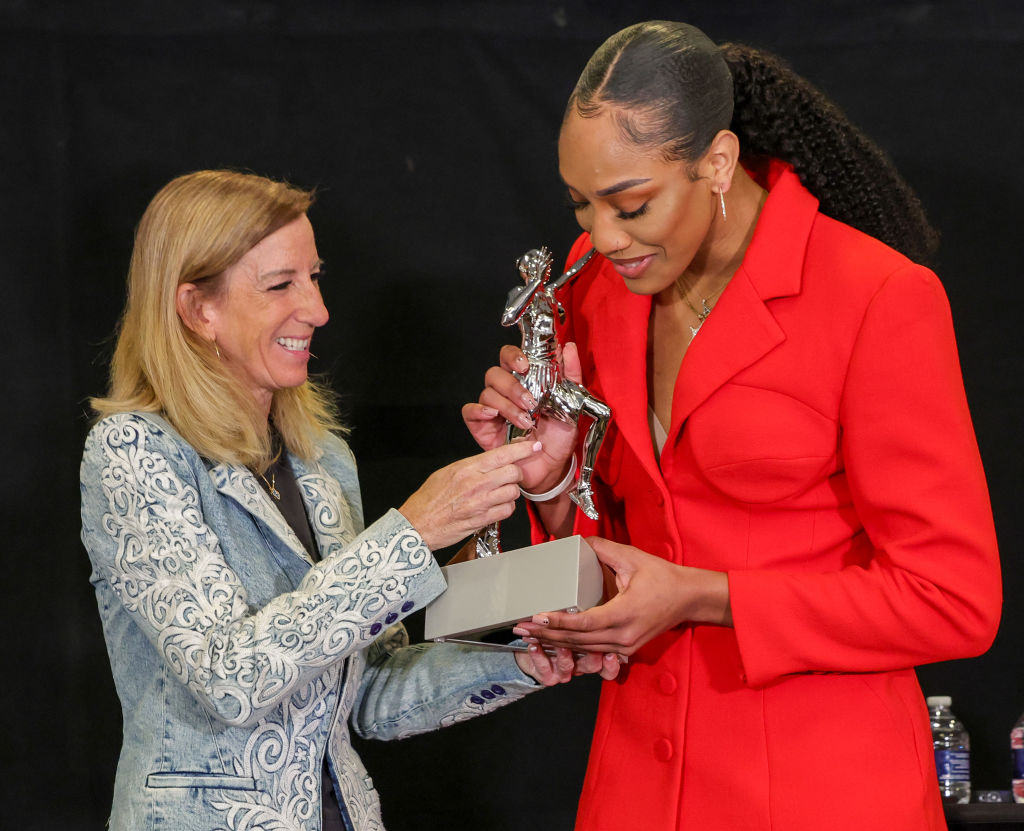
Perhaps most important, in July the league secured a historic media-rights deal. Until this summer, their TV deal was valued at about $60 million per year, a sum many saw as undervalued. Consider that Major League Soccer, founded just before the WNBA and averaged hundreds of thousands fewer viewers last year, sold its media rights to Apple TV in 2022 for an annual $250 million, or $2.5 billion over the decade-long contract. But the league’s new deal was negotiated this summer as part of a $77 billion package with the NBA. Some $2.2 billion of that will go to the WNBA over 11 seasons, averaging about $200 million a year — less than Major League Soccer, but a little more than three times its current haul.
“On the business side obviously it’s been a good injection of revenue, new fans, new viewers, and people just excited about women’s basketball,” said Jennifer Rizzotti, team president of the Connecticut Sun and head coach for the USA 3x3 Women’s National Team at the 2024 Olympics. “Now the challenge is to continue to take that momentum and turn it into something that’s sustainable.”
One might think the influx of cash and upsurge in popularity might have improved the WNBA’s overall financial situation. And in recent years it has. In 2023, for example, the league reported revenues of $200 million, double their $102 million income from 2019. But in June, The Washington Post reported a curious development. According to two unnamed sources “with knowledge of the figures,” the WNBA is on track not to break even, or generate a profit, but to lose money this year. In some ways, this is unsurprising; the W has historically reported losses. Back in 2018, NBA Commissioner Adam Silver said the league loses about $10 million a year, on average. But as the Post reported, the WNBA is poised to lose much more than usual: $50 million, meaning their losses have quintupled, even as their revenue has spiked. “Ten years ago, when the revenues were smaller, the WNBA claimed, ‘We’re losing $10 million a year,’” Berri said. “Now the revenues are $200 million. They’ve doubled, and now we’re losing $50 million a year. Are you telling me the revenues are escalating and so are your losses? How does the math work on that?”
What could account for the sudden loss? The WNBA did not respond to requests for comment. But the particulars of the league’s financial headache can be hard to detangle, in part because its financial data is not public. Unlike the NBA, whose team valuations and revenue estimates abound in outlets like Forbes, there are few hard numbers about the WNBA’s accounting. The numbers that do come out tend to come from either the league itself or the NBA, with few specifics or supporting data.
Agha said that, on the one hand, it’s “entirely normal” for startup leagues to declare losses in their early years, as they may be reinvesting any positive cash flow back into the business. “In fact, it’s really normal for all companies to have losses for many years,” she said. “Major League Soccer — which is maybe the closest comparable — it took them at least a decade” to turn a profit, “if not more. They lost hundreds of millions of dollars and they had two billionaires that basically kept the league afloat for about a decade.”
Notably, the WNBA’s current hole is the exact same size as the cost of the charter program, so it’s possible the disparity arose from the sudden investment in plane travel. But press releases about the charter program seem to attribute the new investment to the $75 million capital raise from 2022. Even if the funding did not come entirely from that raise, one would think the additional capital might cushion the loss.
But both Agha and Berri offered another possible explanation. It’s common, Agha said, for professional teams and leagues to use accounting practices and legal tax loopholes to declare a loss “even if they’re cash-flow positive and even if the asset value of the business is increasing every year.” She attributed the practice to two primary motivations. First, declaring a loss can help leagues justify the need for public subsidies to fund stadiums and arenas. It can also give the league leverage in contract deliberations, helping management negotiate player salaries down in their collective-bargaining agreement.
“The WNBA has no story here. They don’t have any evidence that says they’re not making a profit. They just have an assertion. They assert it. And I know why they assert it,” Berri agreed. “If the WNBA came out and said, ‘OK, we lied. We have a lot of money. We’re making a profit,’ the women would instantly say, ‘Why are you paying us so little?’”
Perhaps there’s the rub. The WNBA’s collective-bargaining agreement, ratified in 2020, is set to expire in 2027, but the union has the option to opt out in November. That opens up the players to renegotiate in 2025, potentially securing higher salaries and more favorable marketing agreements. “It sounds like it’s likely, from the comments that we’ve heard from the players, that they’re ready to renegotiate,” Rizzotti said. “It’s a favorable time for the players and the owners to come to a new agreement.”
A new contract would give the players an opportunity to address a long-running concern: they still don’t receive, as the Los Angeles Sparks’ Chiney Ogwumike put it, an “equitable share of basketball-related income” under their current agreement. Even as the WNBA’s earnings have exploded, player compensation was already set by the 2020 bargaining agreement. As a result, their salaries as a share of total revenue have trended down, rather than up — from 11.1% to 9.3%.
If anything, the true inequality between the men’s and women’s leagues is not their salaries — as the NBA does generate many multiples more in revenue than the WNBA — but in the percentage of league revenue that goes to players. In the NBA, players take home roughly 50% of the league’s total revenue, a percentage similar to the MLB, NHL, and NFL, and even smaller leagues. But as Berri and Walker note in “Slaying the Trolls,” WNBA players have historically taken home a fraction of that. Last year, for example, when the league made an estimated $200 million, the players’ combined salaries were just $17 million, giving them about 10% of the total pie. That’s a slice far smaller than what the NBA was paying even back in its early years, when the league was making less money than the WNBA today.
“To put it another way,” Walker and Berri wrote, “the WNBA players in 2023 were paid worse — in percentage terms — than at any time period in NBA history.”
The WNBA’s financial situation sits in especially stark contrast to the NBA today, where revenues and team valuations are so high that in 2020, the league owners voted to allow private-equity funds to buy passive minority stakes in teams. The investments are limited: only a handful of firms can invest in NBA teams, and their stake is capped. No one equity provider can acquire more than 20% of an NBA team and funds are barred from having governance rights. But the move amounted to what private-capital magazine Buyouts called a “veritable revolution.”
NBA players could share some of the wealth. The NBA’s latest collective-bargaining agreement, ratified last summer, includes a provision allowing NBA players to purchase minority stakes in independently owned WNBA teams — meaning those that don’t share ownership with an NBA team. These stakes are capped too, at 4%. The idea was to build off the recent enthusiasm toward the WNBA and interest from former NBA stars like Magic Johnson, whose investor group bought the LA Sparks in 2014, and Dwyane Wade, who bought a minority stake in the Chicago Sky last summer. According to Tremaglio, no active NBA players have invested in the women’s teams yet. Still, the contract has been in effect for only one year. “It’s pretty early,” she said. “And as you know, it’s changing so much now.”
The league is certainly growing at a rapid clip. Earlier this year, Engelbert told CNBC that the average franchise valuation has grown tenfold in the past four years alone. “You would think that there would be a lot of interest in investing in the WNBA at this time — if it’s allowed by team rules. The reason I say ‘if’ is that it’s still unclear,” Agha said. “Nobody that I have ever met understands exactly the business structure and who owns the league and what portion and what control they have… As far as I know, the rules are not public.” Put another way, it could be a while before anyone knows how they funded those planes.
Tarpley Hitt is a journalist in New York. She is working on a book about Barbie.