As bitcoin flirts with hitting $100,000, its case for being digital gold has never been stronger
Charting every single day of bitcoin for the last decade reveals that not only is it more valuable — it’s also less volatile. For now.
There’s an old genre of internet joke, archived on Reddit:
“A boy asked his Bitcoin-investing dad for $10.00 worth of Bitcoin.
Dad: $9.67? What do you need $10.32 for?”
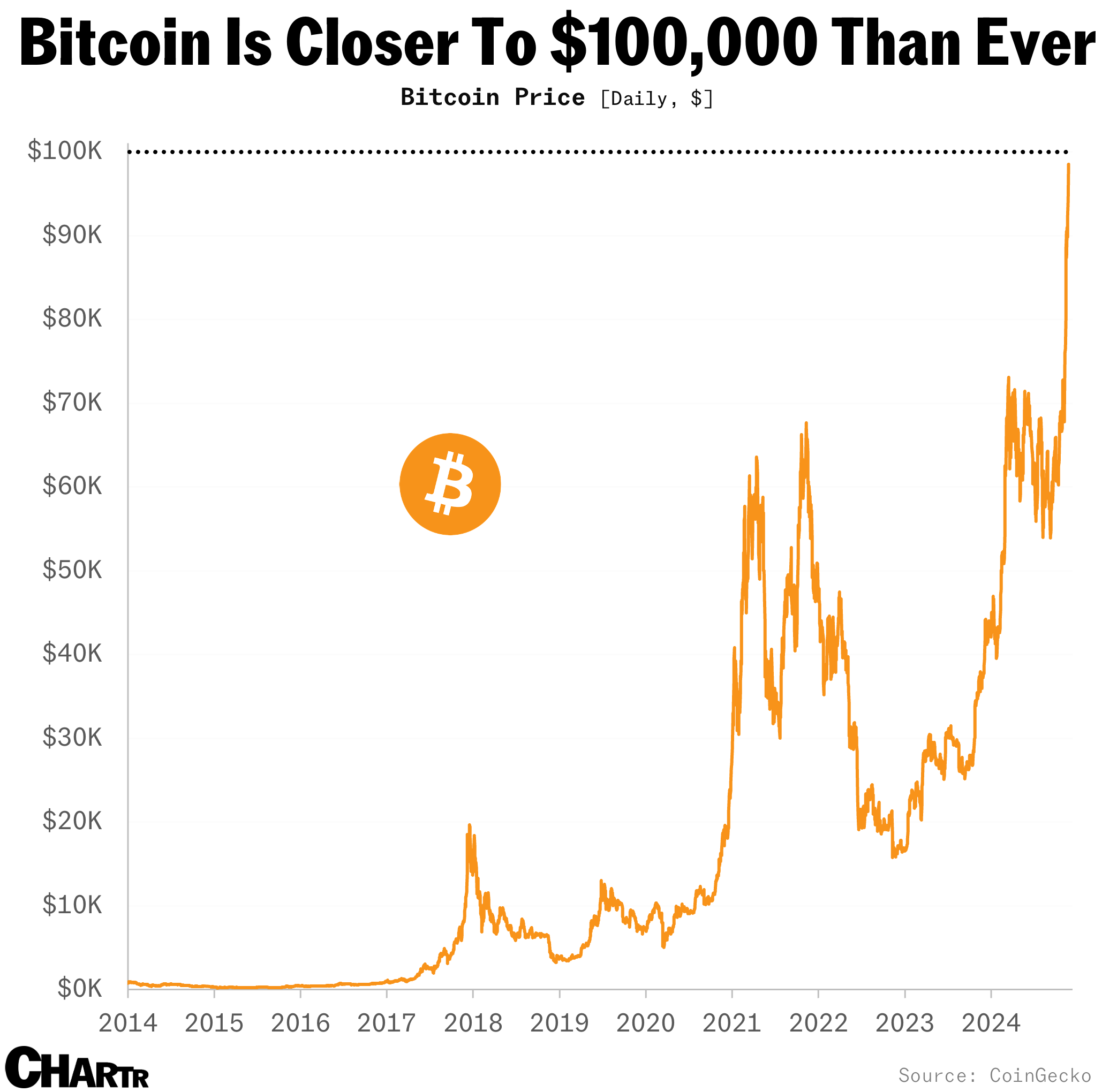
Playing on the trope that bitcoin was wildly volatile, the joke was popular in years gone by, ridiculing crypto enthusiasts for the obvious flaw in their blockchain-backed store of value. But, with bitcoin prices soaring over the last month, that joke is feeling a lot less funny. At the time of writing, the cryptocurrency is flirting with the exciting but completely arbitrary price milestone of $100,000 per bitcoin.
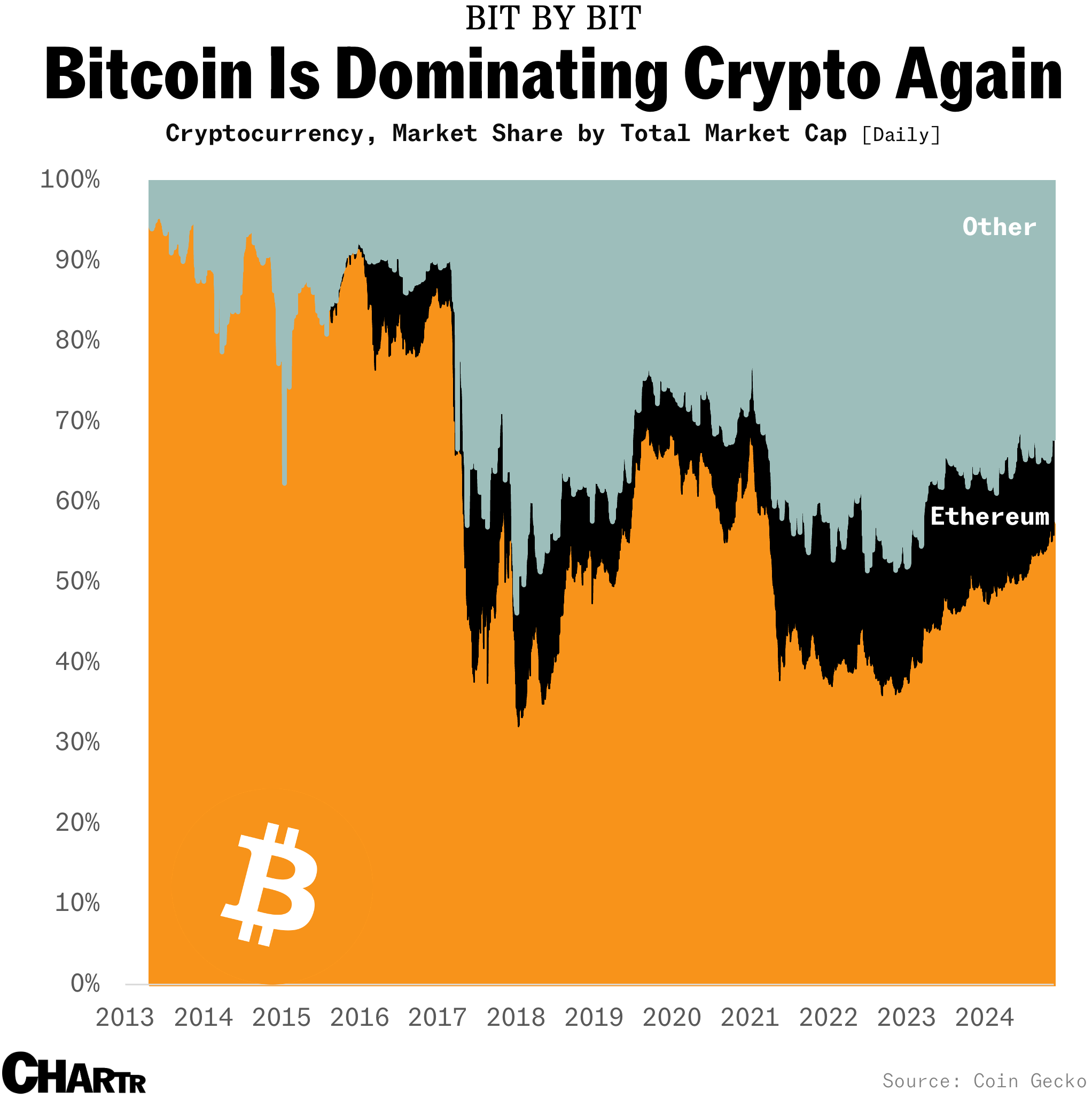
As the original cryptocurrency, bitcoin has never not been the top dog in the Wild West of crypto. However, as altcoins and NFTs gained traction in the pandemic, many predicted that bitcoin may have squandered its first-mover advantage — but bitcoin’s comeback has been swift. Indeed, even with altcoins like ethereum and meme coins such as dogecoin, shiba inu, and Pepe rallying in recent weeks and months, bitcoin’s dominance is once again unquestionable. At the latest count, bitcoin currently accounts for more than 60% of the value of all crypto assets globally.
The last time bitcoin went past the 60% crypto-dominance mark was back in March 2021, only a few months before the market began to turn. That was the start of a brutal period for the industry — a bitter crypto winter — which saw prices plummet, bitcoin’s dominance drop to ~40%, and global exchange FTX blow up.
The flurry of negative headlines from 2021-22 led to a steady stream of selling from many speculators. Crypto godfather Elon Musk’s decision to stop Tesla from accepting bitcoin as a payment, citing the token’s environmental toll from mining, was one. China’s crypto crackdown, then a consequent ban in September — in a country where half the world’s bitcoin-mining power was generated — was another. Security breaches, waning appetite from institutional investors, major scandals like FTX, and the onset of rampant inflation in major economies put a dampener on crypto and bitcoin speculation.
But in the last two months, and especially since Election Day, bitcoin has soared, with all the bitcoin in the world now worth nearly $2 trillion — not far off the market cap of Google owner Alphabet. Much of the recent rise has been attributed to the return of the “crypto president.” SEC Chair Gary Gensler, who had been a fierce critic of many crypto-related projects, announced his resignation yesterday, making way for a Trump nominee to run the powerful regulator.
But bitcoin’s renewed dominance isn’t solely a “Trump pump” story; institutional investors have also been slowly getting comfortable with the asset.
Institutional inflows and interests, especially after climbing out of a bear market, have centered around bitcoin. Gold, which itself is having a glittering year, has long been a financial curiosity. Yes, we use gold for jewelery and the like, but the not-very-useful metal’s role as a globally important financial safe-haven asset is largely a societal construction. Gold is extraordinarily valuable in part because for decades we’ve all simply agreed that it is so. Increasingly, some people seem to feel the same about bitcoin.
All that glitters is (not) gold
Bitcoin advocates have long made the case for the longest-standing cryptocurrency to become a kind of “digital gold,” an argument that’s increasingly compelling with its large market cap, high liquidity, and established reputation. Along with being the gateway cryptocurrency, it also has a devoted group of fans, also known as “bitcoin maximalists,” who believe the coin actually is the currency of the future. Trump has even considered creating a bitcoin reserve, in a similar vein to the United States’ enormous actual gold reserve.
Bitcoin’s new “safe asset” appeal has echoed the success of US spot exchange-traded funds, with many popular products focusing on bitcoin over its biggest altcoin counterparts like ethereum. In the Messari Mainnet conference in October, Robert Mitchnick, BlackRock’s head of digital assets, conceded that the performance of the company’s ethereum-based ETFs were “underwhelming” compared to its bitcoin ETFs. Indeed, US bitcoin ETFs now hold a massive $105.91 billion in assets, compared to $9.77 billion of ethereum, as of November 22. Even big investment banks like Goldman Sachs are now dabbling in bitcoin ETFs.
But, remembering our joke with the dad and son: is bitcoin really a lot less volatile than it used to be? We’ve crunched the numbers on every single daily move in bitcoin for the last ~13 years to find out.
Per data from CoinGecko, bitcoin has been a lot less likely to move >10% in either direction in 2023 and 2024 compared to previous years. Indeed, in any 24-hour window tracked by CoinGecko, bitcoin hasn’t closed down more than 10% from its previous close at any point in 2023 or 2024 (though it has swung wildly intraday).
Of course, it’s easy for volatility to look lower when prices are going up. Bitcoin is still tightly wound with other speculative, risk-on assets. As Luke Kawa pointed out yesterday: “Through a sophisticated cryptography-based peer-to-peer currency you have created ‘the Nasdaq 100, but on steroids.’”
Furthermore, while bitcoin may be less volatile than it used to be — it’s not swinging up or down 10% or 20% in a single day very frequently these days — it’s still a lot more volatile than actual gold itself. Indeed, data from Koyfin reveals that bitcoin’s volatility over the past year has been roughly triple that of gold.
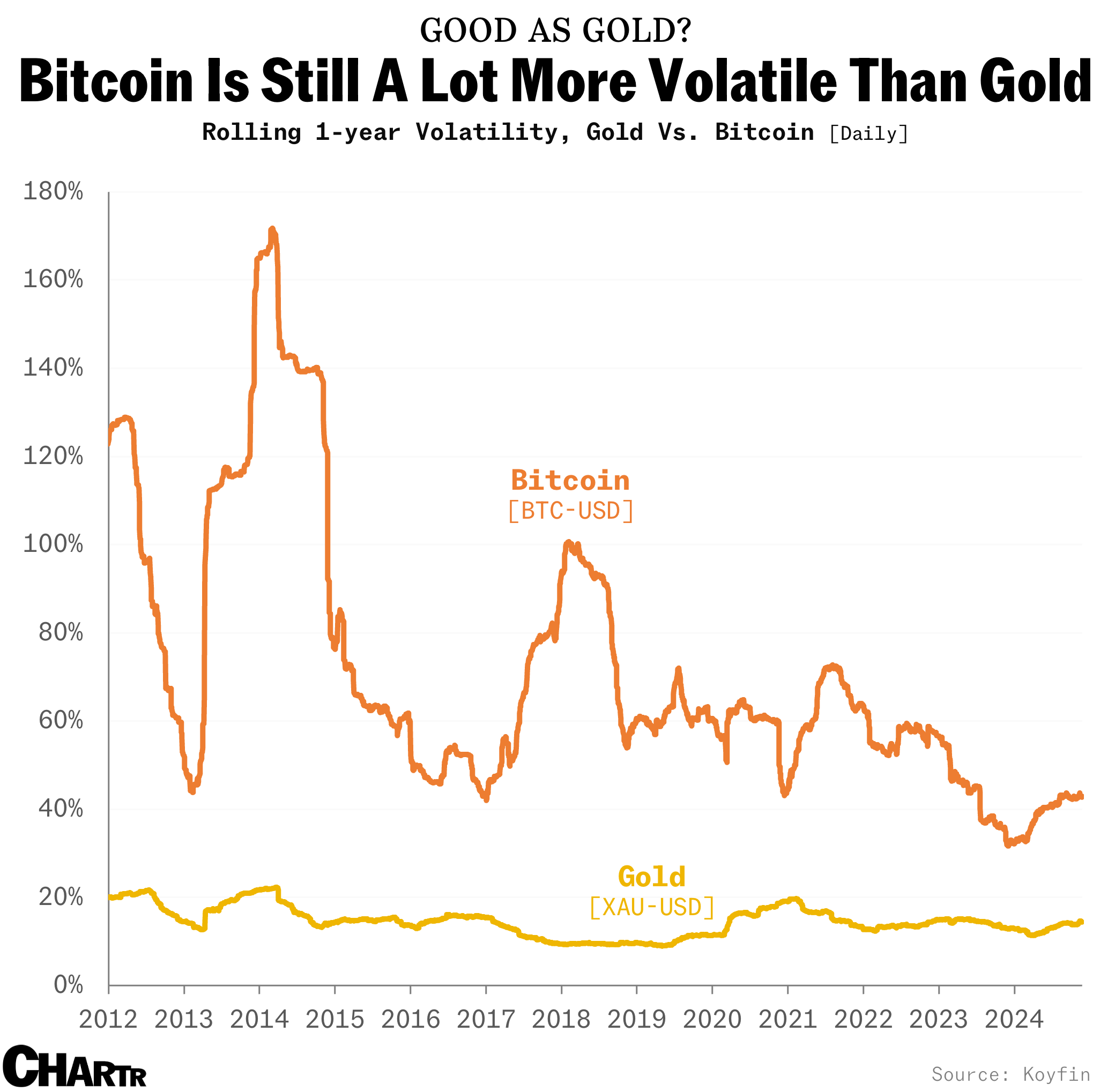
Back on the bike
Looking back on the last bull market, Nat Eliason, cryptocurrency entrepreneur and author of “Crypto Confidential,” said on the “Snacks Mix” podcast last week, “After bitcoin and ethereum had come down from their peaks, people were chasing other opportunities.”
While the main character of this postelection rally is undeniably bitcoin, as people look for opportunities to spend their newly enlarged crypto wallets, this might mean the return of some familiar trends. For one, NFT weekly sales have nearly doubled this past week and, believe it or not, the Bored Ape Yacht Club is making a comeback, too. History doesn’t repeat itself, but it often rhymes.