
Markets
Facade of The Bank of England, Threadneedle Street, City of London, UK
The Bank of England (Getty Images)
QUID GAME

Lending the UK government a few quid hasn’t been this lucrative for decades

UK bond yields are soaring as investors demand higher returns to lend to the UK government.

Hyunsoo Rim

Buying bonds is usually seen as a safe, boring bet; somewhere to securely stick cash that isn’t earmarked for a more exciting or higher-risk investment — and buying government bonds is especially so. Returns for buying German bonds, for example, hovered near zero percent for the best part of a decade.

But investors lending money to the UK government for 30 years can now earn as much as 5.35% a year — a record-high yield not seen since 1998 — while the yield for buying a 10-year gilt (what the UK calls its government bonds) has also hit its highest level since 2008 this morning.
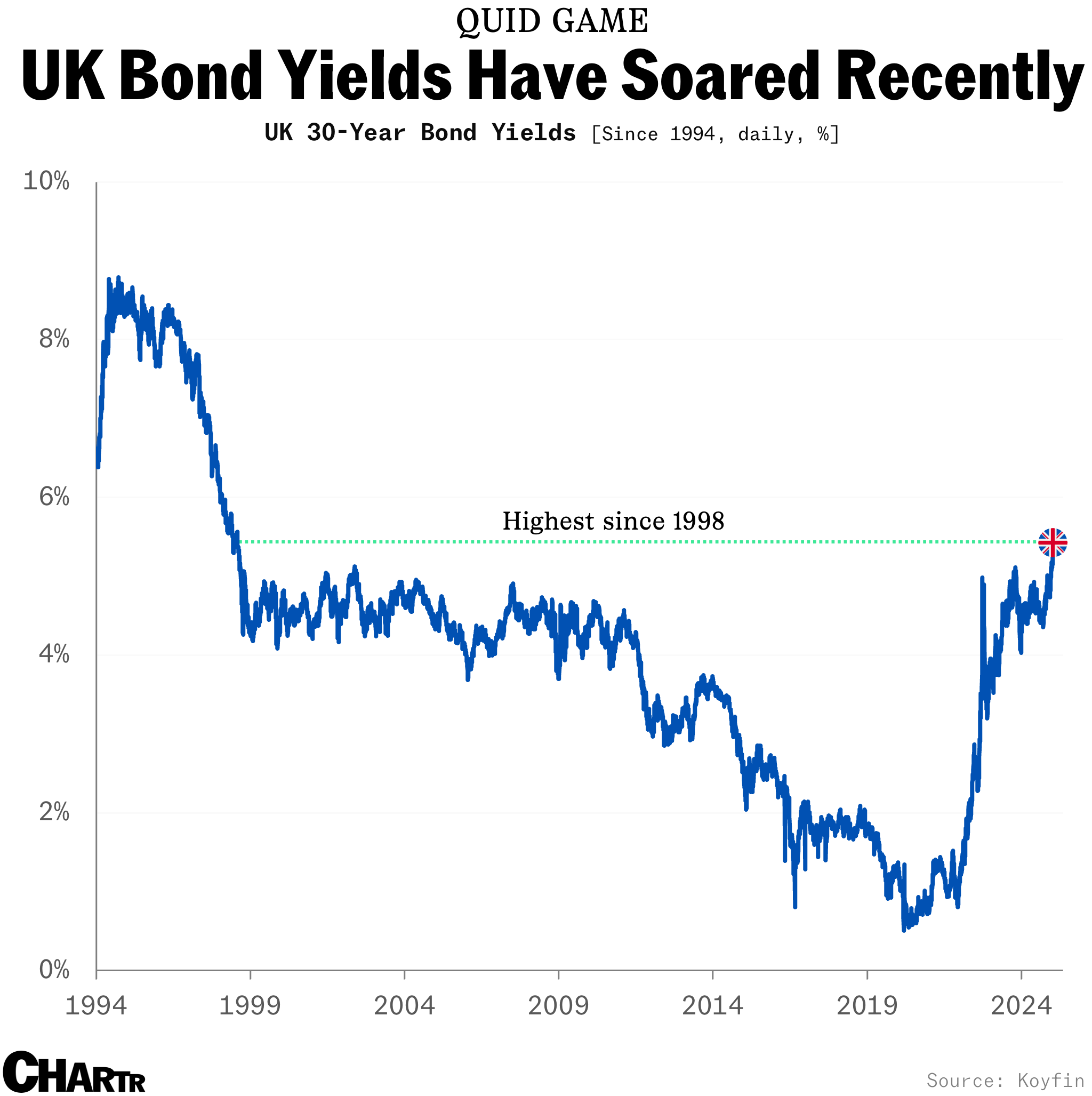
UK 30-Year Bond Yields Soar, Chart
Sherwood News

While soaring yields may seem like a win for investors, they’re rather a warning sign, as sovereign yields offer some signal on investors’ confidence in that countrys economy. In France, for example, recent budget turmoil pushed yields higher than those of corporate giants like LVMH and L’Oréal, which, though an imperfect comparison, made lending to the French government look riskier than backing its luxury handbags and cosmetics makers.

Gilty of oversupply?

The UK’s rising yields reflect concerns about the nation’s budget: there are simply too many bonds and not enough people who want to buy them, with Tuesday’s sale of £2.25 billion in new 30-year gilts by the UK’s Debt Management Office at a record 5.2% yield. That offering was part of the government’s staggering £297 billion bond-issuance plan for this year — the second-largest on record, which is set to fund public investments by the new Labour government.

However, the market appears hesitant to absorb such a flood of gilts. Investors are wary of the country’s debt pile as growth stagnates (or stops altogether) and inflation stubbornly stays above the Bank of England’s 2% target, dampening hopes for any near-term rate cuts.

Across the pond, US yields have also risen over the last three months, with the US 10Y trading at 4.71% this morning.

More Markets

See all Markets
markets

Adobe rises on $25 billion stock buyback

Adobe was up as much as 3.5% in early trading on Wednesday after the company announced a share repurchase plan worth up to $25 billion, signaling to investors that company management sees retiring shares as a prudent use of capital at these levels. The stock has been down more than 60% since Feb 2024, largely on concerns that AI tools will disrupt the company’s business.

The new authorization, which Adobe detailed will extend through April 30, 2030, “is a direct expression of confidence in our robust cash flow and the long-term value we are delivering to investors,” said CFO Dan Durn in a press release.

Indeed, fears that new agentic models could affect demand compounded when Anthropic unveiled Claude Design last week, sending the company’s shares down on the announcement. Adobe released a series of AI-enabled customer service functions shortly after. Rival Figma, which Adobe was set to acquire before the deal was blocked by regulators, has also been under pressure.

Adobe is also not the only spooked software company proposing new buyback plans to bring investors back, joining Salesforce, which actually issued debt to buy back shares in a programme of the same size ($25 billion).

markets

United beats Q1 earnings and revenue estimates, lowers full-year profit guidance amid surging jet fuel prices

United Airlines reported its first-quarter earnings results after the bell on Tuesday. The carrier’s shares ticked down in after-hours trading.

For Q1, United reported:

  • Adjusted earnings of $1.19 per share, compared to the Wall Street estimate of $1.08 per share compiled by FactSet.

  • $14.6 billion in revenue, compared to the $14.39 billion consensus estimate.

In the first quarter, United’s fuel expense grew 12.6% from the same period last year to $3.04 billion.

For the second quarter, United expects adjusted earnings per share of between $1 and $2, shy of Wall Street expectations of $2.08. For the full year ahead, United said it expects earnings between $7 and $11 per share, compared to its prior guidance of between $12 and $14 per share.

“Guidance assumes United’s revenue recovers 40% to 50% of the fuel price increases in the second quarter, 70% to 80% of the fuel price increases in the third quarter and 85% to 100% of the fuel price increases in the fourth quarter 2026,” read the company’s investor update.

Earlier this month, United was among the first major US airlines to hike its bag fees amid higher fuel costs. Its shares have fallen more than 15% from a February high days before the war in Iran began.

United has also made waves this month following reports that CEO Scott Kirby had floated the idea of a merger with American Airlines to President Trump. A merger between two of the big four airlines would create a true US behemoth, controlling more than a third of the American market. American Air last week said it wasn’t interested in merging with United and hadn’t held talks on the idea. On Tuesday, Trump told CNBC that he doesn’t like the idea either.

markets

Hedge funds are following retail traders into the Magnificent 7

Hedge funds are following retail traders into the stocks the masses never stopped buying.

“As we kick off earnings for megacap tech stocks, this stood out: [hedge funds] have started buying Mag7 stocks again this month though positioning remains well below the peak levels seen in early 2016,” wrote Goldman Sachs’ Cullen Morgan.

Goldman PB Mag 7
Source: Goldman Sachs

In early April, JPMorgan strategist Arun Jain noted that retail investors had basically been selling everything but the Magnificent 7 stocks as part of a more cautious stance due to the Iran war.

(Apple has been a long-standing exception to this trend, presumably because retail traders arent fond of its hands-off approach to AI.)

JPM Retail flows

Last August, Jain discussed how retail activity tended to “crowd in” institutional buyers in meme stocks, while Goldman’s John Marshall advised clients to piggyback on stocks beloved by retail traders. Speculative, retail-geared assets proceeded to go on a tremendous run that soured in October.

But there are some early indications that a similar bout of speculative fervor is bubbling up once more.

markets

POET Technologies surges above $10 for first time in 4 years amid explosion in call volumes

POET Technologies is up nearly 40% this week as options market activity goes haywire in a faint echo of what got the stock on retail traders’ radars in October.

As of 11:12 a.m. ET, more than 10 calls have changed hands for every put traded. This bullish impulse has propelled the stock above the $10 threshold for the first time since March 2022.

Shares of the optical communications firm briefly dipped last week after Wolfpack Research said it was short the company because its investors would be exposed to an “IRS tax nightmare.”

The company responded that day saying it was taking measures for US shareholders that “should mitigate certain potential adverse US federal income tax consequences to it that could otherwise result from the Company’s status as a passive foreign investment company.”

Latest Stories

Sherwood Media, LLC produces fresh and unique perspectives on topical financial news and is a fully owned subsidiary of Robinhood Markets, Inc., and any views expressed here do not necessarily reflect the views of any other Robinhood affiliate, including Robinhood Markets, Inc., Robinhood Financial LLC, Robinhood Securities, LLC, Robinhood Crypto, LLC, Robinhood Derivatives, LLC, or Robinhood Money, LLC. Futures and event contracts are offered through Robinhood Derivatives, LLC.

