Markets
F1 Grand Prix of Las Vegas
Actually, it’s only a sparkling shower since it’s not from an AI region in France (Mark Thompson/Getty Images)

Retail traders are killing it this year because of both what they’re buying and when they bought it

Buy the dip. Buy AI. Buy gold.

2025 is shaping up to be a dream year for retail traders: outperforming thanks to both what they bought and when they bought it.

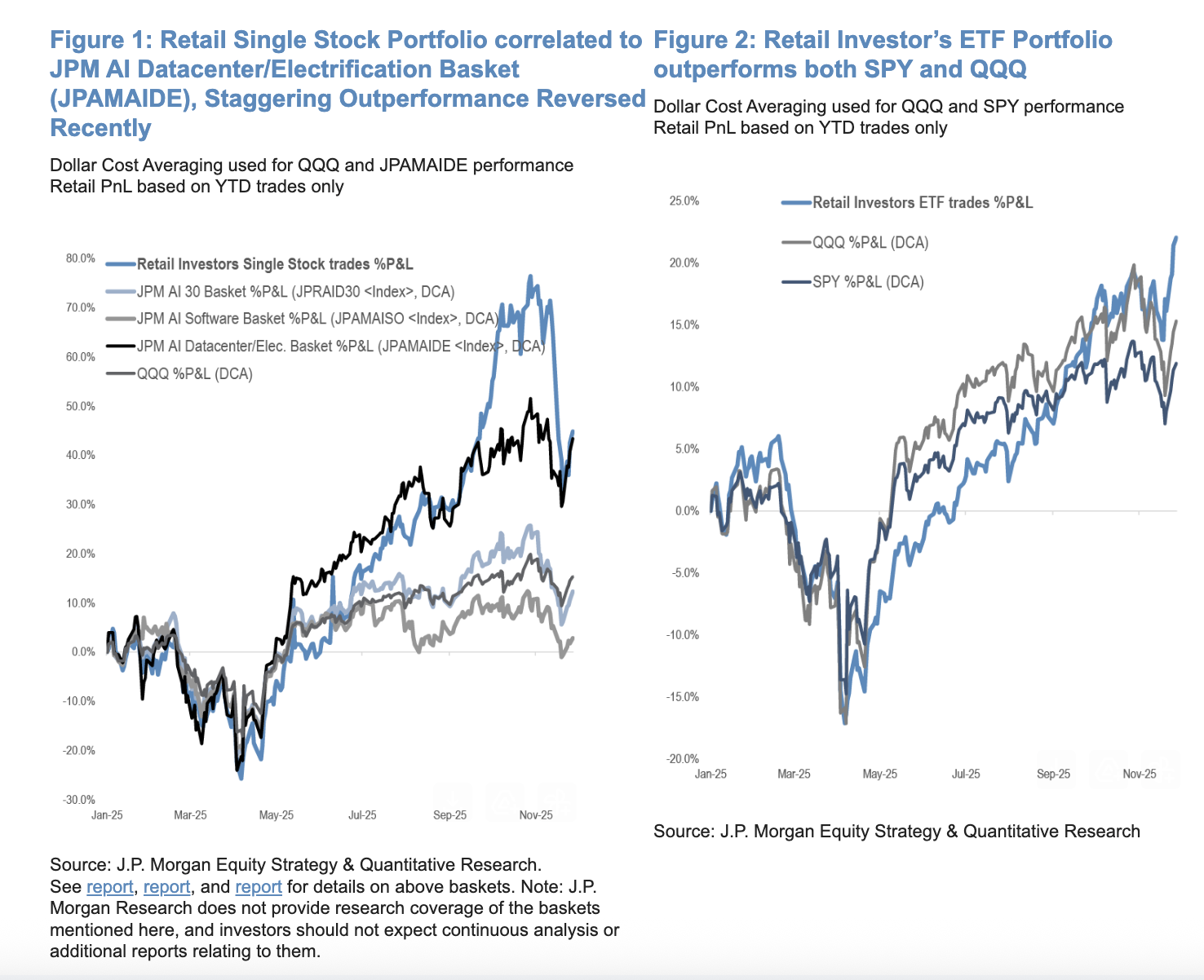
“In ETFs — which represented 75% of retail’s invested dollars this year — retail investors outperformed both SPY and QQQ, thanks to their larger Tech bias and successful risk taking in precious metals during the September and October gold rush,” wrote JPMorgan analyst Arun Jain.
JPM retail trading

“Retail investors built substantial positions in AI/Tech companies by buying the dip during 3 episodes of weakness between Jan and Apr,” Jain added. “From May onward, they scaled back their stock purchases and shifted their focus to trading ETFs, chasing interesting trends such as GLD.”

The strategist noted that retail investors’ single-stock portfolio is fairly correlated to a JPMorgan AI data center/electrification basket, implying that the crowd is very long that theme — while also benefiting slightly from either good timing or security selection among the AI cohort.

Retail’s outperformance versus just steadily buying AI-linked stocks is smaller, thanks to recent volatility that saw speculative stocks get hammered for a month starting in mid-October, but the results still crush buying and adding to the Invesco QQQ Trust each month. Ahead of that brisk pullback, retail traders’ favorite stocks enjoyed a record winning streak late in Q3.

Retail’s success in the stock market is of no small import for the US economy.

I am a strong proponent of the idea that the resilience in US consumption year to date in the face of a rising unemployment rate and increase in tariffs is at least partially attributable to retail traders’ willingness to keep buying the dip — jumping in with their biggest net purchases in at least 10 years during the S&P 500’s worst day since 2020 back on April 3, the session after reciprocal tariffs were announced.

That made the cohort the biggest beneficiary of the ensuing bounce-back in stocks after the sharp declines from mid-February through early April.


More Markets

See all Markets
Old electronic items tossed on ground for disposal, Hudson

Technology giants don’t look like they used to, as the asset-light era fades

Oracle and Meta are now some of the most capital-intensive businesses in the S&P 500, spending more than energy giants. I guess data really is the new oil?

markets

Space stocks rip amid speculation on Altman joining race

Space stocks AST SpaceMobile, Planet Labs, and Rocket Lab all soared Thursday amid a recovery in the high-beta momentum class of shares coveted by some retail traders.

(High-beta momo stocks are basically shares that have been on a winning streak for a while, and tend to go up a lot more than the overall market on positive days. Goldman Sachs includes all three of the aforementioned space stocks in its themed basket of such shares.)

There’s little other fundamental news out there on the companies themselves.

But a Wall Street Journal report that OpenAI impresario Sam Altman has been toying with the idea of entering the space industry, potentially standing up a rival to Tesla CEO Elon Musk’s Starlink satellite service, may also be contributing.

As we’ve mentioned elsewhere, sometimes these stocks seem to trade on a what’s-bad-for-the-Musk-empire-is-good-for-us-and-vice-versa vibe.

markets

Intel sinks on news it will hang on to networking unit

Intel dropped in early trading Thursday after it disclosed plans to retain ownership of its networking unit following a strategic review of operations.

The unit, known as NEX, makes products like infrastructure processors, which do needed “housekeeping” tasks like running security checks, thereby freeing core Intel CPUs to do the higher-value operations. It also produces switches and controllers that manage and direct the flow of data to CPUs.

markets

Quantum computing stocks soar on return of bullish options bets

The calendar says December, but the price action is starting to look a lot more like September to me:

Quantum computing companies IonQ, Rigetti Computing, and D-Wave Quantum are all up at least 7% as of 11:04 a.m. ET, buoyed by a wave of bullish options activity.

  • Nearly 50,000 calls in IonQ have already changed hands, well above the 20-day average for a full session, with activity concentrated in strikes from $50 to $55 in contracts that expire between Friday and mid-January. Its put/call ratio is near 0.2, versus an average of over 1 for the past 20 sessions.

  • More than 65,000 calls have traded in Rigetti, a hair shy of its full 20-day average. Like IonQ, options activity has a bullish tilt, with a put/call ratio of about 0.7 versus a 20-day average of roughly 1.2.

  • D-Wave, which received positive commentary from Evercore ISI on Wednesday, isn’t seeing call activity as elevated as its peers, but the options action is also very skewed toward the bull side, with a put/call ratio of less than 0.3 versus a 20-session average of 0.7.

Pure-play quantum computing stocks nearly doubled from late August to late September amid heavy options market activity thanks to reports on government support for the sector, M&A activity, tech breakthroughs, and a flurry of price target hikes by Wall Street.

markets

Hims announces acquisition of Canadian telehealth firm Livewell

Hims & Hers rose in early trading after it announced its acquisition of Livewell, a Canadian telehealth company, marking its official entrance to that market.

The company announced in July that it would expand into Canada by 2026, taking advantage of the patent expiry for semaglutide, the active ingredient in Novo Nordisk’s blockbuster GLP-1s, Ozempic and Wegovy. Hims said Thursday that it would do that through an all-cash acquisition of Livewell.

Novo’s patent on semaglutide is set to expire in Canada in January. It would be the first time generics for the blockbuster GLP-1 drugs are available anywhere, and generic drugmaker Sandoz International has already announced plans to make copies of the drug. In the US, Hims sells copycat versions of Novo’s drugs, which has led to conflict between the companies.

On Wednesday, Hims announced that it would purchase YourBio, a device that uses “bladeless microneedles thinner than an eyelash” to collect blood samples, in another all-cash deal. According to its latest quarterly filing, the company had $345.8 million in cash and cash equivalents.

Latest Stories

Sherwood Media, LLC produces fresh and unique perspectives on topical financial news and is a fully owned subsidiary of Robinhood Markets, Inc., and any views expressed here do not necessarily reflect the views of any other Robinhood affiliate, including Robinhood Markets, Inc., Robinhood Financial LLC, Robinhood Securities, LLC, Robinhood Crypto, LLC, or Robinhood Money, LLC.