

Markets
F1 Grand Prix of Las Vegas
Actually, it’s only a sparkling shower since it’s not from an AI region in France (Mark Thompson/Getty Images)

Retail traders are killing it this year because of both what they’re buying and when they bought it

Buy the dip. Buy AI. Buy gold.

Luke Kawa

2025 is shaping up to be a dream year for retail traders: outperforming thanks to both what they bought and when they bought it.

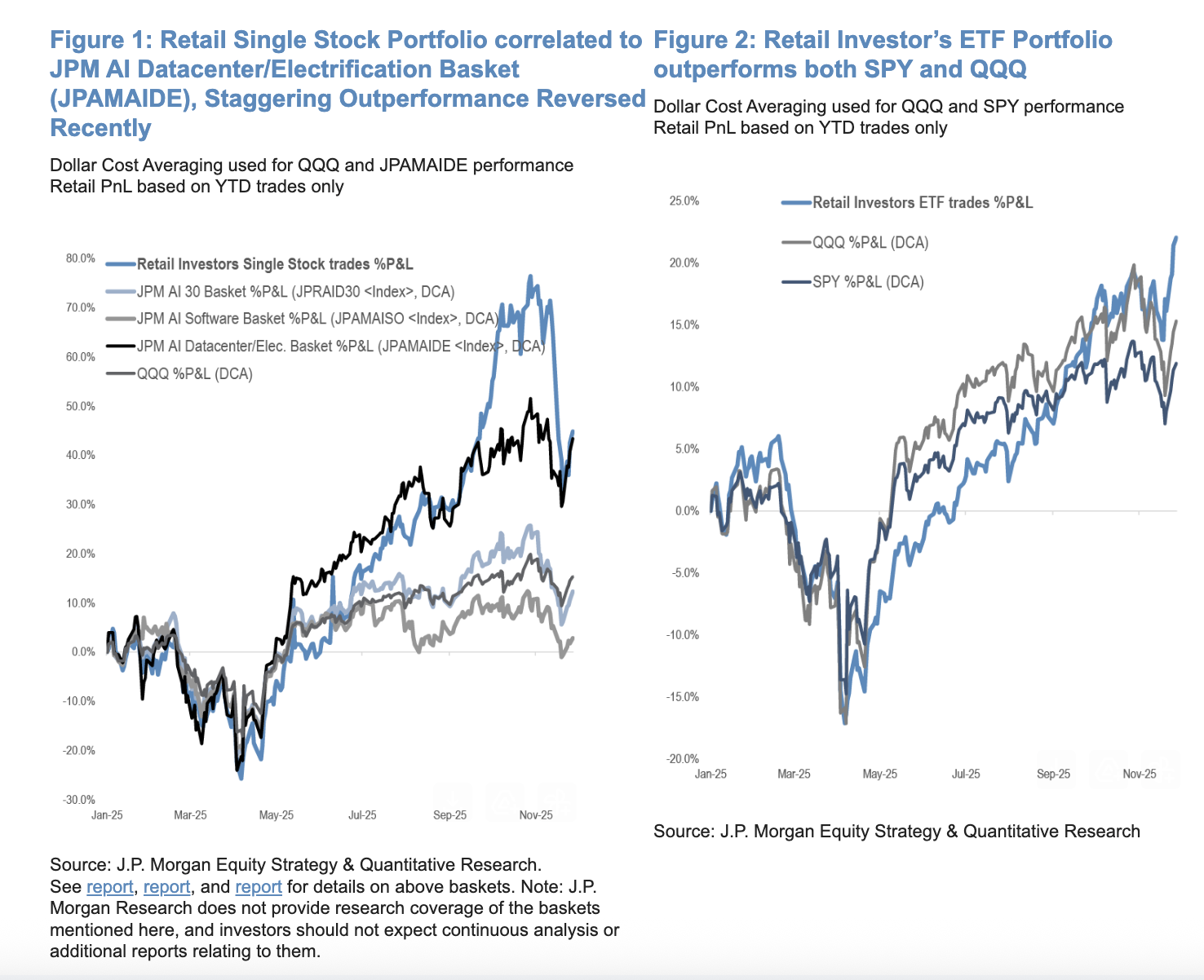
“In ETFs — which represented 75% of retail’s invested dollars this year — retail investors outperformed both SPY and QQQ, thanks to their larger Tech bias and successful risk taking in precious metals during the September and October gold rush,” wrote JPMorgan analyst Arun Jain.
JPM retail trading

“Retail investors built substantial positions in AI/Tech companies by buying the dip during 3 episodes of weakness between Jan and Apr,” Jain added. “From May onward, they scaled back their stock purchases and shifted their focus to trading ETFs, chasing interesting trends such as GLD.”

The strategist noted that retail investors’ single-stock portfolio is fairly correlated to a JPMorgan AI data center/electrification basket, implying that the crowd is very long that theme — while also benefiting slightly from either good timing or security selection among the AI cohort.

Retail’s outperformance versus just steadily buying AI-linked stocks is smaller, thanks to recent volatility that saw speculative stocks get hammered for a month starting in mid-October, but the results still crush buying and adding to the Invesco QQQ Trust each month. Ahead of that brisk pullback, retail traders’ favorite stocks enjoyed a record winning streak late in Q3.

Retail’s success in the stock market is of no small import for the US economy.

I am a strong proponent of the idea that the resilience in US consumption year to date in the face of a rising unemployment rate and increase in tariffs is at least partially attributable to retail traders’ willingness to keep buying the dip — jumping in with their biggest net purchases in at least 10 years during the S&P 500’s worst day since 2020 back on April 3, the session after reciprocal tariffs were announced.

That made the cohort the biggest beneficiary of the ensuing bounce-back in stocks after the sharp declines from mid-February through early April.

More Markets

See all Markets
markets

Hedge funds are following retail traders into the Magnificent 7

Hedge funds are following retail traders into the stocks the masses never stopped buying.

“As we kick off earnings for megacap tech stocks, this stood out: [hedge funds] have started buying Mag7 stocks again this month though positioning remains well below the peak levels seen in early 2016,” writes Goldman Sachs’ Cullen Morgan.

Goldman PB Mag 7
Source: Goldman Sachs

In early April, JPMorgan strategist Arun Jain noted that retail investors had basically been selling everything but the Magnificent 7 stocks as part of a more cautious stance due to the Iran war.

(Apple has been a longstanding exception to this trend, presumably because retail traders aren't fond of its hands-off approach to AI.)

JPM Retail flows

Last August, Jain discussed how retail activity tended to “crowd in” institutional buyers in meme stocks, while Goldman’s John Marshall advised clients to piggyback on stocks beloved by retail traders. Speculative, retail-geared assets proceeded to go on a tremendous run that soured in October.

But there are some early indications that a similar bout of speculative fervor is bubbling up once more.

markets

POET Technologies surges above $10 for first time in 4 years amid explosion in call volumes

POET Technologies is up nearly 40% this week as options market activity goes haywire in a faint echo of what got the stock on retail traders’ radars in October.

As of 11:12 a.m. ET, more than 10 calls have changed hands for every put traded. This bullish impulse has propelled the stock above the $10 threshold for the first time since March 2022.

Shares of the optical communications firm briefly dipped last week after Wolfpack Research said it was short the company because its investors would be exposed to an “IRS tax nightmare.”

The company responded that day saying it was taking measures for US shareholders that “should mitigate certain potential adverse US federal income tax consequences to it that could otherwise result from the Company’s status as a passive foreign investment company.”

markets

GE Aerospace falls after leaving earnings guidance unchanged

Jet engine maker GE Aerospace slid in early trading Tuesday, as its better-than-expected Q1 results were overshadowed by uninspiring guidance.

It reported:

  • Q1 adjusted revenue of $11.61 billion vs. the $10.71 billion consensus expectation.

  • Adjusted earnings per share of $1.86 vs. the $1.60 consensus estimate.

But management left full-year 2026 adjusted EPS guidance where it was at between $7.10 and $7.40, compared to a consensus expectation of $7.49 from analysts.

“Were holding our full-year guidance across the board, given the macro uncertainty, though, with our strong start to the year, we are trending toward the high end of that range,” CEO Larry Culp said on the conference call.

GE Aerospace hit an air pocket in March as the start of the US war against Iran sent energy prices soaring and hurt expectations for the profitability of commercial carriers. A rally in April had pushed the stock close to positive territory for the year, but it’s solidly in the red after the results today.

Latest Stories

Sherwood Media, LLC produces fresh and unique perspectives on topical financial news and is a fully owned subsidiary of Robinhood Markets, Inc., and any views expressed here do not necessarily reflect the views of any other Robinhood affiliate, including Robinhood Markets, Inc., Robinhood Financial LLC, Robinhood Securities, LLC, Robinhood Crypto, LLC, Robinhood Derivatives, LLC, or Robinhood Money, LLC. Futures and event contracts are offered through Robinhood Derivatives, LLC.

