
Markets
President Trump Holds "Make America Wealthy Again Event" In White House Rose Garden
(Chip Somodevilla/Getty Images)
Eggs, obviously

Tariffs might be starting to show in America’s inflation rate — but where are prices rising the most?

Coffee. Content. Child care. What’s up (and down) as US inflation hits 2.7%?

Hyunsoo Rim

According to new data from the Bureau of Labor Statistics, consumer prices rose 2.7% year over year in June — slightly above forecast and the fastest pace since February — with some suggesting that President Trump’s sweeping tariffs may finally be filtering through to nudge up prices on a range of goods.

But beyond the monthly ups and downs, where has inflation hit hardest — and where have prices actually fallen — in the last 12 months?
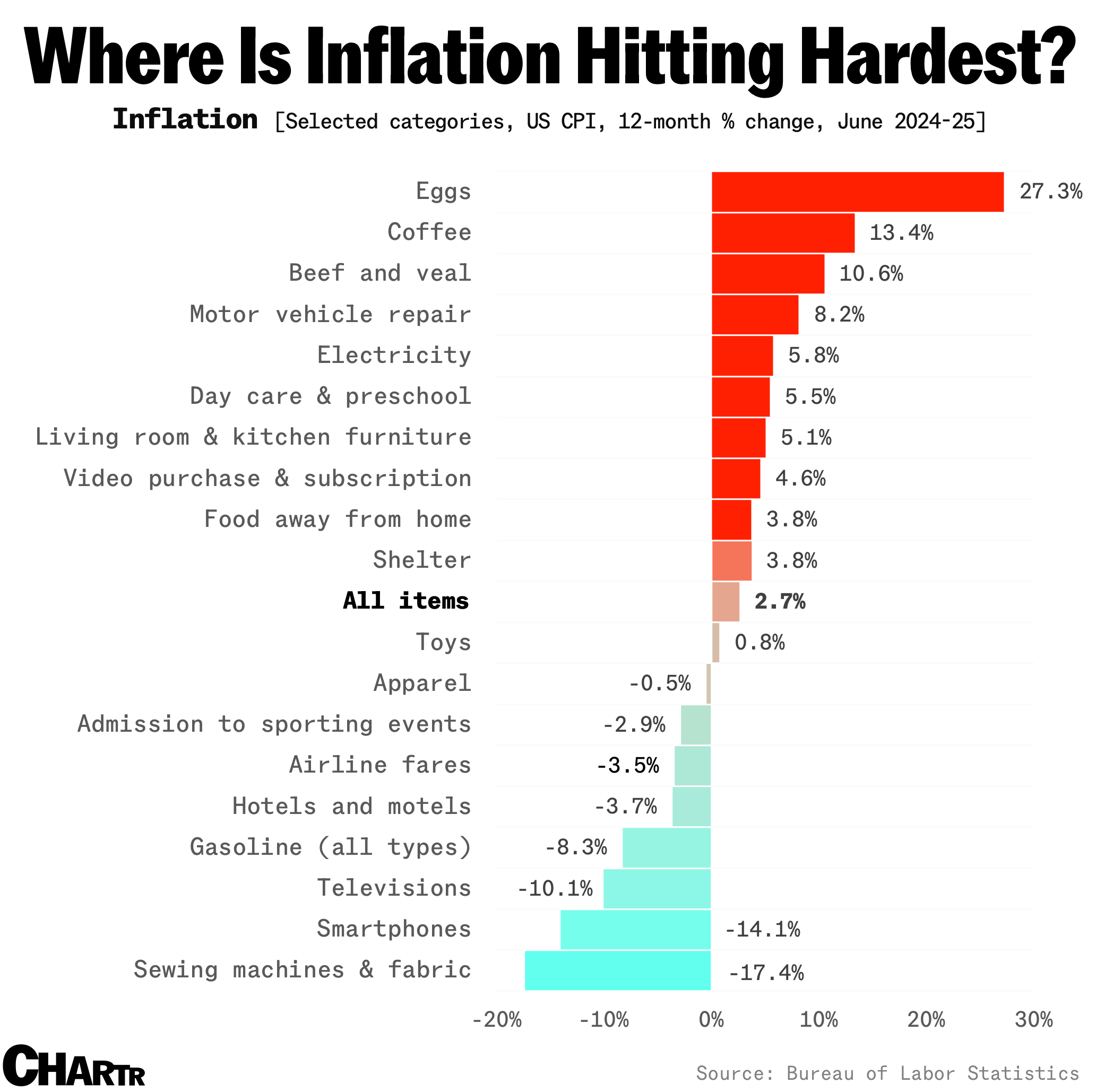
Where are prices rising chart
Sherwood News

The bad news: Food at home is up 2.4% from last year, the fastest rate in nearly two years. Among the biggest contributors are eggs (up 27%) amid avian flu disruptions, while your morning coffee (up 13.4%) and evening steak (up 10.6%) have also gotten pricier on the back of squeezed supply and tariff jitters.

Electricity bills (up 5.8%) are another sore spot, partly due to AI-hungry data center demand straining outdated infrastructure. Elsewhere, in another sign that tariffs might be taking hold, import-heavy categories like kitchen and living room furniture (up 5.1%) are climbing fast.

The slightly-less-bad news: The cost of dining out is up 3.8% — still high, but easing from last month. Housing costs rose by the same amount, though that’s the slowest rate since November 2021. And tariff-sensitive categories like apparel and toys remain relatively flat from last year… for now.

The good news: While repairing a car has gotten pricier, fueling one hasn’t, with gasoline prices down 8.3% thanks to surging global oil supply. Meanwhile, it could be a good time to get globe-trotting: airfares are down 3.5% from June 2024 and hotel stays have fallen 3.7%, too.

For homebodies, maybe now’s the opportunity to invest in your favorite pastimes? TVs are 10.1% less expensive than they were — though what that means in reality, as we’ve discussed, is likely a little different — while sewing machines and supplies for the craftier-minded have plunged 17.4%. However, that may not last once new tariffs set in.

More Markets

See all Markets
markets

SpaceX gets a wave of bullish ratings from Wall Street analysts

SpaceX received more than a dozen positive analyst calls on Tuesday — including from major Wall Street banks — as they initiate coverage on Elon Musk’s space and AI company.

SpaceX went public on June 12 at a $2.2 trillion valuation, the largest debut in history. While the company hasn’t yet posted a profit, it seems to have convinced Wall Street that it will get there and grow its valuation on the way.

Of the at least 17 analysts that gave a rating on Tuesday, all but one gave it a “buy” or “outperform” rating. MoffettNathanson was "neutral."

The ratings come as SpaceX joined the Nasdaq 100 index, a benchmark tech-heavy basket of companies that underpins millions of portfolios. The inclusion adds built-in demand for the stock from index funds and ETFs.

Still, SpaceX fell more than 5% on Tuesday amid a broader sell-off, and is currently effectively flat from its opening price of $150 a share.

markets

Nike sinks to lowest level since 2014 after warning of “challenged” sales environment in Q4 report

Did Nike do it?

Investors had a mixed reaction after the global sports apparel company reported its fourth quarter earnings on Tuesday after the bell. Shares initially rose 5% as Nike beat out Wall Street expectations amid a hefty tariff refund bonus. However, the stock then sank to its lowest level since August 2014 in postmarket trading.

Here are the Q4 numbers:

  • Revenue of $11.0 billion (estimate: $10.8 billion).

  • Adjusted earnings per share of $0.20 (estimate: $0.12).

Ahead of this report, Nike warned that results would be flattered by a one-time tariff refund (now estimated at roughly $0.52 per share for the bottom line). That gave the company an extra cushion in snapping its streak of seven quarters of year-over-year profit declines.

Over the past year, the company had been punished by tariffs on imported goods, stagnant consumer spending, and increasing competition from other footwear brands like New Balance, Adidas, and Hoka.

Outgoing CFO Matthew Friend deemed it an “increasingly challenging operating environment, where sell-through remains challenged.”

Latest Stories

Sherwood Media, LLC and Chartr Limited produce fresh and unique perspectives on topical financial news and are fully owned subsidiaries of Robinhood Markets, Inc., and any views expressed here do not necessarily reflect the views of any other Robinhood affiliate, including Robinhood Markets, Inc., Robinhood Financial LLC, Robinhood Securities, LLC, Robinhood Crypto, LLC, Robinhood Money, LLC, Robinhood U.K. Ltd, Robinhood Derivatives, LLC, Robinhood Gold, LLC, Robinhood Asset Management, LLC, Robinhood Credit, Inc., Robinhood Ventures DE, LLC and, where applicable, its managed investment vehicles.

