
Markets
"Daedalus: Legends of Crete" Exhibition Kicks Off In Beijing
A bull head-shaped relic on display (Zhang Xiangyi/Getty Images)

United Airlines’ dual forecasts have a deeper, ugly message about the outlook for US stocks

The bull case for the US, omnipresent for over a decade, is much more elusive these days.

Luke Kawa

There’s a hidden message in United Airlines’ dual forecast that’s being celebrated by Wall Street. In this case, what’s not being said is speaking volumes.

The management team at the airline provided two sets of guidance for this year: one for a “things stay the same, as we expected” outcome, and one in the event of a US recession.

It leaves one wondering, if that’s the status quo and the bear case, what’s the bull case?

Now, this may be an attempt to keep investor expectations in check, setting up a low bar to step over later. These kind of tactics from management teams are why Societe Generale strategist Andrew Lapthorne once slammed earnings season as “cheating season.” But if anything, United’s forecasts on what would happen to the company’s finances in a recession are a significant improvement versus what’s happened in either of the past two.

But in discussing the outlook for the US dollar, Jon Turek, founder of JST Advisors, posed this question: “What is the right tail?”

Left-tail outcomes are ones where the economy goes pear-shaped. Right tails are positive surprises — best-case outcomes.

That’s a pretty profound question that applies not just to the US dollar, but also the domestic economy and stocks. It gets straight to the heart of how deeply the US outlook has changed since November, when optimism about how bright America’s future would be ran rampant, thanks in part to presumed pro-business policies that would be pursued by the incoming Trump administration.

For years, the US has had a much more visible bull case than other global markets, thanks to outsized profit growth (primarily through megacap tech firms) and relatively more supportive (or less destructive) fiscal policy decisions compared to the rest of the world.

Now, per Bank of America’s April global fund manager survey, investors are much more confident that Chinese policymakers will deliver fiscal stimulus that boosts growth in the second half of this year than they are in US activity getting any kind of a lift from tax cuts.
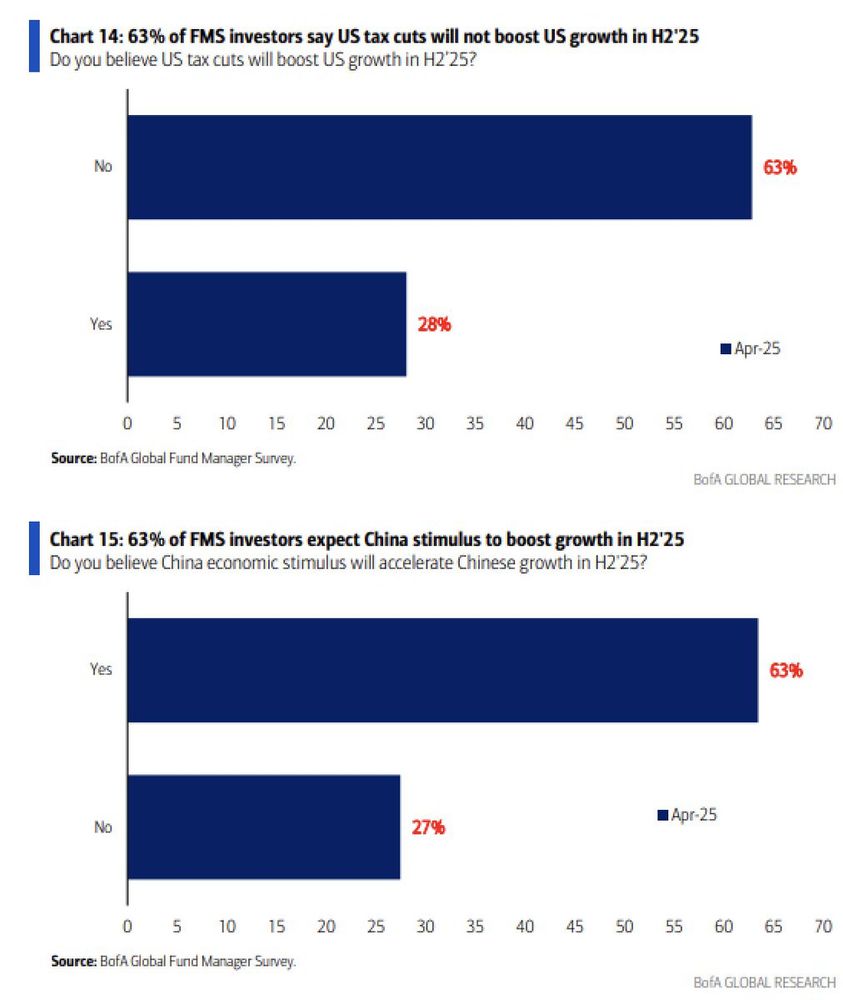
BofAFMS China US

Deutsche Bank strategists Michael Puempel and George Saravelos observed that foreign ownership of US stocks has increased sixfold since 2010, with most of that increase coming thanks to valuation increases rather than new money piling in, and that position is at risk of reversing to the detriment of US assets.

They wrote:

“The increased weight towards US equities during the bull market years is what stands out the most from our analysis. This has likely lowered the bar for repatriation flows driven by negative asset price moves, thus increasing the sensitivity of the USD to equity valuations. If US-centric trade actions are determined by market participants to represent a structural shift in policy over the next several years, eroding the US equity exceptionalism narrative, it is likely that investors will begin to increase allocations to non-US markets, presenting a headwind to the USD over the near to medium-term.”

The world’s massive overweight position in US equities is something that fund managers are unwinding at a record pace with no end in sight, per Bank of America.

Maybe the AI boom really heats up again (or never really slowed down as much as feared). Maybe there’s enough resilience in US households and corporate balance sheets to weather the hit to growth coming from tariffs, and we’re facing more of a prolonged slowdown in growth rather than a recession.

But “we think our old winners still have more legs and maybe we won’t have a recession” is not the kind of bull thesis you’d put on a bumper sticker.

More Markets

See all Markets
markets

SoftBank rallies on OpenAI and SB Energy IPO plans; its Japanese-traded stock notches best day since 2000

SoftBank shares skyrocketed in Tokyo trading, notching their biggest daily gain since 2000, boosted by news about planned IPOs at OpenAI, in which SoftBank has a sizable stake, and SoftBank’s own SB Energy unit. ADRs of SoftBank traded in the US rallied, too.

OpenAI is accelerating the timeline to its public debut, preparing to confidentially file its IPO prospectus with regulators as early as Friday, according to The Wall Street Journal. That could set the stage for a highly anticipated public listing as early as September.

SoftBank has systematically expanded its financial exposure to OpenAI, securing a highly valuable stake in the company. As of the fiscal year-end, SoftBank’s cumulative investment in OpenAI totaled $34.6 billion, with a fair value of $79.6 billion, and cumulative investment gains totaled $45 billion, according to a SoftBank filing.

For SoftBank, a successful public debut is critical to demonstrating that OpenAI can protect its market position amid intense industry pressure. Investors have grown increasingly anxious that OpenAI is losing ground to competitors like Anthropic, which is currently in talks for a funding round that could push its own valuation past that of OpenAI.

Adding to the upward momentum, SB Energy, the digital infrastructure and clean energy development firm co-owned by SoftBank and Ares Management, confirmed its own confidential draft registration filing for a major US public listing.

This multipronged IPO pipeline has boosted investors’ confidence in billionaire founder Masayoshi Son’s high-conviction AI thesis, showcasing a road map for SoftBank to transition its paper gains into potential liquidity. SoftBank’s stock is up 37% so far this year.

markets

Nio posts better-than-expected first-quarter earnings and forecasts strong Q2 sales

Chinese EV maker Nio posted Q1 results before markets opened on Thursday, reporting earnings that beat expectations and strong sales guidance for the second quarter. Shares of the company climbed more than 4% in premarket trading.

For the first quarter, Nio reported:

  • Adjusted earnings of $0.00 per share, compared to the $0.05 loss per share that Wall Street analysts polled by FactSet had expected.

  • $3.7 billion in revenue, compared to the $3.74 billion consensus estimate.

  • 83,465 vehicle deliveries, slightly exceeding its own forecast of between 80,000 and 83,000.

For Q2, Nio guided for deliveries of between 110,000 and 115,000, compared to estimates of 113,807. The company expects second-quarter revenues to come in between $4.75 billion and $4.99 billion, while analysts are forecasting $4.6 billion.

The Chinese auto industry has seen a surge in exports so far this year, as companies make efforts to combat declining domestic sales. Nio, which is still relatively new to overseas operations, has plans to ship “several thousand” EVs overseas this year.

Latest Stories

Sherwood Media, LLC and Chartr Limited produce fresh and unique perspectives on topical financial news and are fully owned subsidiaries of Robinhood Markets, Inc., and any views expressed here do not necessarily reflect the views of any other Robinhood affiliate, including Robinhood Markets, Inc., Robinhood Financial LLC, Robinhood Securities, LLC, Robinhood Crypto, LLC, Robinhood Money, LLC, Robinhood U.K. Ltd, Robinhood Derivatives, LLC, Robinhood Gold, LLC, Robinhood Asset Management, LLC, Robinhood Credit, Inc., Robinhood Ventures DE, LLC and, where applicable, its managed investment vehicles.

