

Markets
markets

Warren Buffett is building cash as the market soars


If Warren Buffett is selling, should you be buying?

It’s worth considering, as Berkshire Hathaway, the company run by the world’s greatest value investor, has been building a massive $325 billion pile of cash as the stock market soars.

This isn’t a big mystery. The cash build can be explained by the simple fact that Buffett, age 94, and the whippersnappers who do most of the daily trading at his shop are value investors.

It means they try to buy stocks when they are cheap — that is, undervalued, essentially when they have low price-to-earnings ratios.

And it has become abundantly clear that US stocks sure ain’t cheap at the moment, and there are few bargains to be had. That doesn’t mean the market is going to crash. Stocks can stay overvalued for a long time.

But if you happen to have a few hundred billion on your hands, and short-term Treasury bills are paying 4.50% annualized, why not stuff $325 billion into them, generating about $15 billion a year in risk-free returns? Sounds good to me.

This piece was updated to correct “millions” to “billions” in final paragraph.
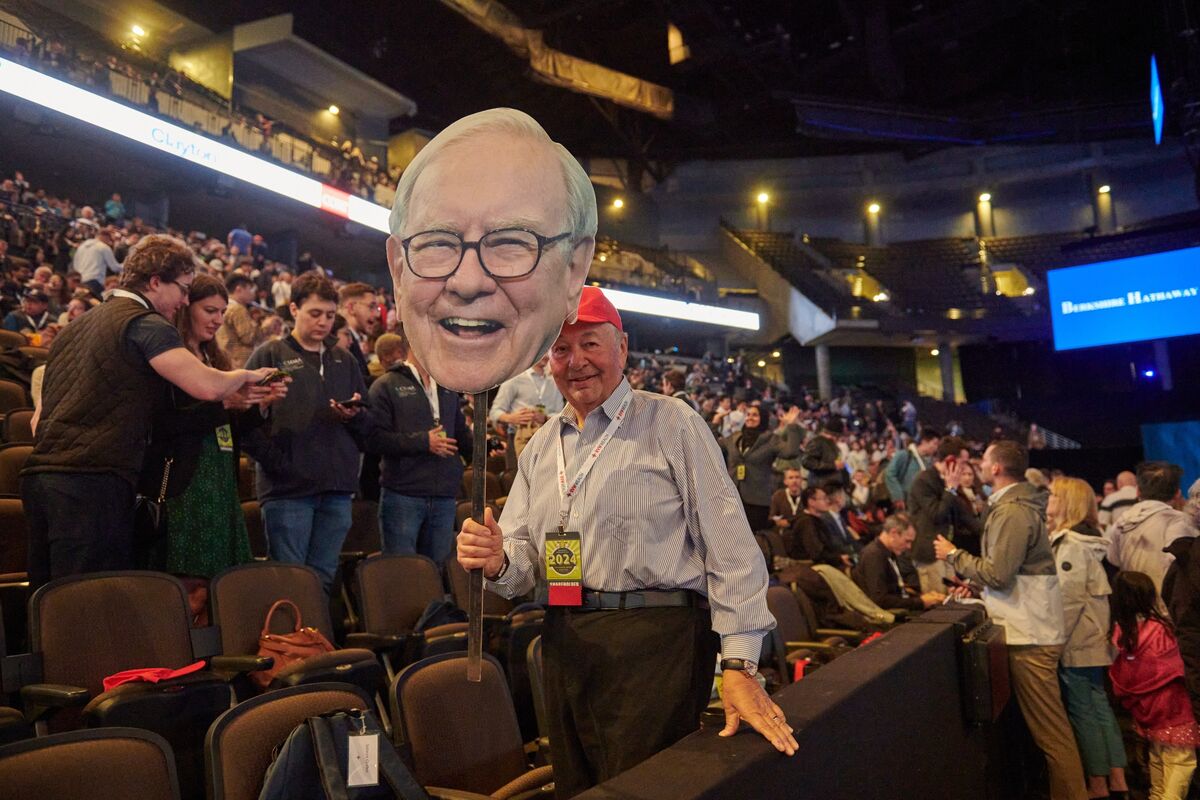
This isn’t a big mystery. The cash build can be explained by the simple fact that Buffett, age 94, and the whippersnappers who do most of the daily trading at his shop are value investors.

It means they try to buy stocks when they are cheap — that is, undervalued, essentially when they have low price-to-earnings ratios.

And it has become abundantly clear that US stocks sure ain’t cheap at the moment, and there are few bargains to be had. That doesn’t mean the market is going to crash. Stocks can stay overvalued for a long time.

But if you happen to have a few hundred billion on your hands, and short-term Treasury bills are paying 4.50% annualized, why not stuff $325 billion into them, generating about $15 billion a year in risk-free returns? Sounds good to me.

This piece was updated to correct “millions” to “billions” in final paragraph.

More Markets

See all Markets
markets

SoFi Technologies slides on $1.5 billion share sale announcement at $27.50 a share

SoFi Technologies is down more than 7% in early trading on Friday after the company revealed plans to raise $1.5 billion through a public stock offering, with shares to be priced at $27.50 each — a discount of roughly 7% from Thursday's closing price of $29.60.

The offering includes a 30-day option for the underwriters to purchase up to an additional 8,181,818 shares, equivalent to an additional 15% of the nominal offering, which is expected to close December 8th.

Proceeds from the offering will go toward "general corporate purposes," SoFi said, including "enhancing capital position, increasing optionality and enabling further efficiency of capital management, and funding incremental growth and business opportunities."

The sale comes as SoFi's stock has been on a tear this year — nearly doubling (up 97%) in 2025 before this morning's slump. The company also posted better-than-expected Q3 sales and profits back in October, driven by growth outside its original lending business, including trading, wealth management, mortgages, and credit cards.

CEO Anthony Noto has repeatedly emphasized SoFi's push beyond lending. In November, the company launched a priority waitlist for SoFi Crypto, enabling users to trade dozens of cryptocurrencies, including Bitcoin, Ethereum, and Solana.

The stock is hovering around the offering price of $27.50 on Friday.

markets

Netflix agrees $83 billion deal for Warner Bros. Discovery’s streaming and studio businesses, at $27.75 per share

Netflix this morning announced that it will acquire the Warner Bros. side of the Warner Bros. Discovery business — which includes its studio and streaming businesses — in a deal worth $82.7 billion, or $27.75 per share.

The streaming giant beat out competition from other suitors like Comcast and Paramount Skydance, the latter of which had been crying foul about the sales process just yesterday, having sought a deal for the WBD business in full, including its vast array of networks, which will now be spun out as Discovery Global, a new publicly-traded company.

Unless halted by regulators, when the deal closes in the approximately 12-18 months, Netflix will pick up IP such as the Harry Potter franchise and DC universe through the Warner Bros. studio division as well as the company’s burgeoning streaming division, including HBO Max — though a recent report suggested this addition might not significantly boost Netflix’s market share, sending shares tumbling on Wednesday.

While it’s still far too early to say what impact the potential deal will have on the biggest film and TV streaming business in the world, and the wider world of entertainment in general, NFLX investors haven’t seemed hugely enthused by the prospect throughout the process, and shares have slipped as much as ~3.2% in premarket trading.

markets

Report: US senators plan to introduce bill blocking Nvidia from selling advanced chips to China for 30 months

US senators are on the verge of introducing a bill that would block Nvidia from selling its H200 or Blackwell chips to China for 30 months, the Financial Times reports. The H200 is Nvidia’s best chip from the Hopper generation, while the Blackwell line is its current flagship offering.

Shares of the chip designer are little changed in the wake of this report, still up more than 1% on the session. The reaction makes sense, seeing as previous positive indications on Nvidia’s ability to sell advanced chips to China failed to inspire much positive momentum in its shares.

The stock got a short-lived jolt higher (that didn’t last the day!) on November 21 after Bloomberg reported that the Trump administration had discussed the possibility of selling its H200 chips to China.

Nvidia has effectively been shut out of China’s AI market in 2025. First, export restrictions meant it could no longer sell the H20, a nerfed version of its Hopper chip, to the world’s second-largest economy. After that export ban was lifted, demand from China “never materialized,” per Nvidia CFO Colette Kress. Reports indicate that China banned its leading technology giants from purchasing these semiconductors, instead pushing them toward domestic alternatives.

President Donald Trump had mused about allowing Nvidia to sell Blackwell chips to China prior to his meeting with Chinese President Xi in late October, but failed to do so. The two leaders did not discuss the topic at that time.

Per the FT, this upcoming bill would be a bipartisan effort, being cosponsored by the leading Republican and Democrat members of the Senate Foreign Relations East Asia subcommittee.

markets

AI energy plays soar on an explosion of call buying

Like their quantum computing counterparts, AI-linked energy plays are benefiting from an explosion of bullish options activity on Thursday.

  • Oklo is up double digits with call volumes above 106,000 as of 2:46 p.m. ET, more than double its 20-day average for a full session, with a put/call ratio of about 0.6. Call options with a strike price of $110 that expire this Friday (which are now in-the-money thanks to today’s surge) are seeing the most activity.

  • Nuscale, another nuclear energy play, has seen nearly 140,000 call options change hands versus a 20-day average of 51,073.

  • And fuel cell company Bloom Energy has traded nearly 80,000 calls, roughly twice its 20-day average, with a put/call ratio of about 0.3.

During his appearance on Joe Rogan’s podcast released on Wednesday, Nvidia CEO Jensen Huang talked up the potential for nuclear energy, saying, “In the next six to seven years I think you are going to see a whole bunch of small nuclear reactors.”

This adds to the evidence that the speculative bid is back in a big way after smaller stocks tied to the AI boom and quantum computing cratered from mid-October through most of November as credit risk began to seep into the AI trade.

Latest Stories

Sherwood Media, LLC produces fresh and unique perspectives on topical financial news and is a fully owned subsidiary of Robinhood Markets, Inc., and any views expressed here do not necessarily reflect the views of any other Robinhood affiliate, including Robinhood Markets, Inc., Robinhood Financial LLC, Robinhood Securities, LLC, Robinhood Crypto, LLC, or Robinhood Money, LLC.