Business
Two people sit at a table outside at a gas station
FILL ’ER
UP
Fill it with regular and a table for two please (Gina Ferazzi/Getty Images)

Gasoline is dead. Long live the hoagie.

Gas stations and convenience stores have doubled down on fresh food, and customers are buying in.

For decades, America’s gas stations were merely a place to fill up, buy cigarettes, or shamefully lug around a bathroom key attached to a painted two-by-four.

But as we move into the new year like well-oiled hot dogs on life’s eternal rolling grill, major change is happening in the gas-station and convenience-store industry. Chains are increasingly focusing on fresh, quality food — and it’s paying off. Convenience stores offering fresh food and even dine-in options account for 58% of US convenience-store spending, up from 48% in 2019.

Food has always been a selling point for convenience stores; some chains even have their roots in the food businesses. Sheetz began as a deli. Rival Wawa pivoted from iron foundry to a dairy business over a century ago. Still, outside of local favorites, convenience-store eats haven’t had the best reputation. A gas-station taquito has, historically, been consumed more out of a lack of options than a desire for quality cuisine. But, as regional chains like the East Coast’s Wawa, the South’s Buc-ee’s, or the Midwest’s Casey’s General Stores have boosted their offerings, cultlike support and sales have followed.  
Largest Convenience Store In The World Opens In Texas
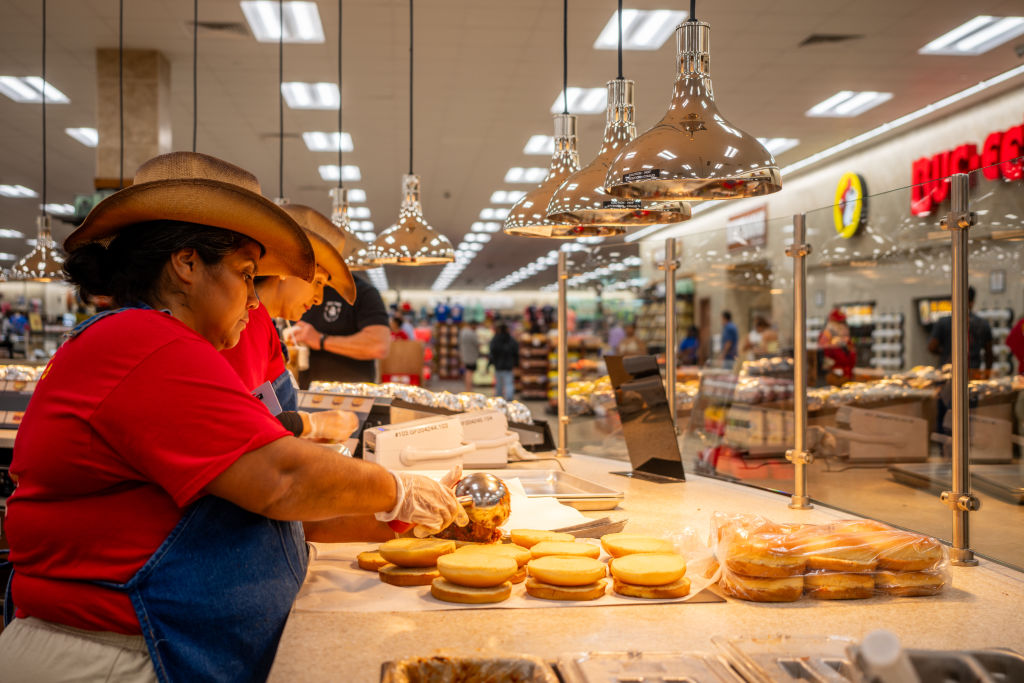
The gas-station sandwich has come a long way (Brandon Bell/Getty Images)

Wawa, a company with a brand reputation rivaling the Philadelphia Eagles in Pennsylvania, says it makes 183 million hoagies a year. At an annual output of about 175,000 hoagies per location, Wawa makes a million more hoagies than it does cups of coffee.

Meanwhile, Buc-ee’s, a Southern chain that sells brisket and nuggets, opened the world’s largest convenience store in Texas this June. At 75,000 square feet, the store is larger than a football field and about 10x the average Cheesecake Factory. To give some context for the passion Buc-ee’s customers have for the brand, an unaffiliated site that repackages Buc-ee’s snacks and merch said it made up to $3.6 million in sales last year.

Last month, Casey’s, which happens to operate the fifth-largest US pizza chain by store count, reported that its gross profit for inside sales like food, drinks, and grocery items grew 12% to $620 million in Q2 — nearly $200 million more than Domino’s raked in during its latest quarter. Meanwhile, the chain’s gross profit for fuel grew just 1% to $312 million. Casey’s margin on food was 59%, while its margin on gas was closer to 10%.

These margins explain why the industry has embraced food so intensely. Gas consumption in the US has largely stagnated for the past two decades, with sales hitting 8.9 million barrels a day last year — a repeat of 2003’s figure. With fuel-economy improvements in newer cars and the spread of EVs, these trends will likely continue. In fact, earlier this week both Exxon and Shell warned investors that their next quarterly profits would take a hit.

EV charging also takes significantly longer than filling up a tank, giving convenience stores more opportunities to sell brand merch and hot dogs inside.

“I think gas-station owners realize that they can be competitive with restaurants, that they can serve the kind of quality that restaurants serve,” said Stafford Shurden, a restaurant owner and host of a web series called “The Gas Station Tailgate Review” that features Shurden reviewing gas-station food out of his truck. Shurden, who also happens to be a farmer and a former legal judge, predicts that more large chains will be racing to copy the quality-food formula.

Quality is huge in an industry like convenience where, for the most part, stores sell commodities. Because there’s no difference between two bags of Doritos, a consumer isn’t going to cross the highway to buy Doritos from one store over another. 

“If you take a pork belly and make bacon out of it and put it on top of a hamburger, it’s not a commodity anymore. Now it’s something you can’t get anywhere else,” Shurden said. “That’s the attraction that these hot-food items have, is this ability to create an identity that can’t be copied.”

Fresh food is reportedly key to Circle K parent Couche-Tard’s $47 billion offer to buy 7-Eleven. In October, 7-Eleven said it would shutter over 440 stores in North America, hit by declining cigarette sales. The company’s turnaround ambitions include a plan to vastly expand its US food offerings. 

Jeff Lenard, the spokesperson for the National Association of Convenience Stores (NACS), the industry’s trade organization, says gas-station food is a 20-year overnight success.

“Convenience stores are the only channel that sells a concept. Grocery stores sell groceries. Drug stores sell drugs. But convenience is whatever somebody says it is,” Lenard said. “And right now, what customers are saying is convenience is great food, anywhere I can get it.”

In an industry with a rival on every corner, standing out is vital.

“It’s: what are you famous for? It could be employees. It can be an item that people can’t get anywhere else. But if you don’t know what you’re famous for, you’re not famous for anything,” Lenard said.

Somehow, the convenience industry has become masters of branding, be it through food, mascots, or even toys. Hess’ toy-truck biz does an estimated $46 million in sales every year.

Invoking the author Scott Godin’s quote about Nike, Shurden said convenience stores’ success can be measured like this: “If Buc-ee’s opened a hotel, we could guess with pretty good certainty what that would look like. But if the Hampton Inn opened a gas station, it’d be pretty generic.”

More Business

See all Business
business

Electronic Arts launches a platform to put more ads in its games

Video game publishing giant EA launched a new platform on Monday designed to make the process of selling immersive ad space in its popular games easier.

The company says the platform, called EA Advertising, allows brands to “integrate directly into gameplay through dynamic, real-time placements, from stadium signage to custom in-game content.”

More so than other studios, EA has incorporated advertising into its most popular titles. As Kotaku points out, the company’s ad efforts stretch as far back as 2006. Several of its sports franchises already feature partnerships with brands like Visa, Lowe’s, Red Bull, and PepsiCo.

In-game advertising hasn’t exactly been embraced by fans, but industry experts expect it to ramp up as companies seek more revenue to offset higher games budgets and surging memory costs. EA rival Take-Two has taken a different approach, with CEO Strauss Zelnick recently saying the company was “not at risk of doing brand partnerships” in the forthcoming “Grand Theft Auto VI,” and that ads in full-price games seems “unfair.”

The $55 billion deal to take EA private, led by Saudi Arabia’s Public Investment Fund, is set to close at the end of this month. Being the largest leveraged buyout in history, EA will likely look for more ways to boost revenue to cover interest payments.

More so than other studios, EA has incorporated advertising into its most popular titles. As Kotaku points out, the company’s ad efforts stretch as far back as 2006. Several of its sports franchises already feature partnerships with brands like Visa, Lowe’s, Red Bull, and PepsiCo.

In-game advertising hasn’t exactly been embraced by fans, but industry experts expect it to ramp up as companies seek more revenue to offset higher games budgets and surging memory costs. EA rival Take-Two has taken a different approach, with CEO Strauss Zelnick recently saying the company was “not at risk of doing brand partnerships” in the forthcoming “Grand Theft Auto VI,” and that ads in full-price games seems “unfair.”

The $55 billion deal to take EA private, led by Saudi Arabia’s Public Investment Fund, is set to close at the end of this month. Being the largest leveraged buyout in history, EA will likely look for more ways to boost revenue to cover interest payments.

business

JM Smucker says it sold $1 billion worth of Uncrustables in FY2026

After years of booming sandwich sales, JM Smucker has finally earned a billion-dollar crust.

On Tuesday, the company reported results for fiscal year 2026, highlighting better-than-expected profits driven by higher prices for coffee and sweet baked goods. However, at another point on the earnings call, CEO Mark Smucker pointed to one particularly jammy figure: in line with previous forecasts, the company sold $1 billion worth of its (almost always) crustless sandwiches, Uncrustables, in the last year alone.

business

Paramount reportedly offers concessions to resolve multistate antitrust investigation

Paramount has reportedly offered up some concessions in an effort to prevent an antitrust lawsuit by California and about 10 other states, according to Bloomberg reporting on Monday.

Reuters first reported on the potential suit from a group of unnamed states last week, which could throw a wrench in Paramount’s plans to buy rival Warner Bros. Discovery in a Hollywood megamerger.

The list of concessions is unknown, though Bloomberg previously reported that Paramount is open to divesting some of its kids TV assets to appease EU regulators.

Late last month, reports said US regulators appeared likely to approve the $110 billion merger, following a meeting between Paramount CEO David Ellison and DOJ antitrust staffers.

The list of concessions is unknown, though Bloomberg previously reported that Paramount is open to divesting some of its kids TV assets to appease EU regulators.

Late last month, reports said US regulators appeared likely to approve the $110 billion merger, following a meeting between Paramount CEO David Ellison and DOJ antitrust staffers.

$98B ⛽

The IATA released its latest financial outlook for the airline industry over the weekend, forecasting a $98 billion jump in the sector’s collective fuel bill. The world’s largest trade group representing airlines expects the oil spike to halve profits by 49% from last year to $23 billion.

The group also expects profit margins to halve year over year, falling from 2025’s 4.2% to 2%. Still, revenue is expected to climb to $1.17 trillion from $1.07 trillion.

A surge in the cost of jet fuel has rocked US and global airlines this year, leading Delta Air Lines, United Airlines, American Airlines, Southwest Airlines, JetBlue, and others to raise fares and ancillary charges like bag fees. Low-cost carriers, which operate on smaller margins, have been squeezed the hardest, resulting in Spirit’s shutdown.

“It’s a tough year for all airlines, especially those whose balance sheets had not yet recovered from COVID. And, of course, for those operating in the Gulf,” said IATA Director General Willie Walsh, who added that demand is holding up and about half of passengers expect to spend more on travel this year. “That bodes well for a strong northern summer peak season. The big unknown is how long travelers and shippers can tolerate the higher costs of connectivity.”

Hollywood Exteriors And Landmarks - 2025

1 year into the Switch 2, we might’ve seen the top of the console market

The Switch 2 launched on this day in 2025. Amid a rough year for consoles, Nintendo has logged a good one.

Latest Stories

Sherwood Media, LLC and Chartr Limited produce fresh and unique perspectives on topical financial news and are fully owned subsidiaries of Robinhood Markets, Inc., and any views expressed here do not necessarily reflect the views of any other Robinhood affiliate, including Robinhood Markets, Inc., Robinhood Financial LLC, Robinhood Securities, LLC, Robinhood Crypto, LLC, Robinhood Money, LLC, Robinhood U.K. Ltd, Robinhood Derivatives, LLC, Robinhood Gold, LLC, Robinhood Asset Management, LLC, Robinhood Credit, Inc., Robinhood Ventures DE, LLC and, where applicable, its managed investment vehicles.