Business
BROADLANDS, VA - JULY 16: HVAC repairman Steve Seneff removes w
HVAC repairman in Broadlands, VA (Craig Hudson/Getty Images)
Weird Money

Why PE is cutting multimillion-dollar checks to plumbers

A private-equity industry desperate to deploy capital is enriching small-business owners around the US.

Jack Raines

An interesting trend, which I’ve highlighted a couple times now, is that while private equity’s new investments and exits have declined by 60% and 66%, respectively, since 2021, fundraising remains near its peak 2021 levels, creating a tricky situation where funds are raising more money from investors than they are distributing.
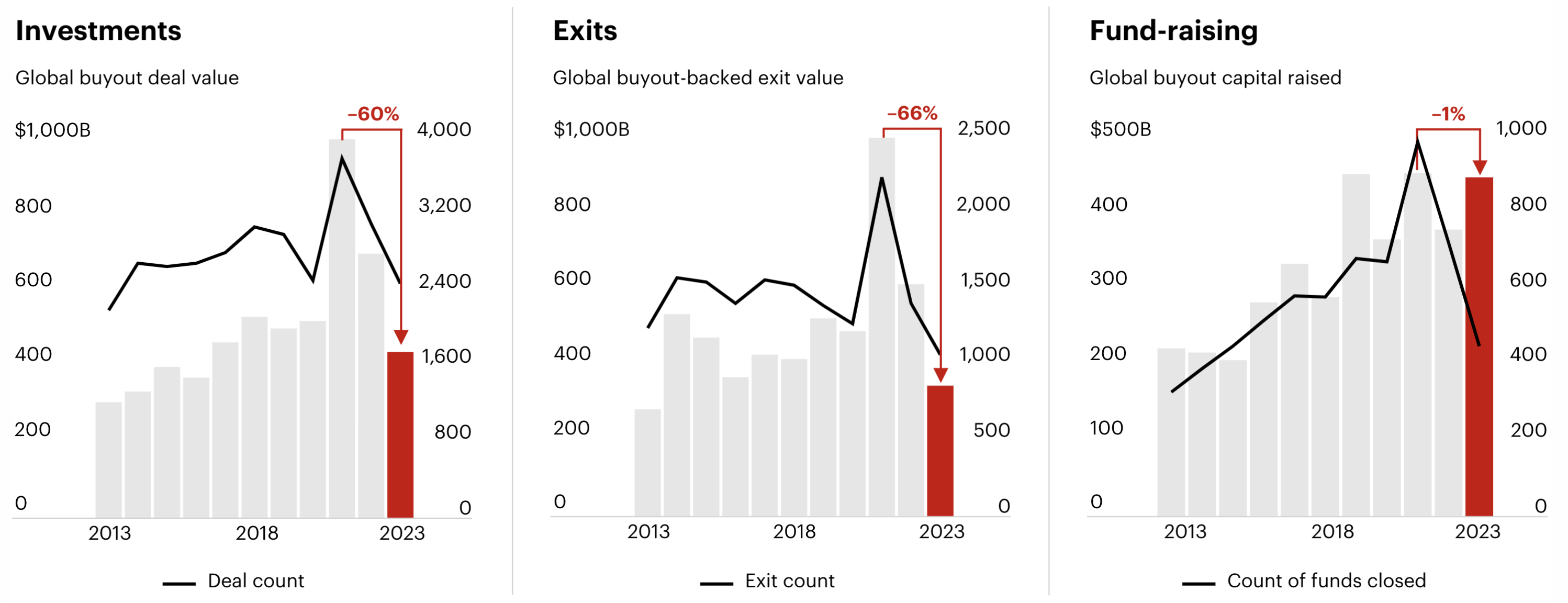
Bain Projections
Source: Bain Capital

One consequence of this prolonged period of high fundraising activity is that private equity is now involved in more mergers and acquisitions than at any point in history, with Bloomberg finding that at least 40% of deals reported to the federal government for antitrust review (the threshold for review is deals valued at at least $119.5 million) involve private-equity investors. That’s up from 10% in 2001.

As private equity has grown more prominent, one particular area that’s seen an uptick in PE involvement has been trade businesses like HVAC and plumbing companies, with business-school-educated PE investors scouring small-town USA for home-service businesses, creating Main Street millionaires along the way. From The Wall Street Journal:

PE firms across the country have been scooping up home services like HVAC—that is, heating, ventilation and air conditioning—as well as plumbing and electrical companies. They hope to profit by running larger, more profitable operations. 

Their growth marks a major shift, taking home-services firms away from family operators by offering mom-and-pop shops seven-figure and eight-figure paydays. It is a contrast from previous generations, when more owners handed companies down to their children or employees.

The wave of investment is minting a new class of millionaires across the country, one that small-business owners say is helping add more shine to working with a tool belt.

The optics of this are really interesting. Private equity is a high-status, white-collar industry full of former investment bankers and business-school graduates. HVAC businesses in Tucson, Arizona, are about as blue collar as they come. A decade ago, as noted by an investor in the Journal piece, these small-business owners had no one to sell to. Now, thanks to the hundreds of billions of dollars raised by PE funds in recent years, there is a ton of cash — supplied by endowments, family offices, and megawealthy limited partners of various funds — destined for the checking accounts of electricians, plumbers, and air-conditioning installment specialists, allowing these small-business owners to focus on what really matters:

“I want to hunt, fish, drink beer and cook meat,” Rice [a sewage inspector and repairman who sold his business to a PE shop in 2022] says, adding that selling his company has given him greater peace of mind for his family.

It’s funny, really. Investors who spent years on Wall Street and got their MBAs from Wharton and Harvard are now doing due diligence on small businesses around the country, competing with other investors to write multimillion-dollar checks that will subsidize plumbers’ ability to “hunt, fish, drink beer and cook meat.”

At the end of the day, every market is determined by supply and demand. It seems like if 40% of large transactions now involve private-equity buyers, and profitable small trade businesses are warranting multimillion-dollar acquisition offers, the high-probability path to getting rich is not going to business school to work for a PE shop that buys small businesses, but going to trade school and then starting a small business that you can sell to the PE shops where business-school guys work after graduation.

More Business

See all Business
business

The Trump administration is reportedly planning a 50% made-in-America requirement for USMCA tariff relief

Qualifying for USMCA-related lower tariffs may soon require more US-made vehicle components, according to reporting by The Wall Street Journal.

The Trump administration is reportedly planning to introduce a 50% US content requirement for vehicles covered by the trade pact to receive lower tariffs. The content would be measured by cost, according to the WSJ.

There currently isn’t any US-specific requirement for those lower tariff rates, but in order to receive preferential tariffs, vehicles are must contain at least 75% regional content (components made in North America). Per Reuters reporting, the Trump admin is seeking to raise the regional requirement to 82%.

These reported plans are subject to change as the US negotiates USMCA terms with Mexico over the next few months.

Overall, Tesla will likely have the easiest time qualifying for any stricter requirements. The automaker’s vehicles contained the highest amount of US/Canadian content in 2025, according to American University research. Ford, GM, and Stellantis all scored lower.

Notably: the underlying government data that many domestic content measurements rely on intentionally combines US and Canadian components, so it’s difficult to know exactly how much of any given vehicle is specifically US-made.

There currently isn’t any US-specific requirement for those lower tariff rates, but in order to receive preferential tariffs, vehicles are must contain at least 75% regional content (components made in North America). Per Reuters reporting, the Trump admin is seeking to raise the regional requirement to 82%.

These reported plans are subject to change as the US negotiates USMCA terms with Mexico over the next few months.

Overall, Tesla will likely have the easiest time qualifying for any stricter requirements. The automaker’s vehicles contained the highest amount of US/Canadian content in 2025, according to American University research. Ford, GM, and Stellantis all scored lower.

Notably: the underlying government data that many domestic content measurements rely on intentionally combines US and Canadian components, so it’s difficult to know exactly how much of any given vehicle is specifically US-made.

business

The $640,000 Luce makes the average Ferrari look like a bargain

Put aside the shape; put aside the smoothing out of Ferrari’s iconic sharp edges; put aside, even, the calls from former Chairman and President Luca Cordero di Montezemolo to “take the Prancing Horse off.” On the grounds of price alone, Luce detractors might have a point.

By now, many of us will have read the criticisms of Ferrari’s first fully electric vehicle, as the Luce — which was unveiled to the world earlier this week and promptly saw the company’s shares crash out in New York and Milan — gets subtly shaded by competitors online and not-so-subtly shaded by basically everyone else.

What makes all of this worse for Ferrari is that, even by the luxury car maker’s notoriously high standards, they’ve slapped a pretty hefty price tag on the Luce, and the company’s CEO, Benedetto Vigna, has already been forced to defend the €550,000 ($640,000) price point, saying yesterday that it’s “fair to pay for innovation,” per Reuters.

While Ferrari’s cars have been getting more expensive of late, as recently as 2022, Ferrari’s average revenue per car sold was around $340,000. At nearly twice that price, this new electric model is obviously proving a little much (visually, conceptually, and financially) for many loyal and long-standing fans of the Prancing Horse to stomach.

Ferrari Luce cost chart
Sherwood News

By now, many of us will have read the criticisms of Ferrari’s first fully electric vehicle, as the Luce — which was unveiled to the world earlier this week and promptly saw the company’s shares crash out in New York and Milan — gets subtly shaded by competitors online and not-so-subtly shaded by basically everyone else.

What makes all of this worse for Ferrari is that, even by the luxury car maker’s notoriously high standards, they’ve slapped a pretty hefty price tag on the Luce, and the company’s CEO, Benedetto Vigna, has already been forced to defend the €550,000 ($640,000) price point, saying yesterday that it’s “fair to pay for innovation,” per Reuters.

While Ferrari’s cars have been getting more expensive of late, as recently as 2022, Ferrari’s average revenue per car sold was around $340,000. At nearly twice that price, this new electric model is obviously proving a little much (visually, conceptually, and financially) for many loyal and long-standing fans of the Prancing Horse to stomach.

Ferrari Luce cost chart
Sherwood News

Latest Stories

Sherwood Media, LLC and Chartr Limited produce fresh and unique perspectives on topical financial news and are fully owned subsidiaries of Robinhood Markets, Inc., and any views expressed here do not necessarily reflect the views of any other Robinhood affiliate, including Robinhood Markets, Inc., Robinhood Financial LLC, Robinhood Securities, LLC, Robinhood Crypto, LLC, Robinhood Money, LLC, Robinhood U.K. Ltd, Robinhood Derivatives, LLC, Robinhood Gold, LLC, Robinhood Asset Management, LLC, Robinhood Credit, Inc., Robinhood Ventures DE, LLC and, where applicable, its managed investment vehicles.