
Culture
Cartoon of family of five
(Getty Images)

The gap between America’s notion of the ideal family size and the actual reality is getting wider

Americans think somewhere around three kids is ideal. The fertility rate has some serious catching up to do.

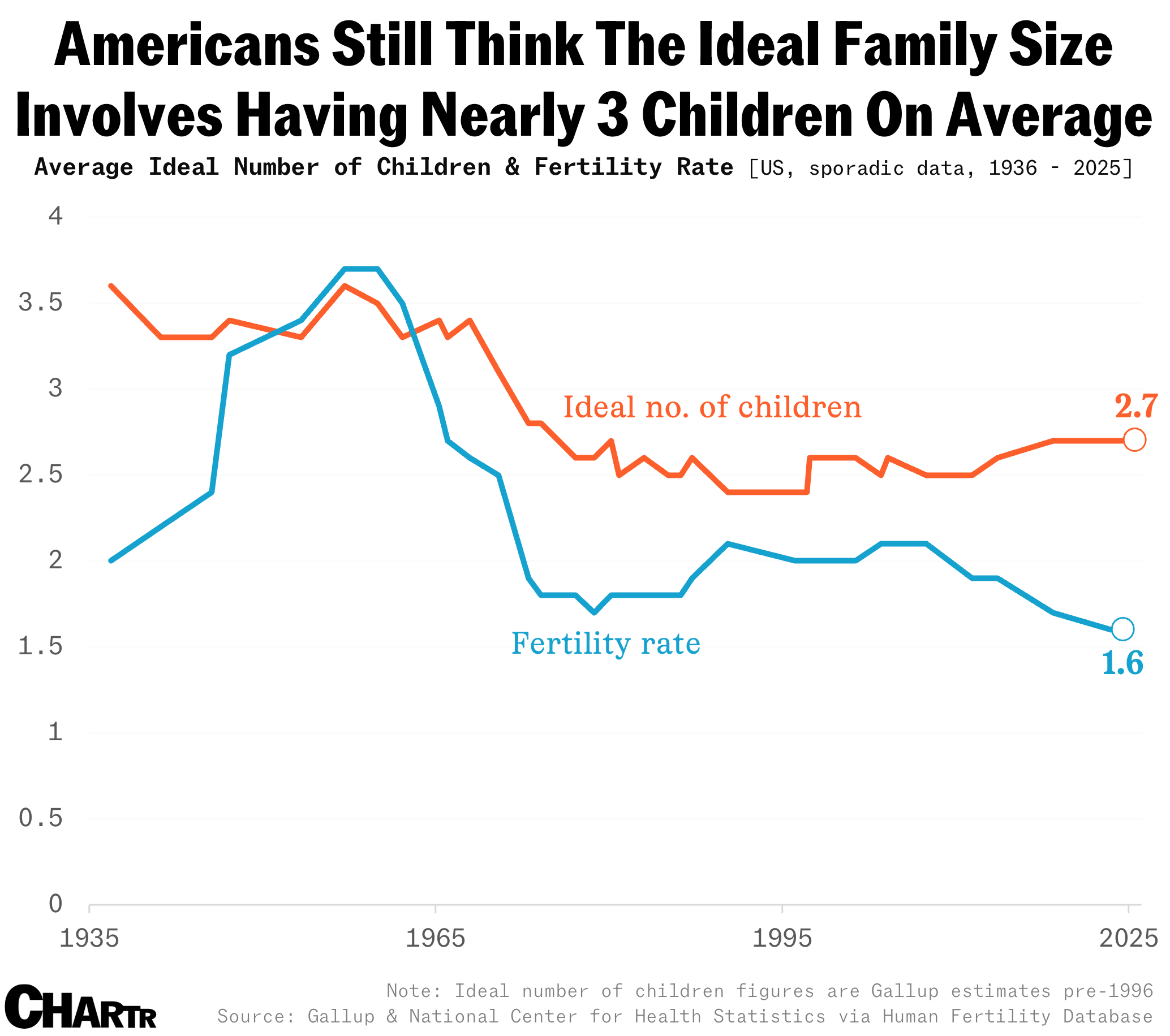
While much is written (and charted) about declining birth rates in the US, Asia, and around the world more broadly, over two-thirds of Americans are still envisioning a dream family with between two and three children, according to recent Gallup data

Since 1936, the American polling and analytics company has asked US adults what they think is the “ideal number of children” for a family. Back then, the average response was 3.6 children, before dropping slightly during World War II. In July of this year, when Gallup asked the same question, the average ideal number of children came out to be 2.7 — after 40% of respondents said two, 27% said three, and 15% said four or more children was their “ideal.” 

Unsurprisingly, though, none of those answers line up with the current birth rate.
Ideal number of children chart
Sherwood News

Even as the American fertility rate dropped to 1.6 births per woman last year — the lowest on record, and falling below the generally accepted replacement rate of 2.1 — the ideal family in the collective American consciousness has still risen modestly from 2.4 in the late 1990s. As Gallup suggested, the data indicates that the nation’s falling fertility rate has more to do with practical issues that would-be parents face rather than shifting attitudes toward having children or the traditional family unit.

Parental guidance

Since 2007, when the fertility rate last sat at that 2.1 replacement level, there have been a lot of external influences on potential parents that may have swayed their decision to have kids one way or another. Costs associated with child rearing, such as the rising price of childcare; the economic hardship that current parents increasingly say they’re facing; and the financial toll pregnancy and motherhood could take on the ever-growing female working population are all factors.

More Culture

See all Culture
Family in front of TV

Hollywood may have its best year at the box office since 2019, but streaming audiences are still obsessed with old content

Viewers are opting for catalog content over new shows and movies across (pretty much) every major streamer.

Tom Jones6/29/26
culture
Tom Jones

The BBC has become the world’s top news website... by collapsing a little less than its competition

Press Gazette just published its annual look at the biggest news sites in the world across all languages; for the most part, it doesn’t make for particularly pretty reading.

The journalism industry publication’s latest update, which is based on estimates provided by Similarweb for May, found that 37 of the world’s 50 most visited news sites saw their reach shrink. Press Gazette highlighted that American outlets have been hit particularly hard by declining Google traffic compared to European counterparts, owing to the platform’s AI features rolling out earlier in the US.

Even the BBC, having climbed the rankings from last year to top the 2026 chart — reportedly in part thanks to Similarweb’s decision to combine the “.co.uk” and “.com” versions of the URL, given that the sites redirect to each other depending on the user’s location — showed a 1.9% decline from last year.

Latest Stories

Sherwood Media, LLC and Chartr Limited produce fresh and unique perspectives on topical financial news and are fully owned subsidiaries of Robinhood Markets, Inc., and any views expressed here do not necessarily reflect the views of any other Robinhood affiliate, including Robinhood Markets, Inc., Robinhood Financial LLC, Robinhood Securities, LLC, Robinhood Crypto, LLC, Robinhood Money, LLC, Robinhood U.K. Ltd, Robinhood Derivatives, LLC, Robinhood Gold, LLC, Robinhood Asset Management, LLC, Robinhood Credit, Inc., Robinhood Ventures DE, LLC and, where applicable, its managed investment vehicles.