Culture
3d robots working at desks with computers in a repetitive office pattern
Getty Images
LEARNING MACHINES

More US teens are using AI for studying. Not all of them feel great about it.

A new survey finds over half of Americans aged 13 to 17 use AI chatbots to help with school.

With investors’ opinions about the future of AI diverging, new research suggests that views about the tech’s impending outcomes are also mixed among some of its youngest users.

A new survey from Pew Research Center, published Tuesday, asked US teens aged 13 to 17 about their AI use, and found that more than half (54%) reported using chatbots to help with schoolwork in 2025 — second only to searching for information (57%) as the top reason, and ahead of using it for fun or entertainment (47%).

Overall, the share of American teens who report using AI for studying has risen significantly in just a few years: back in 2023, Pew found that 13% of students said they ever used ChatGPT for schoolwork; in 2024, it was 26%. Now, only one year later, that share has more than doubled.

Still, even as more teens are turning to chatbots for help researching, editing, or problem solving, that doesn’t mean they all feel entirely happy about the overall impact that AI might have in the coming decades.

US teens AI use chart
Sherwood News

While almost a third of respondents said they think that AI will have a positive impact on society over the next 20 years — with 30% of that cohort citing that it “makes life better, easier” as their top reason — there was still a 26% share that said it would have a negative impact.

Why? Well, besides a history of AI-linked mental health crises, and ignoring the countless hours spent speaking to imaginary characters, the top reason listed in the survey was “overreliance, loss of critical thinking or creativity.” With student test scores slumping in real time, and 1 in 10 teens reporting using chatbots for “all or most” of their schoolwork, could those concerns already be coming into view?

More Culture

See all Culture
culture

Apple and Netflix announce a Formula 1 content swap

Just months after Apple signed a five-year, $140 million-per-year deal for US media rights to Formula 1 races, the streamer is sharing with Netflix.

In a rare content swap, Apple TV will allow Netflix to simulcast the F1 Canadian Grand Prix in May. Netflix, in turn, will allow Apple to carry its popular “Drive to Survive” docuseries.

“Drive to Survive” will land on the queues of both Netflix and Apple TV at 12 a.m. PT this Friday.

The docuseries has been a major driving force behind F1’s increasing popularity in the US, with more than half of the sport’s followers crediting “Drive to Survive” as a key reason they became fans, per a 2022 survey.

“Drive to Survive” will land on the queues of both Netflix and Apple TV at 12 a.m. PT this Friday.

The docuseries has been a major driving force behind F1’s increasing popularity in the US, with more than half of the sport’s followers crediting “Drive to Survive” as a key reason they became fans, per a 2022 survey.

culture

Trump’s speech broke the record for the longest State of the Union address ever

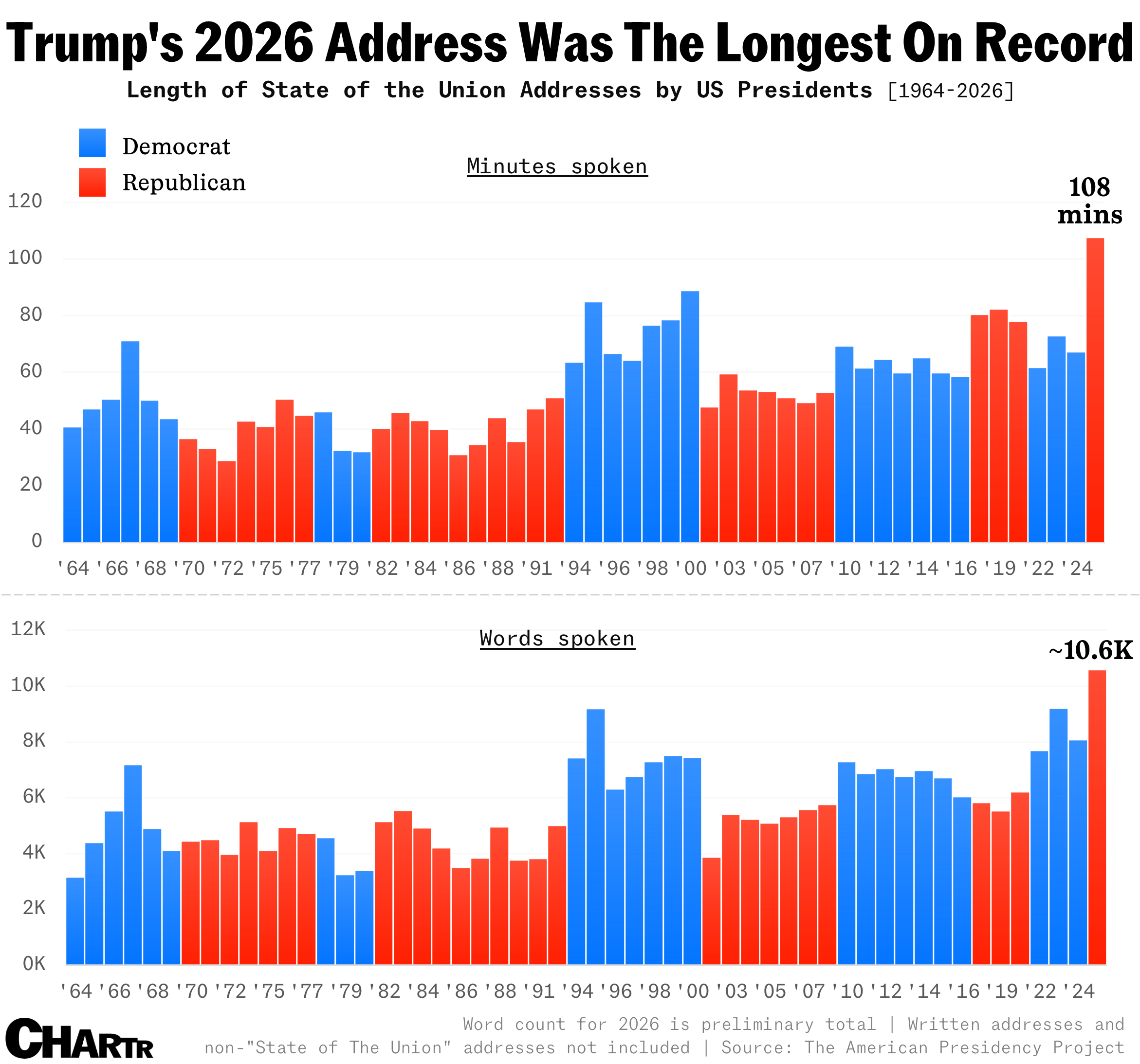
Much like the US men’s hockey team as they walked into the House Chamber during President Trump’s address, there would have been plenty of “mention” traders celebrating at least a few of the president’s ~10,600 words on Tuesday evening, including “hottest,” “egg,” and “alien.”

Lasting almost 108 minutes, Trump’s speech yesterday officially became the longest State of the Union address of the television age, per Bloomberg, surpassing the previous record of 89 minutes set by President Bill Clinton in 2000.

According to data compiled by The American Presidency Project, the president’s address was almost double the average length of all recorded SOTU speeches since 1964, which works out as 55 minutes.

Trump SOTU address
Sherwood News

The speech also marked what could be a new personal best in terms of length for Trump, beating his remarks to Congress in March 2025 by 8 minutes, though this was not included in the average as, according to the APP, it was not an official “State of the Union” speech.

The APP also calculated a preliminary figure for 2026 in terms of word count, and the current president trumped all other spoken-word SOTU addresses. Some addresses, however, haven’t been verbally delivered, and a couple of the written versions have racked up considerably greater tallies — most notably Jimmy Carter’s 1981 written address, which came in at 33,667 words in total.

culture
Saleah Blancaflor

Prediction markets give slight edge to Netflix in Warner Bros. battle after eventful week

The ongoing bidding war between Paramount and Netflix for the acquisition of Warner Bros. Discovery had some significant news this week that could change the outcome:  

  • Things kicked off Tuesday, when WBD said in a statement it would resume talks with Paramount Skydance to consider its best and final offer after Netflix allowed a seven-day waiver. The WBD board continues to “unanimously recommend” the merger with Netflix, while the streaming service will retain its rights to match or exceed any forthcoming offer from Paramount. The negotiation period ends on February 23.

  • IndieWire reporter Brian Welk talked to a few experts about whether the new developments bring clarity to the ongoing bidding war. One professor said without Paramount offering its “best and final offer,” the company loses credibility, while another professor said it makes Netflix look even more confident. 

  • Lightshed Partners analyst Richard Greenfield said on his podcast that Paramount will have to raise its offer to as high as $36 to $37 per share. (The company has stuck to $30.) In comparison, Netflix’s initial offer is for $27.75 a share to buy the studio and streaming service, while Paramount is bidding to buy the whole company. 

  • Semafor reported Thursday morning that some Democratic senators are “unhappy” with the fact that Paramount Skydance CEO David Ellison refused to attend a hearing two weeks ago, and could launch an investigation into the deal if they retake the Senate.

  • Meanwhile, Reuters reported that Netflix has “ample cash” and could increase its offer for WBD if Paramount beefs up its own offer, according to sources. 

  • Netflix co-CEO Ted Sarandos recently appeared on a recent episode of “The Town with Matthew Belloni” to reiterate that he doesn’t plan on ruining WBD’s theatrical business model and promised to keep the 45-day theatrical window for WBD films, which could appease opposition from theater owners.

  • Variety reported that there’s been a shift among WBD employees who now support Netflix’s acquisition, though there’s still some skepticism among others.

WBD shareholders are still set to vote on the proposed Netflix merger next month, on March 20. Despite the renewed talks with Parmount, as of Friday at 12:45 p.m. ET, prediction markets speculating on who will ultimately come out on top have recently flipped to give the edge back to Netflix, pricing in a 46% chance over Paramount’s 44% odds. 

(Event contracts are offered through Robinhood Derivatives, LLC — probabilities referenced or sourced from KalshiEx LLC or ForecastEx LLC.)

Loading...
 
Loading...
 

Latest Stories

Sherwood Media, LLC produces fresh and unique perspectives on topical financial news and is a fully owned subsidiary of Robinhood Markets, Inc., and any views expressed here do not necessarily reflect the views of any other Robinhood affiliate, including Robinhood Markets, Inc., Robinhood Financial LLC, Robinhood Securities, LLC, Robinhood Crypto, LLC, or Robinhood Money, LLC.