Business
Pacman characters eating gold power pills
(Fairfax Media/Getty Images)

Big Tech is back to doing what it does best: gobbling up startups for billions

Google inked its biggest deal ever, Nvidia reportedly bought Gretel, and Meta is chasing an AI chip startup — and that was just in the last week. The flurry of dealmaking could continue.

The technology world is Pac-Man. Big Tech navigates a maze of hardware, software, and talent, trying to build products that change the world, or just make a lot of money, while avoiding the ghosts — regulation, product obsolescence, or consumer backlash — that could take them down.

Along the way they swallow a lot of startups, little pills and pockets of growth that could become a core offering of their platform, like Meta’s 2012 deal for Instagram, or Google’s YouTube tie-up from 2006.

And in 2025, with AI shaking the foundations of almost every tech-adjacent vertical and a new administration in the White House that might be more acquisition-friendly, the giants are keen to strike some deals.

Just last week, Google finally clinched its deal for Wiz. After its $23 billion approach was rebuffed in July of last year, Google gave the cybersecurity startup an additional 9 billion reasons to say yes, agreeing to a $32 billion takeover with an eye-watering 10% break fee, well above the 4% to 7% typically seen in tech mergers and acquisitions. That $3.2 billion gamble is an indication of two things: Google really wanted this one, and it doesn’t see much of a risk of things blowing up after the agreement was signed. Simultaneously, Meta is reportedly after FuriosaAI, a Korean startup with expertise in AI hardware infrastructure, but its $800 million offer was rejected, according to Bloomberg reporting on Monday.

If a startup has something you want — maybe a product, a piece of technology, or just a rockstar team — an acquisition trades time for money.

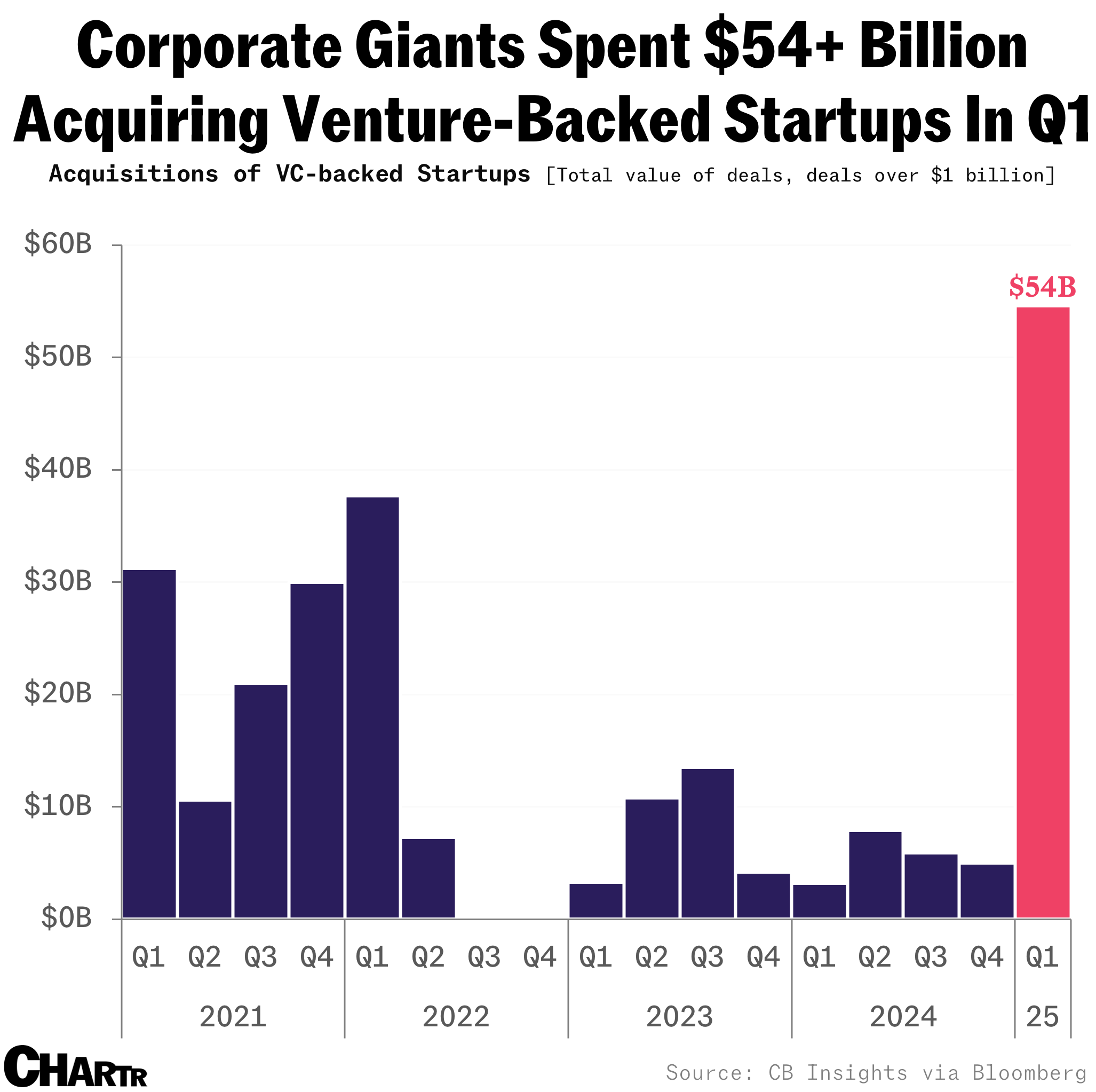
But its not just Meta and Google looking for deals, with data compiled by CB Insights revealing that 11 venture-backed startups were acquired for more than $1 billion in Q1 2025, for a total value of $54.5 billion — the largest quarterly sum on record, driven by Google’s Wiz deal. For comparison, last year, only two startups were bought for more than $1 billion.
Startup Deals
Sherwood News

There are good reasons to expect that this flurry of acquisitions could continue into the future. For starters, the regulatory environment is now wildly different. Lina Khan, who rose to prominence after publishing a prescient article titled “Amazon’s Antitrust Paradox,” is out as chair of the Federal Trade Commission. Her successor, Andrew Ferguson, is likely to take a lighter touch to scrutinizing dealmaking. Speaking to CNBC on March 13, Ferguson had this to say about the FTC’s approach to M&A (emphasis ours):

“Here’s what I want to say about that — if we’ve got a merger or conduct that violates the antitrust laws, and I think I can prove it in court, I’m going to take you to court. And if we don’t, I’m going to get the hell out of the way. The FTC is not going to try to use sort of sub-regulatory means to hold up mergers without actually taking people to court and hope that they die on the vine. That’s over. If we think it violates the laws, we’re going to litigate. And if it doesn’t, we’re going to get out of the way and we’re going to let markets do their thing.”

Sellers might also be more willing to transact than they were previously. Speaking to Bloomberg, David Chen, head of global technology investment banking at Morgan Stanley, said, “The sellers’ willingness to transact has actually improved,” in part due to volatility in markets. Though stocks have bounced slightly this week, fears of a recession and the potential of an accompanying bear market may make a nice soft landing into the arms of a corporate giant a more appealing prospect for founders and leaders of high-flying startups who have a lot of wealth on paper that they’d like to finally cash in. Even “fearless founders” get spooked.

Build or buy?

For would-be corporate acquirers, the AI boom presents a ripe environment for acquisitions, but with every potential deal, the team has to make an evaluation: do we try and build this ourselves, or just go out and buy it?

If a startup has something you want — maybe a product, a piece of technology, or just a rockstar team — an acquisition trades time for money.

Given the speed of change in the field of AI, the tech giants, who are already on track to spend an eye-watering $315 billion on capital expenditures this year, might be willing to spend a little bit more to acquire the tools and talent they need to compete. It’s not the time to keep your powder dry in the hope of saving a few bucks.

Just a week ago, Nvidia reportedly bought Gretel, a synthetic data startup that, according to its website, can help you “generate artificial, synthetic datasets with the same characteristics as real data, so you can improve AI models without compromising on privacy.” Exact terms of the deal weren’t disclosed, but it was said to be in excess of Gretel’s most recent $320 million valuation. That’s a drop in the ocean for Nvidia, but it’s a telling maneuver nonetheless, because Nvidia has typically been one of the least acquisitive of its peers.
Big tech acquisitions dot plot
Sherwood News

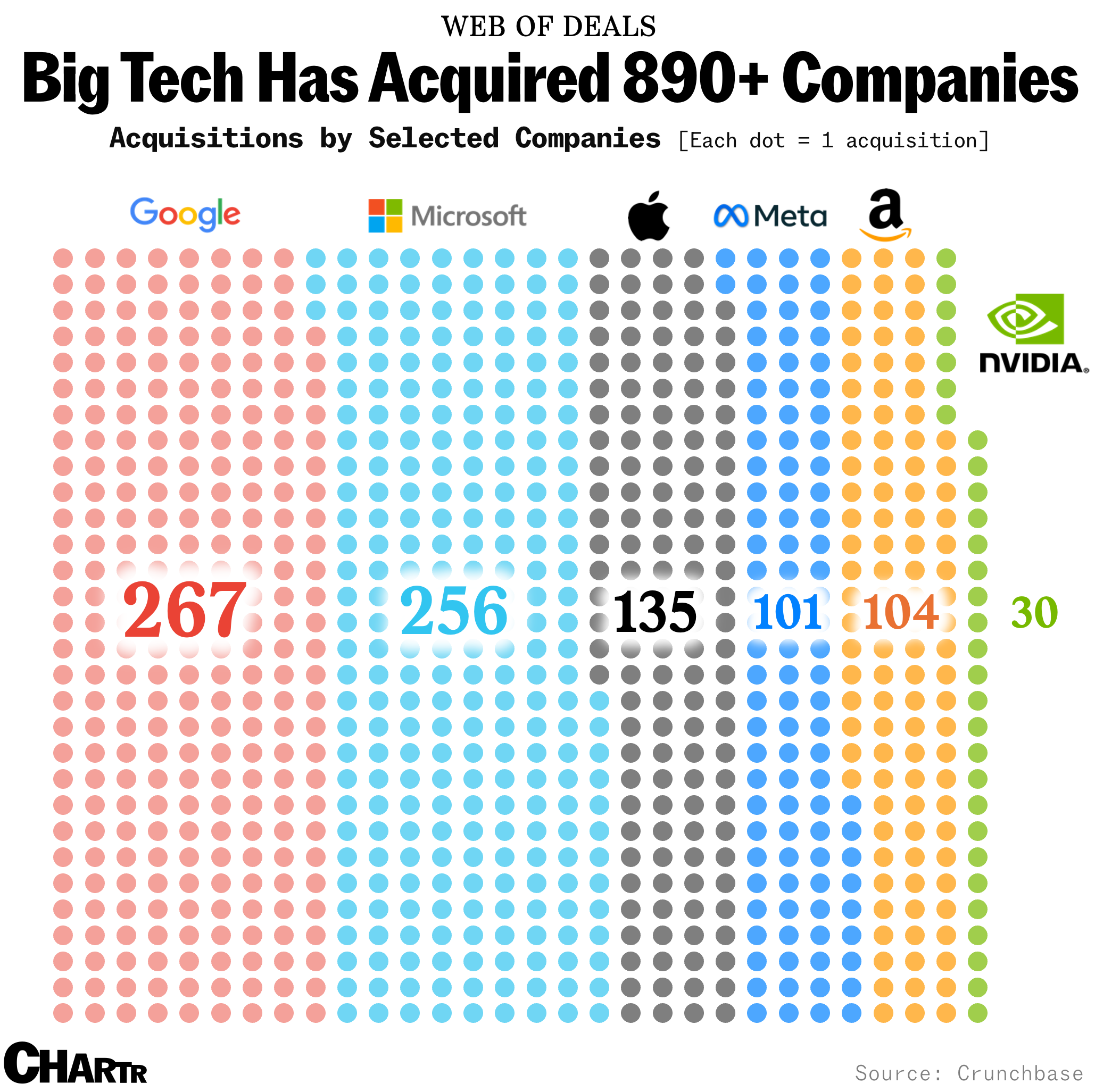
According to data from Crunchbase, Nvidia has acquired just 30 companies. Google, through owner and parent company Alphabet, has bought 267, ahead of the next most acquisitive tech company, Microsoft, which has acquired 256 companies.

With investors falling over themselves to bid up the equity of companies that show the most progress on AI, it seems logical to assume that deals will follow, and with the balance sheets of Big Tech as healthy as they’ve ever been, the financial firepower is certainly there. Policy uncertainty — which has soared this year — could thwart that thesis.

What would have become of all of these startups gobbled up by Big Tech? As my colleague Matt Phillips and I wrote last year, many of them might have become public companies, meaningful competitors... or both.

Go Deeper: Where did all the stocks go?

More Business

See all Business
business
Tom Jones

Prime Day is here again and Amazon’s subscription service has never been more popular

Well, it’s that time of year again: many have made their wish lists, people are scraping together the money they’ve saved to pick out a perfect gift, some are presumably leaving out refreshments for the weary delivery drivers and, more and more, drones.

It’s Amazon Prime Day — meaning that it’s the second day of the four-day promotional event that Amazon still calls Prime Day — of course, and it’s even come early this year, with the company bringing the period into late June from July, when it’s been traditionally held for the last five years.

The Prime Age

Alongside the eyes and endless clicks that the arbitrary stream of listicles on “The Best Prime Day Deals” that almost every media outlet pours into, Amazon will also be cheering the fact that there’s now more Prime users than ever before to devour the retailer and its sellers’ sometimes-contested “discounts.” Indeed, according to the latest annual estimates from Consumer Intelligence Research Partners (CIRP), there were just over 200 million American shoppers using Amazon’s massive subscription service at the end of 2025.

business

Electronic Arts launches a platform to put more ads in its games

Video game publishing giant EA launched a new platform on Monday designed to make the process of selling immersive ad space in its popular games easier.

The company says the platform, called EA Advertising, allows brands to “integrate directly into gameplay through dynamic, real-time placements, from stadium signage to custom in-game content.”

More so than other studios, EA has incorporated advertising into its most popular titles. As Kotaku points out, the company’s ad efforts stretch as far back as 2006. Several of its sports franchises already feature partnerships with brands like Visa, Lowe’s, Red Bull, and PepsiCo.

In-game advertising hasn’t exactly been embraced by fans, but industry experts expect it to ramp up as companies seek more revenue to offset higher games budgets and surging memory costs. EA rival Take-Two has taken a different approach, with CEO Strauss Zelnick recently saying the company was “not at risk of doing brand partnerships” in the forthcoming “Grand Theft Auto VI,” and that ads in full-price games seems “unfair.”

The $55 billion deal to take EA private, led by Saudi Arabia’s Public Investment Fund, is set to close at the end of this month. Being the largest leveraged buyout in history, EA will likely look for more ways to boost revenue to cover interest payments.

More so than other studios, EA has incorporated advertising into its most popular titles. As Kotaku points out, the company’s ad efforts stretch as far back as 2006. Several of its sports franchises already feature partnerships with brands like Visa, Lowe’s, Red Bull, and PepsiCo.

In-game advertising hasn’t exactly been embraced by fans, but industry experts expect it to ramp up as companies seek more revenue to offset higher games budgets and surging memory costs. EA rival Take-Two has taken a different approach, with CEO Strauss Zelnick recently saying the company was “not at risk of doing brand partnerships” in the forthcoming “Grand Theft Auto VI,” and that ads in full-price games seems “unfair.”

The $55 billion deal to take EA private, led by Saudi Arabia’s Public Investment Fund, is set to close at the end of this month. Being the largest leveraged buyout in history, EA will likely look for more ways to boost revenue to cover interest payments.

business

JM Smucker says it sold $1 billion worth of Uncrustables in FY2026

After years of booming sandwich sales, JM Smucker has finally earned a billion-dollar crust.

On Tuesday, the company reported results for fiscal year 2026, highlighting better-than-expected profits driven by higher prices for coffee and sweet baked goods. However, at another point on the earnings call, CEO Mark Smucker pointed to one particularly jammy figure: in line with previous forecasts, the company sold $1 billion worth of its (almost always) crustless sandwiches, Uncrustables, in the last year alone.

business

Paramount reportedly offers concessions to resolve multistate antitrust investigation

Paramount has reportedly offered up some concessions in an effort to prevent an antitrust lawsuit by California and about 10 other states, according to Bloomberg reporting on Monday.

Reuters first reported on the potential suit from a group of unnamed states last week, which could throw a wrench in Paramount’s plans to buy rival Warner Bros. Discovery in a Hollywood megamerger.

The list of concessions is unknown, though Bloomberg previously reported that Paramount is open to divesting some of its kids TV assets to appease EU regulators.

Late last month, reports said US regulators appeared likely to approve the $110 billion merger, following a meeting between Paramount CEO David Ellison and DOJ antitrust staffers.

The list of concessions is unknown, though Bloomberg previously reported that Paramount is open to divesting some of its kids TV assets to appease EU regulators.

Late last month, reports said US regulators appeared likely to approve the $110 billion merger, following a meeting between Paramount CEO David Ellison and DOJ antitrust staffers.

$98B ⛽

The IATA released its latest financial outlook for the airline industry over the weekend, forecasting a $98 billion jump in the sector’s collective fuel bill. The world’s largest trade group representing airlines expects the oil spike to halve profits by 49% from last year to $23 billion.

The group also expects profit margins to halve year over year, falling from 2025’s 4.2% to 2%. Still, revenue is expected to climb to $1.17 trillion from $1.07 trillion.

A surge in the cost of jet fuel has rocked US and global airlines this year, leading Delta Air Lines, United Airlines, American Airlines, Southwest Airlines, JetBlue, and others to raise fares and ancillary charges like bag fees. Low-cost carriers, which operate on smaller margins, have been squeezed the hardest, resulting in Spirit’s shutdown.

“It’s a tough year for all airlines, especially those whose balance sheets had not yet recovered from COVID. And, of course, for those operating in the Gulf,” said IATA Director General Willie Walsh, who added that demand is holding up and about half of passengers expect to spend more on travel this year. “That bodes well for a strong northern summer peak season. The big unknown is how long travelers and shippers can tolerate the higher costs of connectivity.”

Latest Stories

Sherwood Media, LLC and Chartr Limited produce fresh and unique perspectives on topical financial news and are fully owned subsidiaries of Robinhood Markets, Inc., and any views expressed here do not necessarily reflect the views of any other Robinhood affiliate, including Robinhood Markets, Inc., Robinhood Financial LLC, Robinhood Securities, LLC, Robinhood Crypto, LLC, Robinhood Money, LLC, Robinhood U.K. Ltd, Robinhood Derivatives, LLC, Robinhood Gold, LLC, Robinhood Asset Management, LLC, Robinhood Credit, Inc., Robinhood Ventures DE, LLC and, where applicable, its managed investment vehicles.