


2025 was a busy year for news. What with whipsawing tariffs, booming AI data centers, driverless taxis, flying cars, weight-loss drugs, and billionaire beefs... it was a lot. As we look back on this eventful year that broke all the rules, we dug into our archives to find the charts and visualizations that we made to help break it all down for you, our dear readers.
📈 Markets
The biggest tech companies got even bigger
Tech companies entered the $4 trillion market cap club — $5 trillion in Nvidia’s case — and exited. Currently, Nvidia and Apple are the only companies to have retained the vaunted membership.
Prediction markets went political — and mainstream
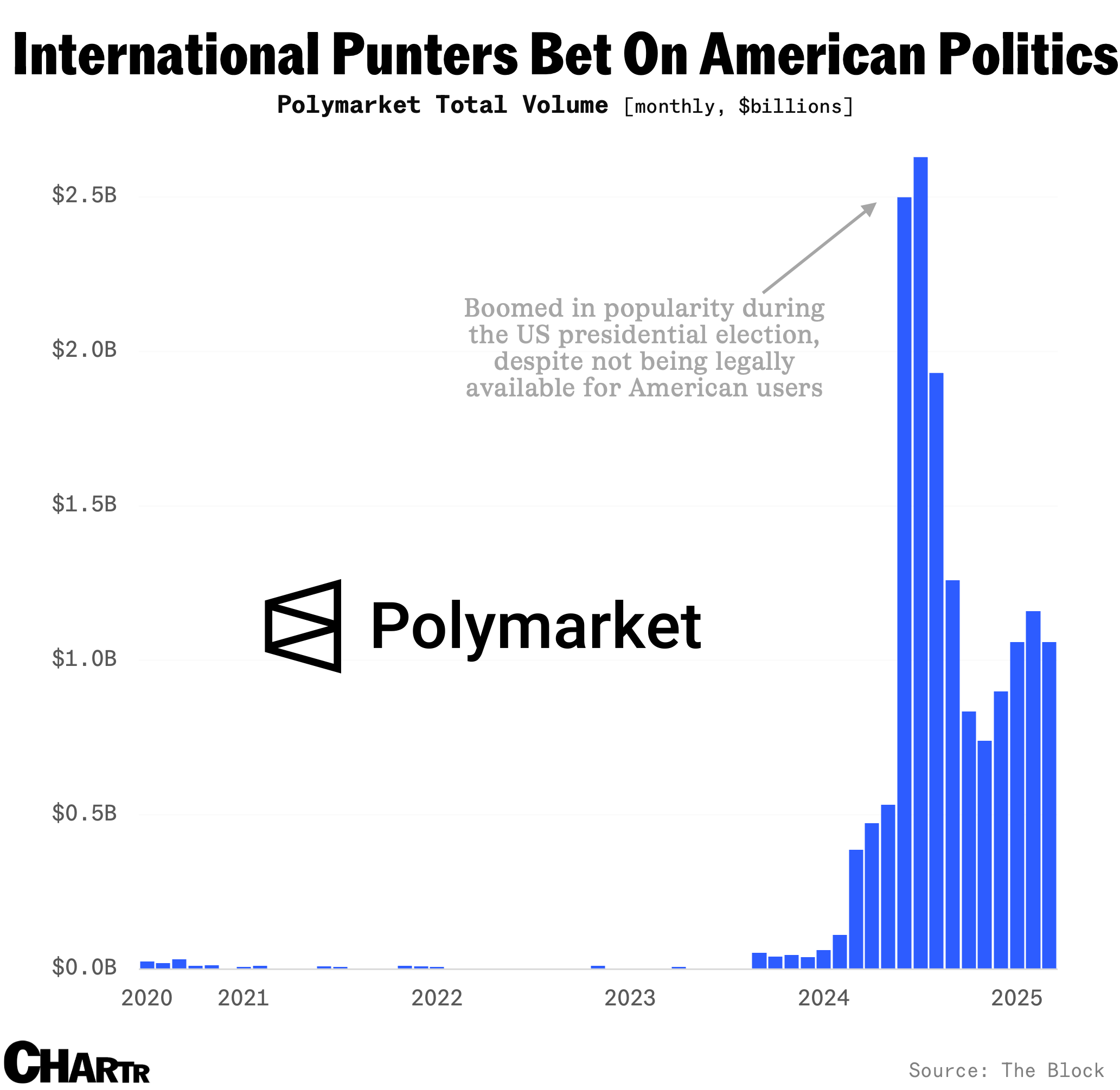
Prediction markets surged ahead of the US presidential election, with substantial volume coming from traders outside the country. In 2025, US regulators expanded the legal pathways for prediction markets, so overall trading volume across the industry is expected to continue rising.
No-good November for bitcoin
November was so bad for bitcoin that investors called it “Nopevember.” December so far isn’t looking much better. We’ll see what they come up with name-wise for the last month of the year.
Gold and silver became the new meme stocks
Judging by momentum, flows, options activity, and retail enthusiasm this fall, gold and silver were the new meme stocks. As Sherwood News’ Luke Kawa put it, “The new shiny toys for traders are the oldest, shiniest perceived stores of value.”
🎬 Entertainment and culture
Just how many ads are there on ad-supported streaming apps, really?
Way back at the beginning of this year, we plopped down on a couch to find out just how many ads you see for select episodes of top shows. We saved you the pain of having to go through hours of episodes on Netflix, Peacock, Disney+, Max, Paramount+, and Hulu to count them. Now it’s likely much higher, as companies like Netflix build out their ad tech and woo advertisers over to streaming.
You’re going to keep paying more for streaming
The cost of streaming subscriptions kept going up this year, with or without ads, as streamers alike sought to make more off their existing audiences amid slowing growth.
The streaming companies are consolidating
One way companies like Netflix and Paramount are hoping to stave off streaming headwinds is by acquiring other companies. This time, they’re both hoping to buy the same one. Netflix, for now, seems to have won the bid, announcing an $83 billion acquisition of Warner Bros. Discovery’s streaming and studio assets. One reason the buy is so enticing: it turns out making content is more expensive than just buying it. Netflix, for example, has spent more since the pandemic on content than the entire cost of the acquisition, which includes HBO and movie assets from Warner Bros.’ 100-year-old-plus studio.
They’re trying to keep up with YouTube
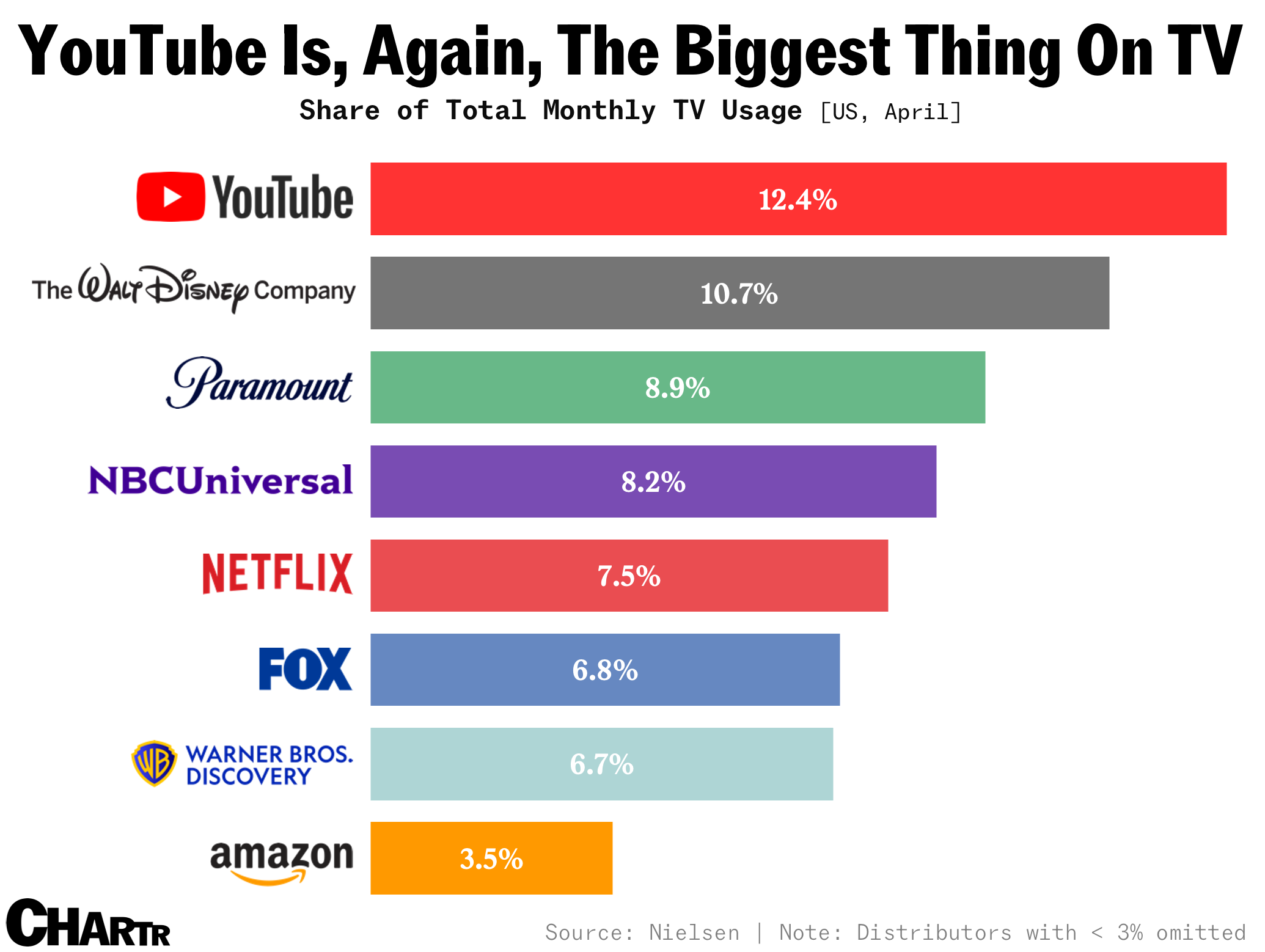
Netflix used to say its only competition was sleep. Now, not only does it compete with other services streaming movies and TV, but it’s also up against short-form social video. Indeed, Americans spend the biggest chunk of their time watching TV through YouTube.
A look at another industry swallowed by streaming
The move to streaming in the movie industry is all but complete, with the music business very much being Streaming ft. Everything Else. We took a walk down memory lane to show you what it used to be like.

💵 Economy / government
All that glitters
While we have been following the rising price of gold, we’ve also been keeping an eye on the increasing amounts of gold leaf appearing in the Oval Office. Over the course of this year, President Trump’s obsession with all things gilded resulted in a week-by-week increase in the number of chalices, medallions, and cartouches, which look like they were bought in bulk. We documented the golden doodads and made a handy visual to show just how much of the office is covered in gold.

The unemployment rate has been ticking up
The latest payroll numbers don’t look good for the US economy, with unemployment rates rising to 4.5%. Unemployment has now risen for four consecutive readings. The last time that happened? 2009.
High- and low-income earners are feeling the pinch
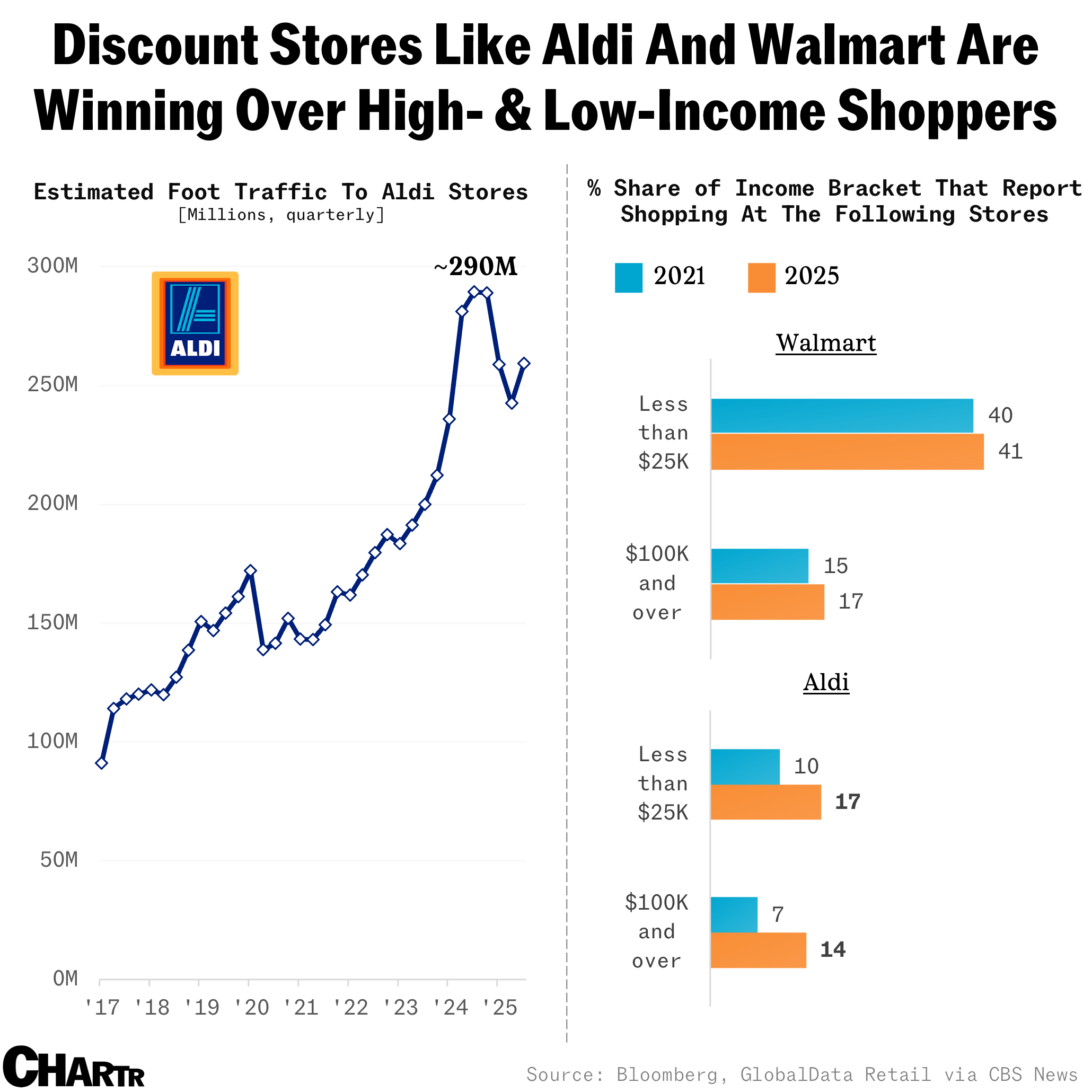
Even the relatively wealthy are looking to save some cash these days. Discount stores like Walmart, Dollar Tree, and Aldi are having a moment, thanks both high- and low-income shoppers, due to the rising cost of goods and increasingly difficult job market.
✈️ Transportation
Airline margins are going down
Airlines’ move to upsell customers on perks like premium seats belie their downward trend in profits. An analysis of company reports and data from the Bureau of Transportation Statistics shows that between 2021 and 2024, the big four US airlines earned approximately $5.51 in profit per passenger — down sharply from the four years leading into the pandemic (2016 to 2019), when the companies’ profit per passenger averaged $19.26.
In the race to autonomy, ride-hailing companies are partnering up
In order to get their highly ambitious and expensive robotaxi companies off the ground and into the mainstream, a number of the biggest players like Google’s Waymo and Uber are partnering up. The odd man out? Tesla, which is hoping to go it alone.
As far as regular EVs, Tesla is getting a bigger share of a smaller pie
The end of the government’s $7,500 tax credit has been bad news for the electric vehicle industry, which is facing declining sales. US EV sales were down 41% in November compared with a year earlier. However, as major automakers pull back on EV production, there’s a bit of a bright spot for pure-play EV companies like Tesla, which is finding itself with a bigger share of a smaller market.
Flying car companies are trying to get off the ground — with lobbying
As companies like Archer Aviation try to grow their air taxi networks, they’re turning to lobbyists to try and get federal approval. Such companies have already outspent their 2024 lobbying budgets in the first three quarters of 2025, which will likely end much higher.
🤖 AI and technology
AI valuations head into the stratosphere
Each new AI funding round has sent AI startup valuations dramatically higher, with several now worth more than $100 billion. Reports have said that OpenAI, valued at $500 billion in its latest round, could IPO next year at an eye-watering $1 trillion valuation.
Their valuations are soaring on the specter of AGI
Of the many claims AI companies are making, their goals of reaching artificial general intelligence — being better than humans at most tasks — is perhaps the most intriguing. Some of the biggest brains in tech (and those with the most skin in the game) have been making predictions regarding when that milestone will come to pass.
To achieve its AI goals, Big Tech won’t stop spending
Last quarter alone, Meta, Microsoft, Amazon, and Alphabet combined spent nearly $100 billion on purchases of property and equipment, largely in service of building out AI data centers. Judging by their forward-looking statements, that spending isn’t going down anytime soon.
That spending is showing up in the real estate market
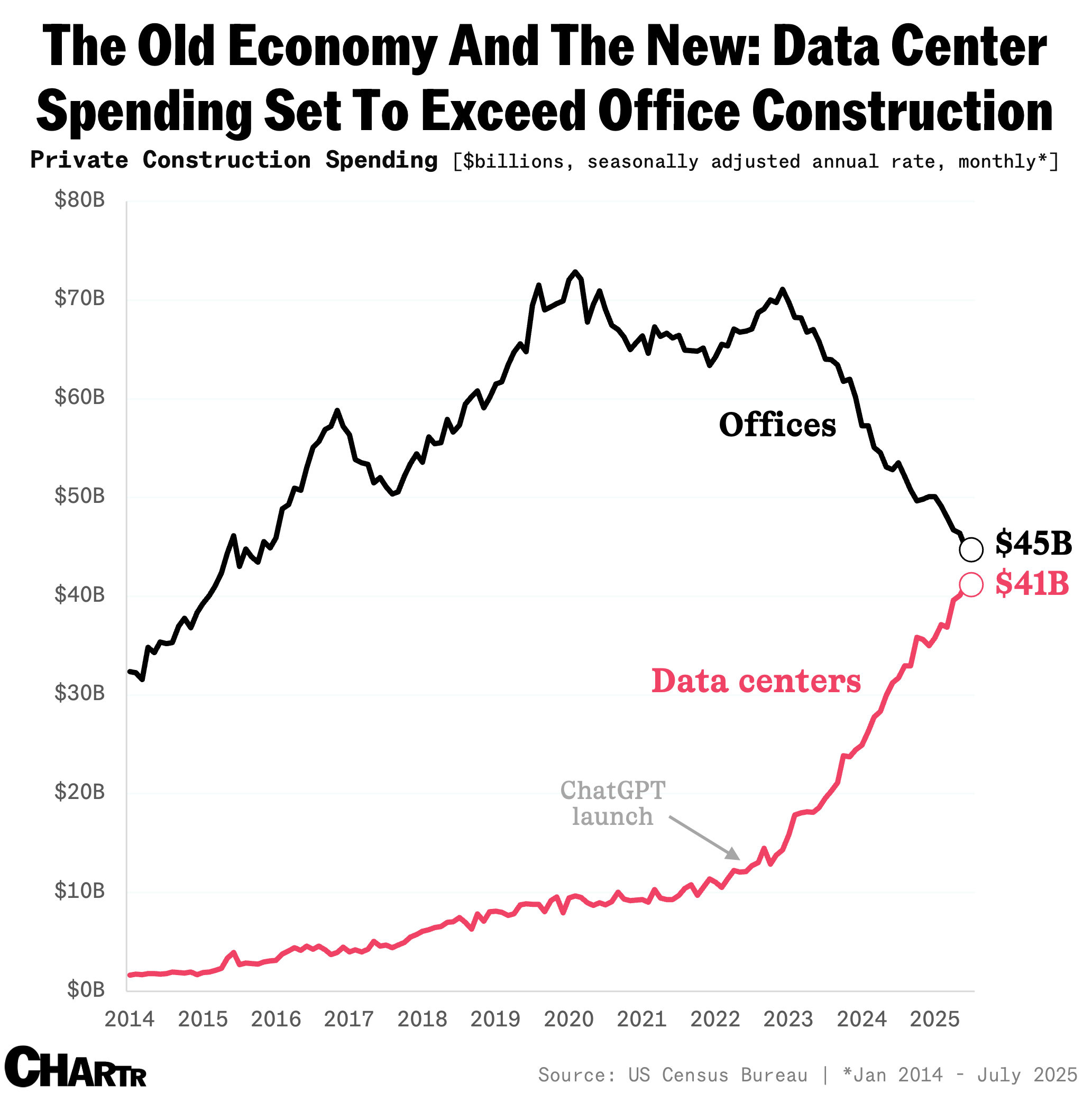
Data centers are changing landscapes, economies, and the real estate market. One way to view the mammoth spending on their construction is to compare it with office construction, which is nearing the point of being surpassed by what companies are shelling out for new data centers.
Big Tech’s most important infrastructure is at the bottom of the sea
The conversation around AI infrastructure usually involves massive data centers, gigawatts of power, and millions of GPUs. But there’s another crucial part of Big Tech’s infrastructure that might be even more important, and it lies at the bottom of the sea. We took a look at what the sprawling networks of undersea fiber-optic cable looks like for Meta, Google, Amazon, and Microsoft.
AI adoption
Consumers have adopted AI chatbots much more quickly than other platforms. ChatGPT recently reported nearly 900 million weekly users, outpacing TikTok’s, Facebook’s, and Gmail’s journey to a billion.

The billionaires are fighting and copying each other
2025 was a big year for ongoing beefs between billionaires. When they weren’t trying to tear each other down on social media or in the courts, they were attempting to one-up each other in the same industries. Check out this overlap between Elon Musk, Jeff Bezos, and Mark Zuckerberg.
📦 Tariffs
America’s trade deficit with China
Ever since Trump’s “Liberation Day” announcement and crippling global tariffs, international trade has seen unprecedented turmoil. Companies responded to the uncertainty by stockpiling their products and finding new supply chains in an effort to ride out the chaos. Chinese imports were subjected to some of the largest tariffs, so we took at look at America’s trade deficit with China. The top categories of the $438.9 billion worth of Chinese goods that Americans imported last year include machinery, electronics, clothing, and furniture.

Big companies can’t stop talking about tariffs
One indication that tariffs were a big deal this year: S&P 500 companies managed to talk about them even more than AI, which has become the go-to word for companies in and out of the tech industry. Earnings transcripts mentioning tariffs surged passed 1,000 this year as businesses of all stripes dealt with the fallout of Trump’s policies.
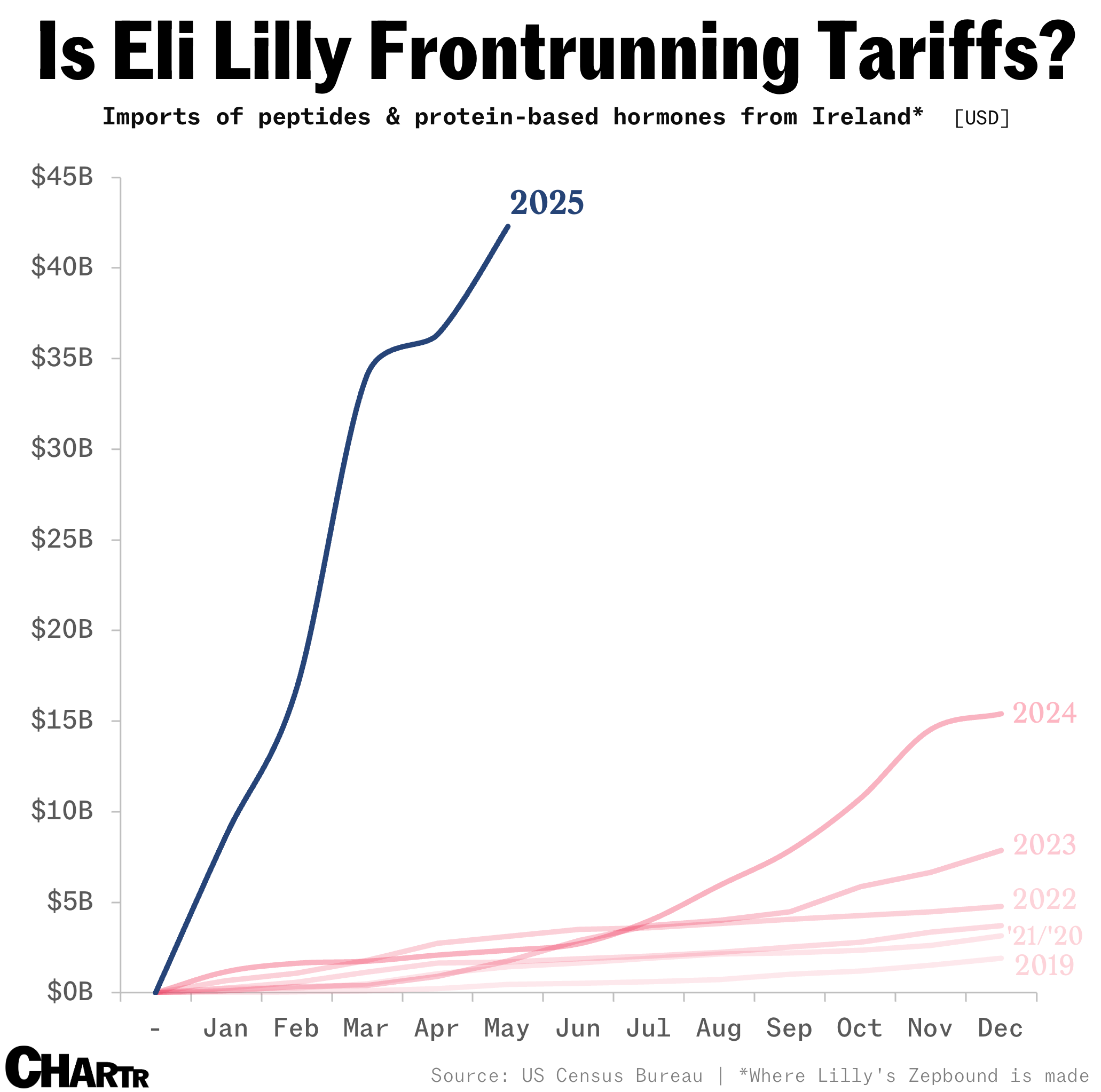
Eli Lilly may have found a tariff work-around
Desperate times called for desperate measures. A number of companies, including Apple, sought ways to get ahead of the tariffs. By May of this year, Eli Lilly imported 3x as many of its GLP-1 weight-loss and diabetes drugs than it had in years prior — a measure presumably meant to avoid looming tariffs.
Hopefully that is all the big news to chart for 2025! Who knows what data 2026 will bring us to be visualized.




