Bitcoin hits 6-week low as analyst says Strategy’s cash runway has collapsed to 6 months to cover its dividends
Now that bitcoin has tumbled below the key level of $74,000, some experts say that, short of a major fresh catalyst soon, bitcoin could revisit February lows in the near term.
Bitcoin hit a six-week low, dipping below $73,000 Thursday morning as Bitcoin ETFs continue to suffer, seeing $733.43 million in outflows on Wednesday, the largest daily exit since January 29, according to SoSoValue.
The funds have already registered $1.07 billion in outflows, on track to surpass last week’s $1.26 billion. BlackRock’s iShares Bitcoin Trust saw $527.8 million in outflows, its second-largest outflow since inception. This comes on the heels of yesterday’s massive sale of 29 million IBIT shares, worth a whopping $1.29 billion, in a dark pool transaction.
$IBIT saw its second worst day of outflows yest with $528m amid a 'step back' phase (likely from the block trade Tue). But bf you freak out or spike football (depending on which team you on) IBIT still +$2b YTD (top 2%) and $64b lifetime in flows. So this was less than 1% of that pic.twitter.com/oJGapJpWlw
— Eric Balchunas (@EricBalchunas) May 28, 2026
Now that bitcoin has tumbled below the key level of $74,000, some experts say that, short of a major fresh catalyst soon, bitcoin could revisit February lows in the near term.
Bitcoin Standard Treasury Company CIO and cofounder Sean Bill told Sherwood News that technically, $74,000 is an important pivot point for the bitcoin price.
Before President Trump’s election, that level represented significant overhead resistance, and once broken, it became a pivot point serving as both support and resistance, Bill said.
“For the last month, the market has been caught in a trading range with $74,000 serving as support and the 200-day moving average serving as resistance. If the market begins to consolidate below $74,000, bears will look for a retest of the February lows just above $60,000. But strong support exists at that level with the 200-week moving average coming in just above it at $61,500,” he said, adding that on the flip side, bulls will watch to see if bitcoin can consolidate above the 200-day moving average, currently just above $80,000.
Tim Sun, a senior researcher at HashKey, told Sherwood that while ETF outflows are a negative signal, they do not warrant absolute bearishness, as they are driven by the fact that after US Treasury yields rose, institutions had to adjust the corresponding risk weights in their bitcoin allocations.
In the short term, Sun said, if ETF outflows persist while yields remain elevated, bitcoin still faces further downward pressure, with the area around $75,000 serving as an important observation zone.
“If it fails to reclaim the put wall area at $74,500 and firmly stabilize above $75,000, it could decline further. Looking deeper into CME institutional options, the put wall for the most recent expiries is situated at $60,000,” Sun said.
Strategy’s stress
Bitcoin ETFs have been a key driver of price support since the war began. The other one according to some experts is Strategy’s STRC, which has enabled the largest bitcoin holder to maintain its acquisition pace despite bitcoin’s tumble.
STRC is Strategy’s perpetual preferred equity instrument, launched in July 2025, with a notional value of $10.4 billion and an 11.5% dividend.
That’s a big dividend. And Markus Thielen, head of research at 10xResearch, said in a report that Strategy’s “effective cash runway to cover its $1.7 billion in annual dividend obligations has collapsed to 6.1 months,” down from the 16 months he previously forecast.
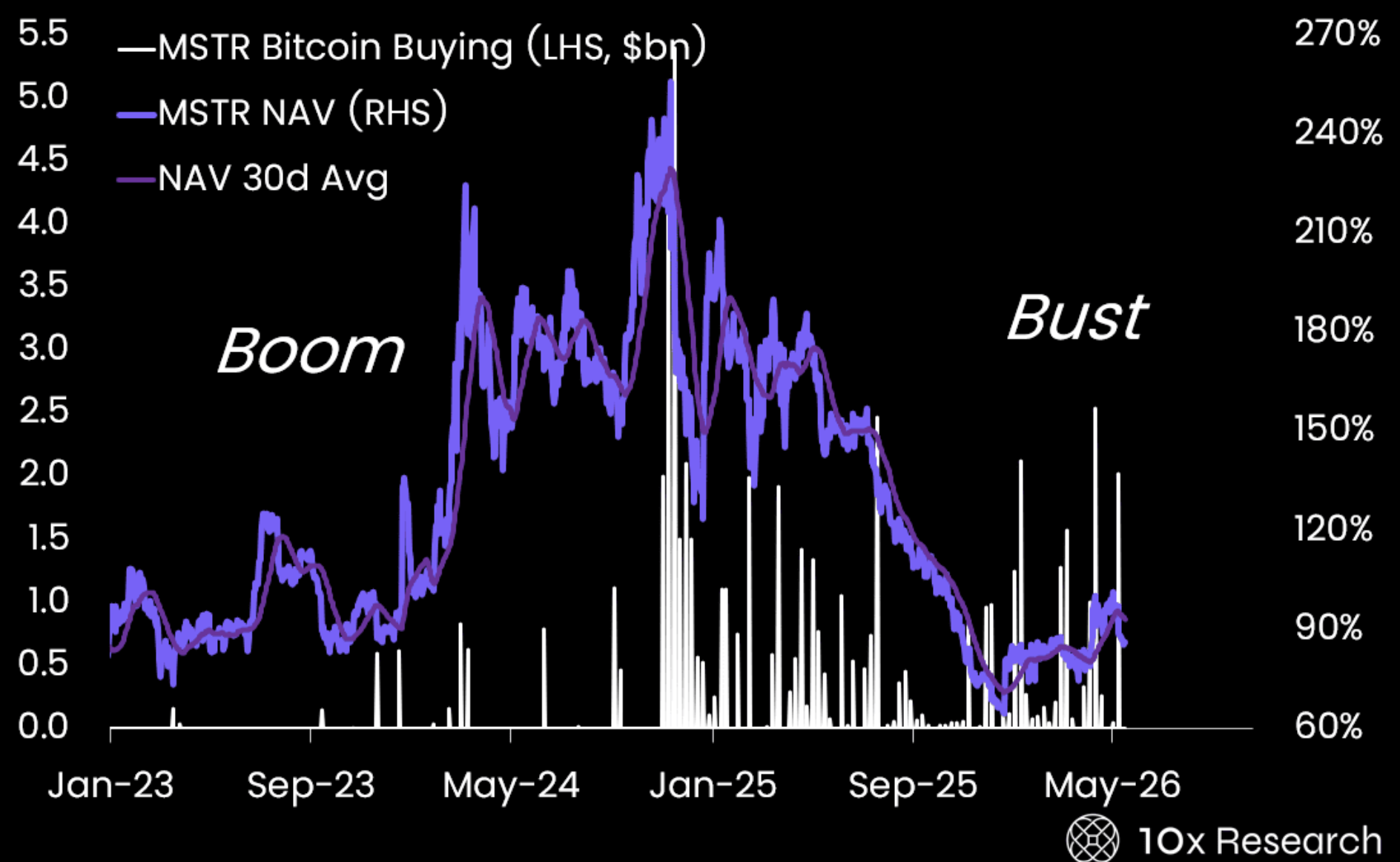
Founder Michael Saylor recently acknowledged Strategy will “probably sell some bitcoin soon.” Thielen noted the deeper issue is what the exit from accumulation means for the broader market.
“The 843,738 bitcoin acquired over nearly six years had an outsized impact relative to the $65 billion directly deployed, because the strategy provided narrative cover for billions more in institutional inflows,” Thielen said.
And removing that anchor does not just impact the company’s balance sheet, “it materially weakens the bitcoin bull case,” as the overhang adds a fresh layer of short-term uncertainty.
Thielen said this also matters beyond the financial aspect, as Strategy is a symbol that inspired other companies to follow in its footsteps and boosted confidence in bitcoin. But now, these newer digital asset treasuries “are even in a worse position,” he said.
“When that symbol starts selling instead of buying, the story changes,” Thielen said, adding that the path back to $100,000 this year looks harder than the market assumed even a few weeks ago.
But some analysts have a rosier view, saying that when Strategy starts to sell some of its bitcoin, it will dampen sentiment but not necessarily affect the price.
“It’s not so much how much they sell, it will be that the man who said he would never sell is now selling. It’s more symbolic than it is material. It will create massive headlines, and other DATs take a lead from Strategy,” Stephen Wundke, strategy and revenue director at Finyx and Algoz Technologies, told Sherwood.